The Supreme Court's decision striking down President Trump's tariffs sends a clear and crucial message: Justices will not be a simple rubber stamp approving presidential actions. In the first year of Trump's new term, 24 challenges to presidential actions reached the court, almost all of them in his emergency file. In 22, the judges ruled in favor of the president. But Friday's 6-3 decision to eliminate their tariffs is a major victory for the separation of powers and the rule of law.
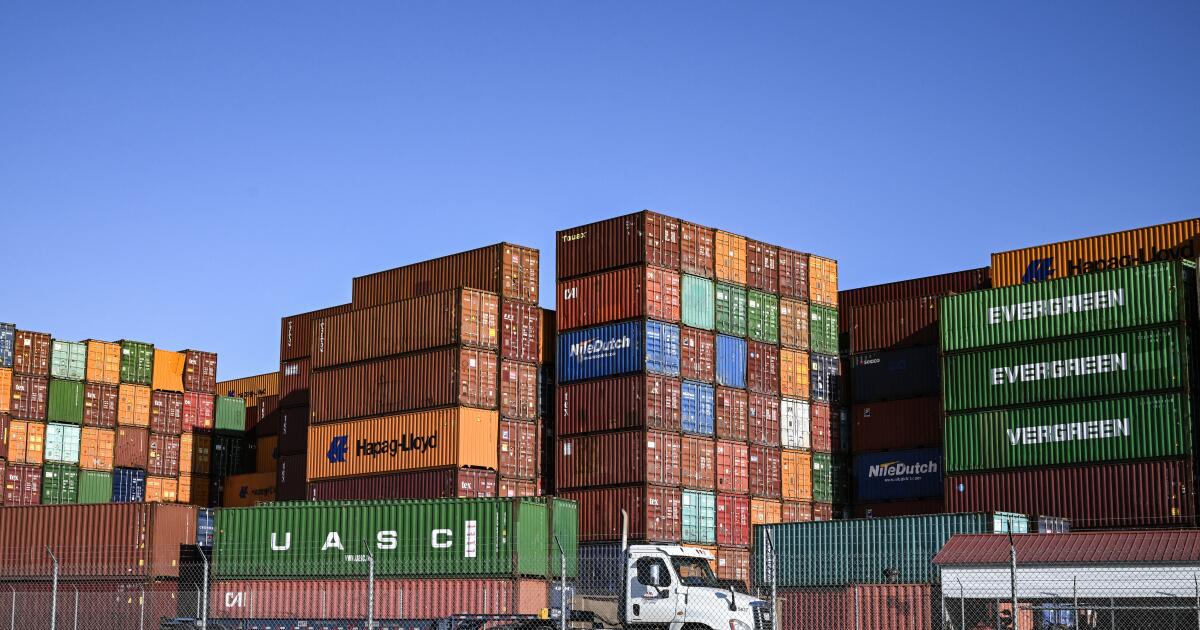
The importance of the tariffs to Trump and their consequences for the world cannot be underestimated. The president said its invalidation “would be a total disaster for the country” and “would literally destroy the United States of America.” In his petition to the Supreme Court, Attorney General D. John Sauer said that “tariffs are promoting peace and unprecedented economic prosperity” and “pulling the United States back from the precipice of disaster, restoring respect and standing in the world.”
Trump has treated the tariffs as something he can impose or rescind at will. But not anymore. The court, in an opinion by Chief Justice John G. Roberts Jr., ruled that Trump lacked the power to impose tariffs, based on a basic constitutional principle: Congress, not the president, has the power to impose taxes, and tariffs are taxes. Roberts began his opinion by explaining this and cited a decision from 1824, according to which “the power of imposing tariffs is 'very clear.'[ly] . . . a branch of taxing power. As he stated: “After all, a tariff is a tax placed on imported goods and services.”
The focus of the decision is whether a federal statute, the International Emergency Economic Powers Act (IEEPA), authorizes the president to impose tariffs. The IEEPA, however, does not mention tariffs, but instead authorizes the president to “regulate…importation” to “meet any unusual and extraordinary threats.”
Roberts, joined by Justices Sonia Sotomayor, Elena Kagan, Neil M. Gorsuch, Amy Coney Barrett and Ketanji Brown Jackson, emphatically concluded that the law does not give the president authority to impose tariffs. Roberts added that “IEEPA's grant of authority to 'regulate…importation' is insufficient. The IEEPA contains no reference to tariffs or duties. The Administration does not point to any statute in which Congress has used the word 'regulate' to authorize taxes. And so far no president has read the IEEPA to confer such power.”
This is clearly correct. The most basic principle of statutory interpretation is that courts must follow the plain language of the law. Nothing in the IEEPA says a word about tariffs. If Congress is going to delegate its power to raise taxes, including tariffs, it should do so explicitly. Furthermore, as Jackson argued in his concurring opinion, there is nothing in the IEEPA's legislative history to indicate that it was intended to give the president broad authority to impose tariffs.
Much of the 160 pages of opinions in this case are a fascinating debate among the justices over a principle of law created by the court just a few years ago: the major issues doctrine, which says a federal agency cannot act on a major issue of economic or political importance without clear guidance from Congress. The Supreme Court used it in 2022 to strike down the Biden administration's requirement that those who work in workplaces with more than 100 employees get COVID vaccines or get regular testing. In 2023, the court invalidated President Biden's student loan relief program because it involved a major issue of economic and social importance without clear guidance from Congress.
Both cases were 6-3 decisions with the conservative justices in the majority. In the tariff case, the justices split 3-3-3 on whether they violated the important issues doctrine. Roberts, along with Gorsuch and Barrett, said the tariffs are obviously a major issue of economic and political importance and that Congress has not given clear authority to the president. Quite significantly, they rejected Trump's position – and that of the three dissenters – that the major issues doctrine does not apply in the area of foreign policy.
The three liberal justices – in Kagan's opinion, joined by Sotomayor and Jackson – did not join the part of the court's decision invalidating tariffs based on the major issues doctrine. In all the previous cases they disagreed about the doctrine of the main issues and generally disagreed with its existence. While it's understandable why they didn't want to use it and why it was unnecessary for them to eliminate the tariffs, the doctrine exists even if these judges don't like it and helps explain why under current law the tariffs are invalid.
In the long term, these justices should be willing to use the important questions doctrine as a check on the Trump administration.
The Supreme Court's tariff decision certainly leaves many questions unresolved. More importantly, should there now be refunds of illegally imposed tariffs and, if so, how will they be paid and implemented? The court did not discuss that part at all.
The biggest significance of the tariff decision is that it shows a court willing to say no to Trump on an important issue. For the barriers of democracy to remain in place for a president who believes, in the words of his chief of staff, Susie Wiles, that he can do literally anything, the courts are an essential and perhaps the only check on the president.
Erwin Chemerinsky is the dean of the UC Berkeley School of Law.