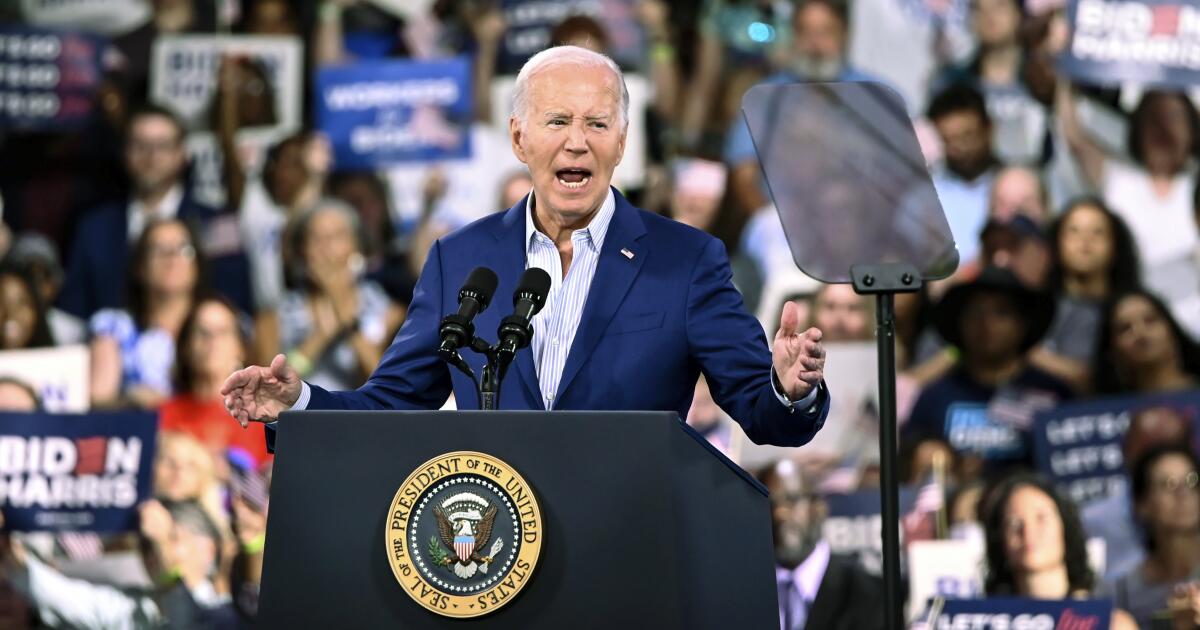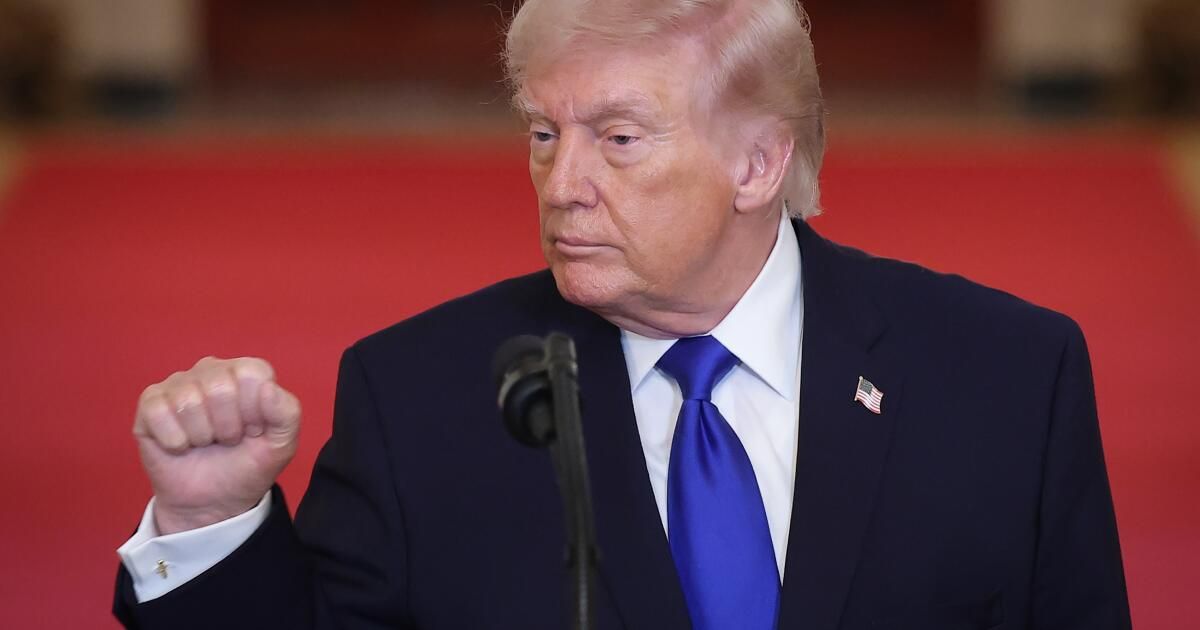
Within hours of the Supreme Court ruling that the White House Generalized “emergency” rates were illegal, President Trump decided to install blanket 10% tariffs under a different supposed authority. He later said he would raise that rate to 15% and gave a combative response at the State of the Union.
The trade war is not ending. It's just changing zip codes. What will not change is the propaganda. next from a White House that insists that Americans not pay the costs.
Consider the following as a guide to the fallacy-ridden arguments you will soon hear more about.
The first argument is optimistic: tariffs “relocalize” production, increase domestic demand, raise wages and leave consumers better off. It's a tidy story. It's also wrong.
Tariffs don't evoke consumer demand out of thin air. Americans bought a lot of washing machines, clothing and steel before the tariffs. What changes is where some things are done. Production shifts from foreign manufacturers with efficiency or cost advantages to more expensive domestic manufacturers. American producers will win, except when they must pay tariffs to import the materials they need (as is often the case).
But everyone who buys the product pays more. The extra $100 a family spends on a washing machine won't be spent at the restaurant next door, the repair shop, or the shoe store. Real wages (what your paycheck actually buys) fall when the prices of most things rise.
Second is the zero-sum argument: making China worse off automatically makes Americans worse off. That's not how the economy works outside of campaign rallies.
Trading is not a game in which one party's loss is the other's gain. It's true that when Americans buy less from China, some of our trade competitors abroad lose revenue. But what happens to American households that lose access to cheaper goods? Or are American producers losing access to cheaper materials and ingredients that make them more competitive?
Both countries are affected. Serious analysts who favor targeted tariffs for strategic reasons generally recognize this trade-off and argue that the benefits justify the costs. What they do not claim is that such costs do not exist.
Third is an attempt to use a populist argument made in the past by US Trade Representative Jamieson Greer. He stated that tariffs cannot hurt low-income Americans because the rich consume the most. This is clearly an attempt to refute the common (and correct) argument that tariffs are regressive or disproportionately harmful to lower-income people.
Unfortunately, our trade official does not understand what regressivity means. A tax is regressive, and therefore not populist, when it absorbs a greater proportion of the income of low-income households than of richer ones. The absolute dollar figure is irrelevant to the question. A billionaire will spend many more dollars on imported goods than a teacher, but that spending represents a small portion of his or her income.
Almost every dollar a teacher earns goes to supporting a family, with much of it spent on clothing, appliances and household items that rely heavily on imports. The empirical record of past tariffs confirms that the burden falls most heavily, as a proportion of income, on working- and middle-class families.
Fourth is the corporate takeover argument: don't worry, the companies will bear the costs. According to the theory, large retailers quietly absorb tariff expenses through slimmer profit margins rather than raising prices.
Even when companies absorb some of the impact, the money doesn't disappear. Instead, these companies hire fewer people, pay lower wages, invest less, or, in industries where profit margins are already tight, raise future prices. The load simply takes a different route to your wallet.
These objections are not hypothetical. They are backed by data.
The Federal Reserve Bank of New York recently published findings that American businesses and consumers absorbed nearly 90% of the economic burden of the 2025 tariffs. The researchers weren't working from theory: They tracked actual import price data at the transaction level and found that prices paid by American importers rose almost one-to-one with tariff rates. These results confirm what the 2018-19 tariff investigation already established and echo other studies of the last year.
The bottom line is that, in the face of tariffs, foreign exporters don't actually reduce their prices to cushion the blow. Corporations do not quietly absorb these blows. The costs are passed on, one way or another, just as the textbooks predict.
We also know that job creation was modest in 2025 and that manufacturing jobs are declining. Whatever economic boom we are experiencing now is driven by investments in computing and electronics, which happen to be the largest sectors exempt from tariffs.
It could offer even more evidence that the administration's tariff policy is not working. But Americans already know this, and that's why strong majorities They are strongly opposed.
The legality of the fees will remain contentious. Talking points will be recycled. For now, the high price will remain ours.
Rugy Veronica He is a senior fellow at the Mercatus Center at George Mason University. This article was produced in collaboration with Creators Syndicate.