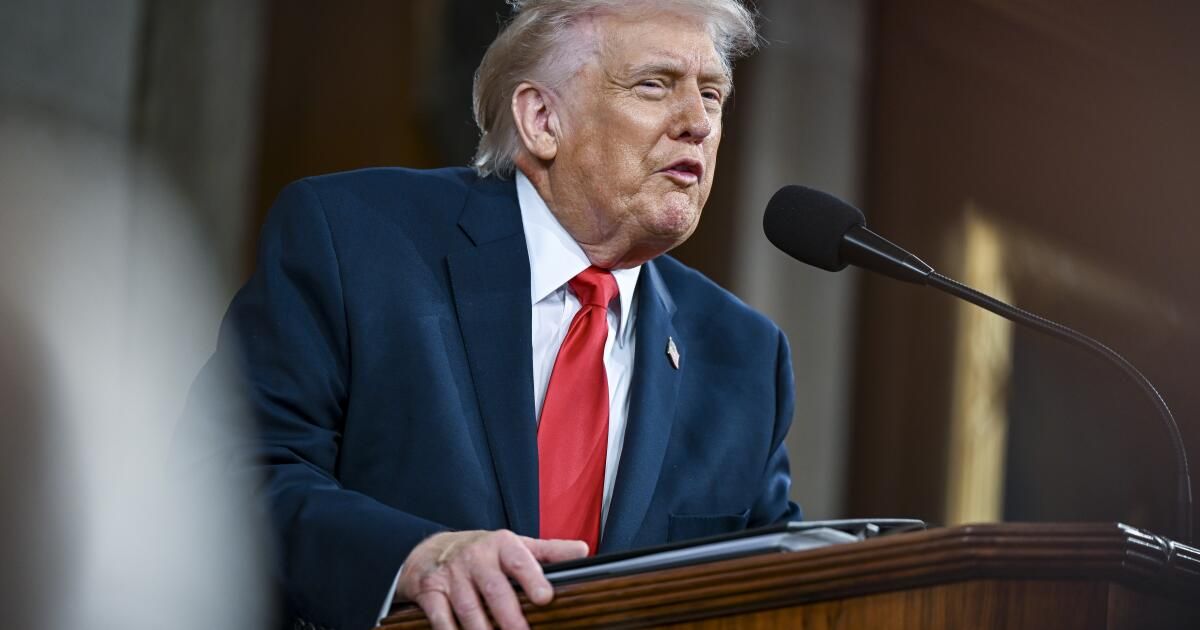
For this year's State of the Union address, as usual, the president was the center of attention. That's exactly where Donald Trump lives, so it's no surprise he broke his record for the length of a nationally televised speech. He was the star of his own reality show, with an audience in the tens of millions. In front of him, the idolatrous Republican legislators jumped up and down to applaud like clowns on antique wind-up music boxes.
In fact, a president arrives at the Capitol as a guest in the house of Congress, there only by invitation of the speaker of the House. It is a historic nod to the separation of powers so essential to the United States system of government. But of course Trump acts like he owns the place. And why not? The Republican majorities in the House and Senate essentially gave him the keys and the title, along with much of his constitutional power over spending, federal appointments, war powers and more.
“What a difference a president makes,” a triumphant Trump imperiously marveled at himself Tuesday night, after exaggerating or falsely claiming his last year's achievements.
Did you understand that? Even with a Congress controlled by his party, with its majorities at risk in this midterm election year due to his unpopularityTrump could not find within his narcissistic self the opportunity to share the misleading credit. On the other hand, he acts alone most of the time, and polls show that 6 in 10 Americans blame him, not the credit.
For the good of the nation, Congress must take back its powers from Trump and, with them, more attention from Americans. None other than Supreme Court Justice Neil M. Gorsuch, a Trump appointee, declared as much just days before the State of the Union address.
Coinciding with the Court's 6-3 vote decision Last week, tearing down the centerpiece of Trump's agenda — unilateral tariffs — as a usurpation of Congress's constitutional fiscal power, Gorsuch all but implored lawmakers to restore Congress' intended role as a co-equal branch of government, and the president to respect it as such. (Spoiler: it won't.)
Gorsuch's opinion was a master class in why the founders created Congress in the first article of the Constitution, reserving the presidency and the judiciary for the second and third articles. I don't agree with Gorsuch on much, but his approval should be required reading for Trump and for members of Congress who clearly need corrective civics lessons. It is worth quoting at length; the italics are mine.
“Our founders understood that men are not angels, and we ignore that idea at our peril when we allow a few (or him) to aggrandize his power based on vague or uncertain authority,” Gorsuch wrote.
“Yes, legislating can be hard and take time,” he concluded. “And yes, it can be tempting to bypass Congress when some pressing issue arises. But the deliberative nature of the legislative process was the central goal of its design. Through that process, the Nation can harness the combined wisdom of the people's elected representatives, not just that of a faction or a man. There, deliberation tempers impulseand compromise turns disagreements into viable solutions. And because laws must gain such broad support to survive the legislative process, they tend to endure, allowing ordinary people to plan their lives. in a way they can't when the rules change day to day. Ultimately, the legislative process helps ensure that each of us has a stake in the laws that govern us and in the future of the nation.”
Do you know what won't last? Trump’s policymaking by “impulse” and by decree, through hundreds of executive orders. In fact, it would be in your best interest to work with Congress on laws that will outlive you and be your legacy. However, you want to be a king and get quick results on a whim, just by flipping through a tweet or a paper signature. Legislating takes time, compromise and, ultimately, sharing of credit.
Perhaps that's why Trump is so determined to erect tangible marble and gold edifices in Washington and beyond: They will endure when his policies don't. And that is the legacy he longs for: mega ballrooms, arches, statues, busts and buildings in his name and image.
Gorsuch was not in the House chamber to hear Trump's speech and his slap to the court's tariff decision. Only four of the nine justices were, including Chief Justice John G. Roberts Jr., who wrote the lead opinion, and two other justices who had joined together to oppose Trump's appropriation of tariff power. The president insisted he would proceed with unilateral tariffs under separate laws, adding that “congressional action will not be necessary.” Republican lawmakers applauded.
The founders, in the Constitution, required presidents to report annually on the state of the union and “recommend” to Congress “such measures as they may deem necessary and expedient.” So it is the president's job to “see that the laws are faithfully executed.” However, as usual, Trump outlined little in the way of a legislative agenda.
The president likes to note, as he did in his speech, that he will preside over this year's celebrations of the nation's 250th anniversary. But you should know that the nation was not born on a day, July 4, 1776. The founders fought for 11 more years over the Constitution, and it took another two years for the states to ratify it.
Yes, democracy has been difficult from the beginning. That's why Trump's appeal to some Americans is his action figure: forget about rules, laws and the Constitution.
But maybe if Trump survey numbers stay in the tankeven Republicans in Congress will have the courage to protect the powers of the institution. And if they don't, that's all the more reason for voters to hand the keys to Democrats in November.
Blue sky: @jackiecalmes
Rags: @jkcalmes
UNKNOWN: @jackiekcalmes