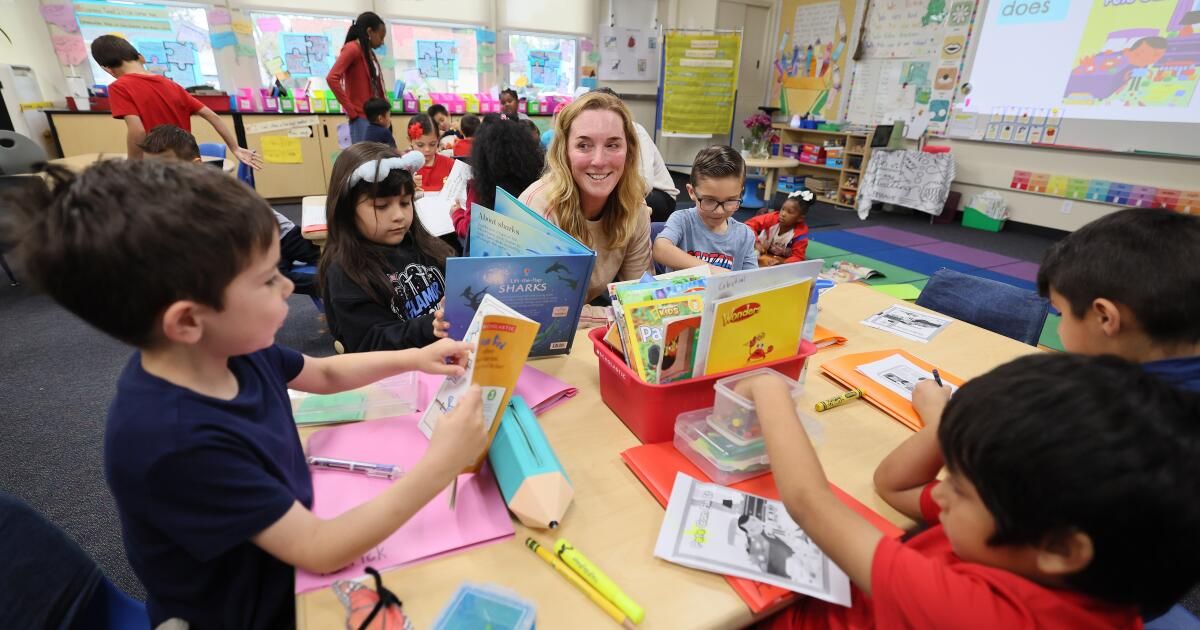
It's called “redshirting” or “the gift of time,” but the practice of holding a kindergartener back for a year offers few long-term benefits, and the academic advantage to students of being older generally equalizes by third grade, according to a new report.
The percentage of parents who reprimand their five-year-olds has remained fairly constant since the 1990s: between about 4.5% and 7%, according to a report from the Northwest Evaluation Association, an evaluation and research organization. The steady figure comes amid abundant and ongoing conversations on social media among parents who favor the option.
Two-thirds of the children who were retained had summer birthdays between June and August (close to kindergarten enrollment deadlines in most states) and would have been young for their grade.
Students who turn 5 years old before September 1 of the school year are eligible to enter kindergarten in California. Children who turn 4 years old on that date are eligible for transitional kindergarten.
The practice aims to give the child an additional year to develop socio-emotionally and enter the school system more prepared.
But its effectiveness can vary and there are some downsides to consider in the long term, according to the report released Monday night.
Although kindergartners may enter school with an academic advantage derived in part from maturity, by third grade they are on par with their classmates when comparing test data, according to the report.
Students who enter kindergarten late may also be at higher risk of dropping out, according to studies referenced in the report. Being at the upper end of the grade means children will turn 18 earlier in high school, legally giving them more options as adults to drop out of school. It also takes away a year from the workforce, causing them to forego the benefits of an additional year of work experience.
The decision to delay kindergarten can financially impact parents, who in many cases must pay for child care or take time off work to care for the child.
When Families Decide to Delay Kindergarten
Boys are more likely than girls to enter kindergarten late. According to the report, the practice is also more common among wealthier families. In 2025, 6.8% of children in higher-income families delayed their start, compared to 3.2% in low-income families, according to the report.
Wealthier families are more likely to be able to afford extra years of child care, have flexible schedules or take a step back from work, while families who earn less may not be able to afford it and may need school services like free meals, said Megan Kuhfeld, director of growth modeling and data analysis at the Northwest Evaluation Association.
That was the case for Madison Cortez of Fremont, who wished she had considered delaying her daughter, now in fifth grade, starting school during the pandemic. Cortez was working at the time, so keeping her son, whose birthday is in August, would have been difficult even if she had considered the option more seriously.
At the time, she also hadn't considered that her daughter would be academically unprepared for kindergarten, but she found that between online learning and her position as one of the youngest students in her grade, she quickly fell behind.
“We had a lot of catching up to do since then,” Cortez said.
Why red shirt in kindergarten can still be useful
Still, individual circumstances should be considered when evaluating the benefits of delaying kindergarten, said Kuhfeld, the report's author. Children who have developmental delays or whose behavioral readiness is delayed may still benefit.
Holding a child back can be a good option to give them more time to develop self-control and self-regulation skills vital to the classroom, said Stanford professor Thomas Dee, who has studied redshirting.
“The advice I give to parents is to, to some extent, trust what you know about your own children,” Dee said.
But it's important to consider how much development can occur in the time span between kindergarten enrollment and the first day of school, Kuhfeld said.
“Many parents are having to make this decision right now, in the winter and spring, when kindergarten is still six months away,” Kuhfeld said, adding that there is time for continued growth and maturity.
How traditional knowledge affects parents' decision
California's implementation of transitional kindergarten, or TK, which has encouraged families to enter the public school system when their child is 4 years old, complicates decision-making.
Each district must determine whether a kindergarten-age (5-year-old) child qualifies to enroll in TK, which is geared toward 4-year-olds, according to the California Department of Education. If a 5-year-old child is enrolled in TK, parents must sign a “Kindergarten Continuation” agreeing that they will continue in kindergarten.
School districts may enroll a child in up to one year of TK, two years of kindergarten, or a combination of two years of TK and kindergarten.
“I hope the expansion of TK in California forces parents to face that decision sooner: It's free and in their community,” Dee said, acknowledging how expensive child care can be.
This article is part of the Times' early childhood education initiative, which focuses on the learning and development of California children from birth to age 5. To learn more about the initiative and its philanthropic sponsors, visit latimes.com/earlyed.