The U.S. Department of Veterans Affairs has terminated agreements that allowed three outside entities, including a prestigious K-12 academy, to use parts of its west Los Angeles campus.
The agency posted a notice on its website Monday night saying it had terminated the leases of the Brentwood school and a parking company and the license for an oil pumping operation on the 388-acre property.
The VA said it was taking the property in compliance with President Trump's executive order last May calling for the creation of a National Warrior Independence Center with housing for 6,000 veterans.
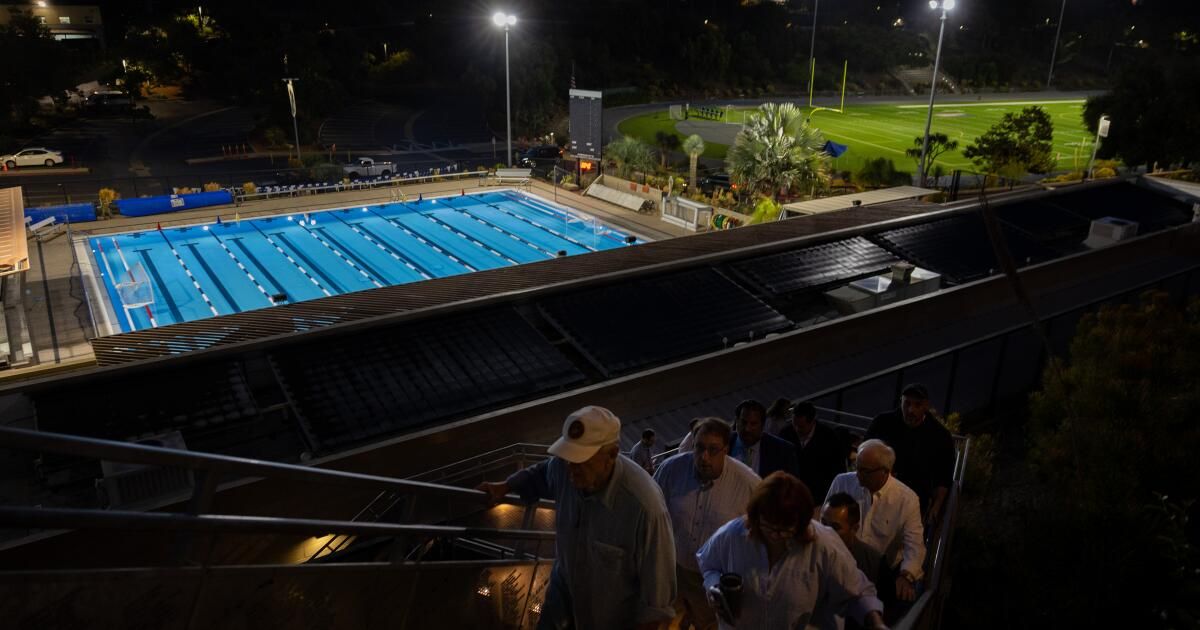
The notice did not say whether the school would lose access to the extensive athletic facilities it built on its 22-acre leased land. These include a football stadium, baseball field, basketball pavilion, exercise equipment and a 10-lane swimming pool.
School officials issued a brief statement saying the VA had offered to meet with them in Washington.
“We look forward to that meeting in hopes of preserving our long-standing relationship and the extensive services that Brentwood School provides and that so many veterans value.”
On Tuesday, the school's use of the facilities continued as normal.
The announcement put a new twist on the tangled intersection of a federal court order requiring the VA to build more than 2,000 on-campus housing units and Trump's executive order.
Although the two initiatives are nominally aligned in the goal of creating more housing for veterans, the VA signaled in a petition to the 9th U.S. Circuit Court of Appeals on Friday that it intends to file an appeal of the federal court ruling. He called for a full review of the December ruling by a three-judge panel that upheld the order.
That request surprised attorneys representing the veterans in the class-action lawsuit, and they said they thought they were on the verge of forming a productive relationship with the VA.
One of those lawyers told the Times in an interview Friday that he had two productive conversations with agency officials and found them thoughtful and deliberate.
“What I'm trying to convey is positivity and optimism,” said Roman Silberfeld of the law firm Robins Kaplan. “Time will tell.”
Silberfeld's optimism arose from the agency's apparent backtracking on plans revealed at a court hearing in January to put up to 800 tiny homes on the property. Veterans objected to the 8-foot by 8-foot units as inadequate. A solicitation to contractors released by the agency after the court hearing described a project for 120- to 390-square-foot modular units with bathrooms and kitchens.
After the petition was filed later Friday, Silberfeld sent an email with the following message: “Bad VA!”
“A day of untold shame for our government,” co-counsel Mark Rosenbaum of the civil rights law firm Public Counsel wrote in an email. “No previous administration ended veteran homelessness, but none before had stooped so low by arguing before an entire appeals court that the law should preserve it.”
The lease terminations also introduce tension between the approaches taken by the VA and U.S. District Judge David O. Carter, who is overseeing the case.
In his view, Carter voided the leases on the grounds that they did not primarily benefit veterans as required by law. He also voided UCLA's 10-acre lease for its baseball stadium and ordered the VA to immediately build temporary housing on its parking lot.
But Carter took a conciliatory stance toward the Brentwood school, saying he did not want to deprive students of the facilities. He signed a new lease agreed to by the school and the veteran plaintiffs that increased veteran access and was limited to one year so the land could be reclaimed if needed for future housing.
The VA rejected the proposal and appealed Carter's ruling.
In a split decision, the appeals panel upheld its voiding of the leases to Brentwood and Safety Park Corp. but reversed its ruling on UCLA, which was based on different law.
Monday's notice cited Carter's conclusion that the leases violated the law, but he took a drastically tougher stance, saying the VA had found that tenants were paying less than $40 million a year.
“These groups have been fleecing taxpayers and veterans for far too long,” VA Secretary Doug Collins was quoted as saying. “And under President Trump, VA is taking decisive action to ensure that the western LA VAMC [Medical Center] “The campus is used solely for its intended purpose: to benefit veterans.”
Rob Reynolds, an Iraq War veteran who often speaks on behalf of veterans named in the case, said he was conflicted by the new developments.
He praised the VA for terminating illegal leases and said he was encouraged by its apparent openness to larger housing units.
He also said he supports the executive order but is alarmed by the agency's continued resistance to court oversight and its reluctance to include veterans in its deliberations.
“We really don't know what's going on,” Reynolds said. “The history of this property for decades has been one of broken promises, so it's really hard to trust that this will be done in good faith.”
VA spokesman Pete Kasperowicz said that by exploring all options, the bidding will allow the VA to consider larger units.
“However, no final decision has been made,” he said.