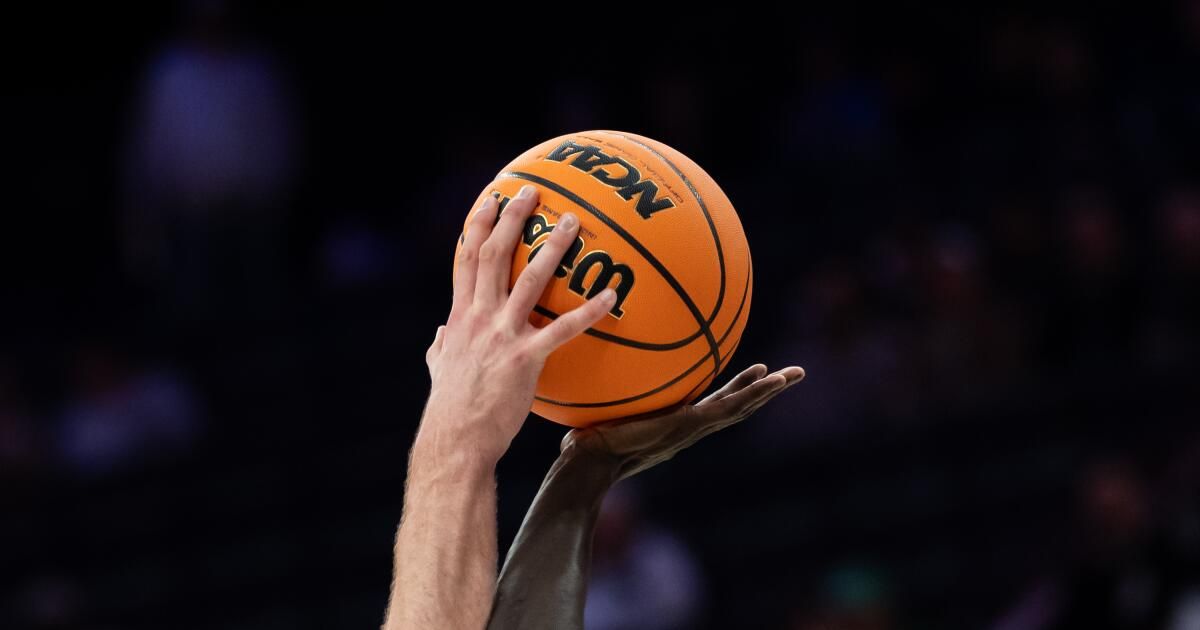
At least 20 people allegedly conspired with known players to fix basketball games, according to a federal indictment filed Thursday.
The indictment filed in Philadelphia cites charges of “bribery in sports competitions” and conspiracy to commit wire fraud, to fix Chinese college and professional men's basketball games.
The U.S. Attorney's Office for the Eastern District of Pennsylvania announced the sweeping indictment involving players from 17 college teams from 2022 to 2025. The scheme also involved two players, Shane Hennen and Marves Fairley, who were indicted in October for their alleged role in an NBA sports betting scheme that included Miami Heat star Terry Rozier.
The most notable player charged Thursday was Antonio Blakeney, Louisiana State's leading scorer in 2016-2017 and a veteran of two seasons with the Chicago Bulls. The guard has played for professional teams in China, Israel and Bahrain since his last time in the NBA in 2019.
According to the indictment, the scheme began with attempts in the 2022-23 season to fix games in the Chinese Basketball Association. Blakeney, who played for the Jiangsu Dragons and led the league in scoring with 32.1 points per game, was reportedly recruited by Hennen and Fairley to cut points.
Hennen and Fairley were named in the indictment along with others who worked as AAU coaches or personal trainers and recruited players to score points, often in the first halves of games. Prop bets (bets on specific events or occurrences within a game that are not tied to the final score) were also placed on certain outcomes based on agreements with players. Payments of up to $20,000 were made to players, the indictment alleges.
“Protecting the integrity of competition is of utmost importance to the NCAA. We are grateful for law enforcement agencies working to detect and combat integrity issues and game manipulation in college sports,” NCAA President Charlie Baker said in a statement Thursday. “The pattern of college basketball game integrity conduct revealed by authorities today is not entirely new information to the NCAA. Through helpful collaboration and with industry regulators, we have completed or have open investigations into nearly all of the teams in today's indictment.”
Universities under investigation include DePaul, Saint Louis, La Salle, Eastern Michigan, Robert Morris, Fordham, Buffalo, Tulane, Northwestern (La.) State, Nicholls State, Southern Mississippi, North Carolina A&T, Kennesaw State, Coppin State, New Orleans, Abilene Christian and Alabama State.
The indictment estimates that the players conspired with up to 39 players on those 17 Division I teams to fix games.
“Our law enforcement personnel have opened sports betting integrity investigations into approximately 40 student-athletes from 20 schools over the past year,” Baker said. “While some investigations are ongoing, it was recently discovered that 11 student-athletes from seven schools bet on their own performances, shared information with known bettors, and/or engaged in game manipulation to collect bets they (or others) placed. This behavior resulted in a permanent loss of NCAA eligibility for all of them.
“In addition, 13 student-athletes from eight schools were found to have failed to cooperate in the sports betting integrity investigation by providing false or misleading information, failing to provide relevant documentation, and/or refusing to be interviewed by law enforcement personnel. None of them are competing today.”
At least four of the accused players are currently active: Simeon Cottle of Kennesaw State, Camian Shell of Delaware State, Carlos Hart of Eastern Michigan and Oumar Koureissi of South Texas. Cottle, in fact, scored 21 points Wednesday night in Kennesaw State's win over Florida International and is Conference USA's leading scorer.
Baker said the NCAA is trying to root out sports betting violations through a “layered integrity monitoring program” that covers more than 20,000 games, but admits the organization can't do it alone.
“We still need remaining states, regulators and gaming companies to eliminate integrity threats, such as college betting, to better protect athletes and leagues from integrity risks and predatory bettors,” he said. “We will also continue to fully cooperate with authorities. We urge all student-athletes to make well-informed decisions to avoid jeopardizing the game and their eligibility.”