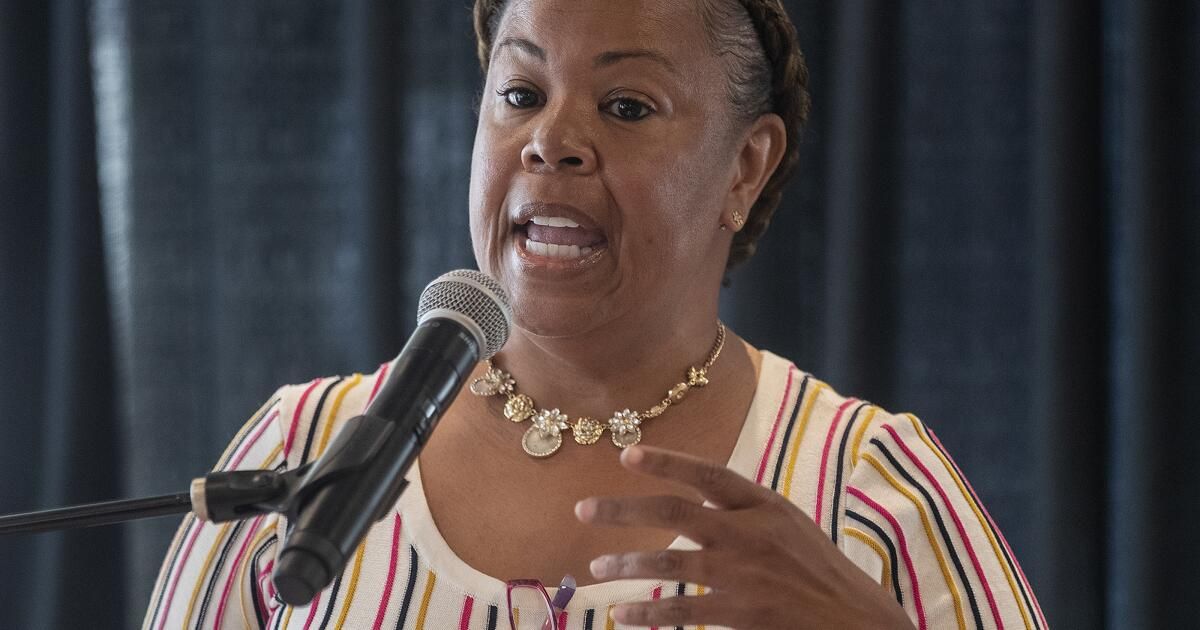
Los Angeles County Chief Executive Fesia Davenport, who has been on medical leave since October, announced she will resign next month.
In a LinkedIn post, Davenport said he was leaving county service to “focus on my health and well-being.”
A notice to the Board of Supervisors provided to The Times on Saturday said he had decided to resign on April 16 “based primarily on hereditary and ongoing health problems initially discovered late last year, the risks of which have become clearer based on more recent medical testing and consultations with my doctors.”
He said the “extraordinary amount of time and energy” required of the chief executive influenced his decision.
“Although I originally assumed I would be able to return to my position, I now know that I would not be able to do the job properly and at the same time prioritize my health,” he told supervisors.
Supervisor Kathryn Barger released a statement Saturday saying, “I am disappointed in Fesia Davenport's decision to resign. Her dedication and accomplishments over nearly three decades have left a lasting impact on Los Angeles County.”
Davenport, who was appointed to the county's top job in 2021, received an undisclosed $2 million settlement last summer to compensate for damage to her “professional reputation” caused by Measure G, a voter-approved ballot measure that will soon eliminate her position.
In a July 8 letter, released by the county attorney in October through a public records request, Davenport said he was seeking $2 million in damages for “reputational harm, embarrassment, and physical, emotional, and mental distress caused by Measure G.”
Under Measure G, which voters approved in 2024, the county chief executive, who manages the county government and oversees its budget, will be elected by voters rather than appointed by the board. The elected county executive will take office in 2028.
Measure G “has had and will continue to have an unprecedented impact on my professional reputation, health, career, income, and retirement,” Davenport wrote to county attorney Dawyn Harrison. He said it had “irrevocably changed my life, my professional career, my financial prospects and my plans for the future.”
At the time the payment was revealed, Davenport had begun a medical leave and said at the time that he hoped to return to work early this year.
A lengthy email to her staff, published on LAist, which first revealed her resignation, said the unspecified “health crisis” has affected three of her siblings and poses risks to her that “have become clearer based on more recent medical testing and consultations with my doctors.”
His brother Raymond died in 2018 after “experiencing a sudden health crisis,” he said. Last year, two more sisters survived the same health crisis, but one will now need 24-hour care for the rest of her life, she said.
“While I am not out of the woods yet, I thank the Board for giving me the space to focus on my health and arm myself with the knowledge I needed to make informed decisions,” he wrote.
The CEO's office issued a statement Saturday saying Chief Operating Officer Joe Nicchitta will continue to serve as interim CEO while Davenport remains on medical leave.
“We appreciate Fesia's nearly three decades of service to Los Angeles County and all she has accomplished on behalf of its residents and communities,” the statement said.
Davenport listed a number of accomplishments in his letter to the board, including creating five new departments that maintained the county's credit rating when other jurisdictions were being downgraded and “balancing the budget while developing a funding plan to compensate victims of sexual assault — the largest settlement of its kind in U.S. history.”
That payment has now come under scrutiny after a Times investigation found that some plaintiffs had been paid to join the class-action lawsuit.