A former LAPD officer was able to fly in and out of the country multiple times and live freely in Southern California for more than a year despite an active arrest warrant against him for the 2015 murder of a homeless man, according to his defense attorney and the Los Angeles County prosecutors leading his pending murder case.
A grand jury indicted Clifford Proctor, 60, in September 2024, after the district attorney's office reopened an investigation into the shooting death of Brendon Glenn. Proctor shot Glenn, 29, twice in the back during an attempted arrest in 2015 in Venice Beach. Glenn was unarmed.
Proctor, who resigned from the LAPD in 2017, was not arrested until last October, when he was detained by U.S. Customs and Border Protection agents at Los Angeles International Airport. Law enforcement sources previously told The Times that Proctor was returning to the country from an international flight when CBP arrested him on a murder warrant.
But in a November court filing, Proctor's defense attorney, Tom Yu, provided evidence and affidavits showing his client had been in the United States and planned to leave the country on the day of his arrest. Travel documents included as evidence in a court filing show that Proctor was scheduled to fly from Los Angeles to Panama City on October 16, 2025.
An affidavit from Proctor's wife submitted to the court by his lawyer shows that he has flown internationally to the Caribbean island of Trinidad four times since September 2024, when the indictment was handed down. During the time he did not travel, Proctor lived in Los Angeles County, according to Yu, who said the district attorney's office never attempted to arrest the former police officer.
Yu said his client did not know he was wanted for murder until his arrest at LAX last year. The Times first reported that an arrest warrant had been issued for Proctor on October 17, 2024, nearly a year to the day before his arrest.
Greg Risling, a spokesman for the Los Angeles County district attorney's office, confirmed that investigators monitored Proctor's Carson home in October 2024. But when his arrest was authorized, Risling said, Proctor was nowhere to be found.
Prosecutors soon learned that Proctor had flown to Trinidad as part of a trip he had planned earlier in the year, according to Risling. Proctor was supposed to re-enter the United States through Miami in late October 2024, Risling said, and investigators went to Florida to arrest him.
“It was later determined that Mr. Proctor had canceled that return flight and the reason is unknown,” Risling said.
Yu said he had no information about his client's alleged change of flight plans. Risling said prosecutors were not aware Proctor was in the U.S. at any time last year and confirmed the agency did not attempt to arrest him, or even search his home in Carson, in 2025.
“If we had known his location, he would have been taken into custody,” Risling said.
When asked about the lack of urgency in arresting a defendant in a murder case, Risling said Proctor was not a threat to the public.
“Mr. Proctor was accused of shooting and killing a man while on duty as a Los Angeles police officer, a circumstance that can no longer occur since Mr. Proctor is no longer on the force,” he said.
Law enforcement experts say it is unusual for someone wanted on a murder charge to have an outstanding warrant for their arrest for a year, especially when they frequently travel abroad.
Proctor's warrant should have been automatically flagged by a U.S. Department of Homeland Security database every time he entered or left the country, according to Neama Rahmani, a former federal prosecutor.
“It would be extraordinary if someone with a murder warrant issued could travel freely internationally in and out of the United States,” Rahmani said. “Why, if there was an active arrest warrant and he was in Los Angeles, was he not arrested? This is a person accused of a high-profile homicide that got attention.”
Even Proctor's defense attorney seemed baffled by the district attorney's office's handling of the case.
“He was here in the US. What happened to the whole year 2025? He was here. Did they just skip the year? We're sorry, did we forget?” said Yu, a former Los Angeles County sheriff's deputy, who described the failure to act on a murder warrant as “reckless.”
A CBP spokesperson said agents encountered Proctor several times “at airports outside the state of California” after the indictment was handed down. However, the terms of the order prevented them from making the arrest.
“The order was restricted to 'in-state pickup only' and did not allow for extradition to California,” the spokesperson said.
A spokesman for the district attorney's office said the warrant was filed that way by special prosecutor Lawrence Middleton, who was hired by the then-district. Lawyer. George Gascón will reexamine Glenn's death. Both Gascón and Middleton declined to be interviewed for this article.
The incident that led to the murder charge occurred in May 2015, when Proctor and another LAPD officer, Jonathan Kawahara, responded to calls about Glenn and his dog causing a disturbance in Venice Beach.
Glenn had just been kicked out of a bar and got into an argument with Proctor about his dog's behavior, authorities previously said. Proctor threatened to shoot the animal. Glenn responded by hurling several racial slurs at Proctor. Both men are black.
Glenn walked to another bar, where he got into an argument with a bouncer who denied him entry. As officers moved to arrest Glenn, a struggle ensued and Proctor shot the 29-year-old man twice in the back, killing him.
In this May 5, 2017, surveillance camera image released by the Los Angeles County District Attorney's Office, police officer Clifford Proctor is shown shooting Brendon Glenn, who died in the shooting.
(Uncredited / Associated Press)
Proctor's previous defense attorneys claimed the officer thought Glenn was reaching for his partner's gun. Explaining her decision not to charge Proctor with a crime in 2018, former Dist. Attorney. Jackie Lacey said it was not unreasonable for Proctor to open fire based on the belief that Glenn was trying to arm himself with Kawahara's gun.
But video evidence from the scene does not show Glenn reaching for the gun, and Kawahara told investigators he did not believe Glenn was reaching for his gun at the time of the shooting.
Glenn's death sparked a public outcry and other law enforcement leaders disagreed with Lacey's conclusions. Former LAPD Chief Charlie Beck publicly called for Proctor to be charged with a crime, and the city's police commission deemed the shooting unjustified. After removing Lacey from office in 2020, Gascón hired a special prosecutor, Middleton, to reexamine several of her decisions in use-of-force cases.
Middleton obtained an indictment charging Proctor with murder on Sept. 20, 2024, according to a transcript of grand jury proceedings made public last year. But Middleton asked the grand jury to wait to issue an arrest warrant until Oct. 3, 2024, because authorities needed “an opportunity to locate the defendant,” according to the transcript.
On October 2, 2024, Proctor flew to Trinidad, where he has dual citizenship, according to his wife's court declaration. Yu said his client had a “pre-planned vacation” in Trinidad and was not trying to escape justice.
Proctor entered and left the United States on international flights several times after the arrest warrant was issued, according to his wife's statement, which was filed in a motion to reduce his bond.
Proctor subsequently took flights to Trinidad and also Barbados, another Caribbean island, and returned to the United States without incident three more times between December 2024 and September 2025, according to his wife's statement.
According to the timeline established by the district attorney's office, all attempts to find Proctor ceased after Gascón was defeated by the current Los Angeles County district. Lawyer. Nathan Hochman in the November 2024 elections.
The Proctor case could be a test of Hochman's commitment to prosecuting cases of police misconduct.
Hochman has criticized Gascón's handling of police prosecutions and fired Middleton almost immediately after taking office.
In his only public statement on the Proctor case, Hochman noted Lacey's decision not to prosecute the former officer and said his newly appointed special prosecutor, Michael Gennaco, would review the viability of the case going forward. Gennaco declined to comment.
A review of grand jury transcripts in the case, which have not been detailed publicly before, suggests that Middleton collected strong evidence against Proctor.
Both Proctor's former partner and the bar employee who was in an altercation with Glenn shortly before the fatal encounter testified against Proctor, according to transcripts.
Kawahara, Proctor's then-partner, said Glenn never physically hit him or tried to disarm him. The younger officer seemed confused by Proctor's decision to use deadly force.
At the time the bullets flew, Kawahara said he had not even considered the need to use his Taser on Glenn, much less lethal force, according to the transcripts.
“I did not feel or see Mr. Glenn trying to disarm me,” Kawahara testified.
DiMario Thomas Sr., the bar's bouncer, told the grand jury that Glenn was clearly intoxicated and resisting officers. But he also didn't see Glenn take the gun from any of the officers and told grand jurors that he was surprised when Proctor pulled out a firearm.

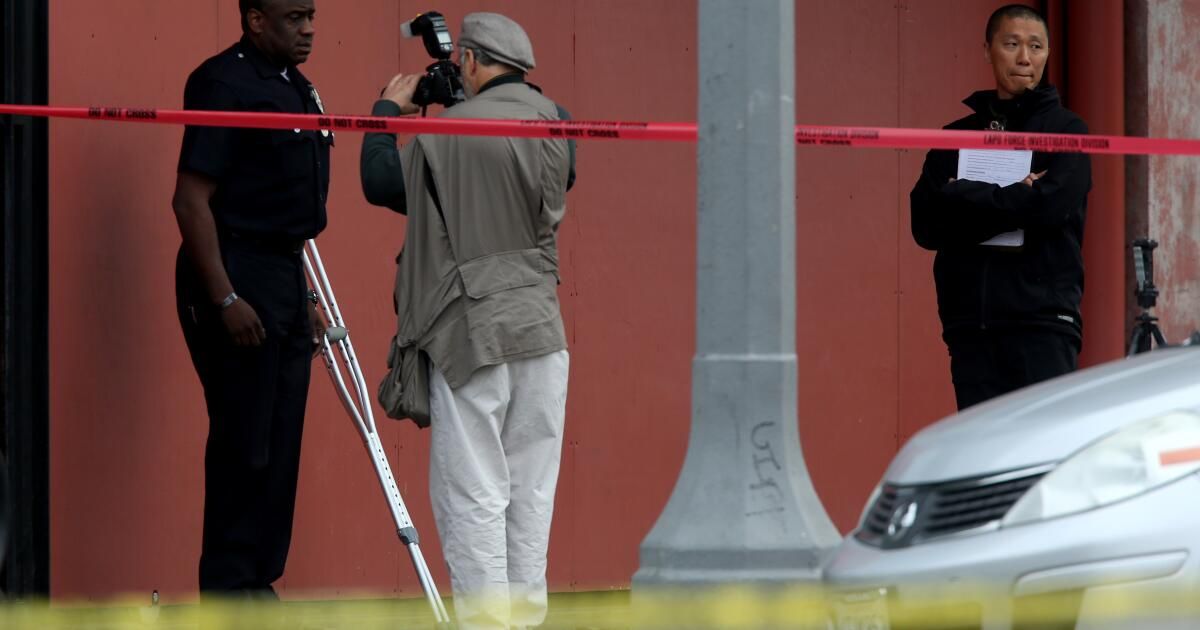
Los Angeles Police Officer Clifford Proctor walks on crutches in Venice, near the scene where he shot and killed Brendon Glenn, an unarmed homeless man, in 2015.
(Irfan Khan/Los Angeles Times)
“In my head, I thought it was an oversized Taser… I didn't see [Glenn] do anything worth getting shot for,” Thomas said, according to the transcript.
After Proctor opened fire, Thomas said the officer followed him back to the bar, apparently seeking confirmation that the bouncer would support his decision to kill Glenn.
“The officer came in and said something like 'Mario, you saw him, you saw him, you saw him reach for my gun,'” Thomas said. “I looked him in the face and said, 'I didn't see anything.'”
The district attorney's office said it has not made a final decision about whether to take Proctor to trial. He is due back in court next month.
Proctor was released last November on $100,000 bail. At a recent court hearing, Yu asked a judge to allow Proctor to travel to Seattle for work. The prosecution did not object.