Days before the trial, a federal judge dismissed an indictment against a TikTok streamer filmed by ICE earlier this year, citing constitutional violations by the government.
In an order Saturday, U.S. District Judge Fernando M. Olguín cited the deprivation of access to an attorney for Carlitos Ricardo Parias while he was detained by Immigration and Customs Enforcement and the government's failure to meet evidentiary deadlines, including the timely release of body camera footage that captured the shooting.
-
Share via
Federal authorities had accused Parias, a well-known TikTok streamer of local breaking news, of crashing his car into agents' vehicles after they cornered him and tried to arrest him during an immigration enforcement operation in South Los Angeles in October. An ICE officer opened fire, hitting Parias in the arm and wounding a deputy U.S. marshal with a ricocheting bullet.
That same day, prosecutors charged Parias with assault on a federal officer. In November, a grand jury indicted him. Parias was scheduled to go to trial on Tuesday.
Tricia McLaughlin, a spokeswoman for the Department of Homeland Security, previously told the Times that Parias had “weaponized his vehicle” and said that “fearing for the safety of the public and law enforcement, our officers followed their training and fired defensive shots.” But recently obtained body camera footage casts doubt on that claim.
The video captures an ICE officer holding a gun in one hand and using the other to open the window of Parias' car. As the officer yells at Parias to turn off the car, Parias raises his hands in the air and asks why he is being stopped. The officer repeatedly attempts to open the passenger side door, before moving the gun to his left hand, just before shooting.
At that moment, Parias' car did not appear to be moving.
“Oh,” the officer said, sounding surprised. “F-.”
“Who shot?” someone asked.
“I shot, I shot,” the officer responded.
In his 28-page order, Olguin dismissed the charge with prejudice, meaning prosecutors cannot refile the same charges of assault on a federal official using a deadly or dangerous weapon and depredation of government property.
“In short, because the deprivation of Mr. Parias's access to counsel during the critical period prior to his trial caused him actual and threatening harm, and because no other remedy could adequately remedy his deprivation, the court agrees with the defendant that dismissal of the indictment is warranted,” Olguín wrote.
A spokesperson for the U.S. attorney's office in Los Angeles, the Department of Homeland Security and ICE did not immediately respond to a request for comment.
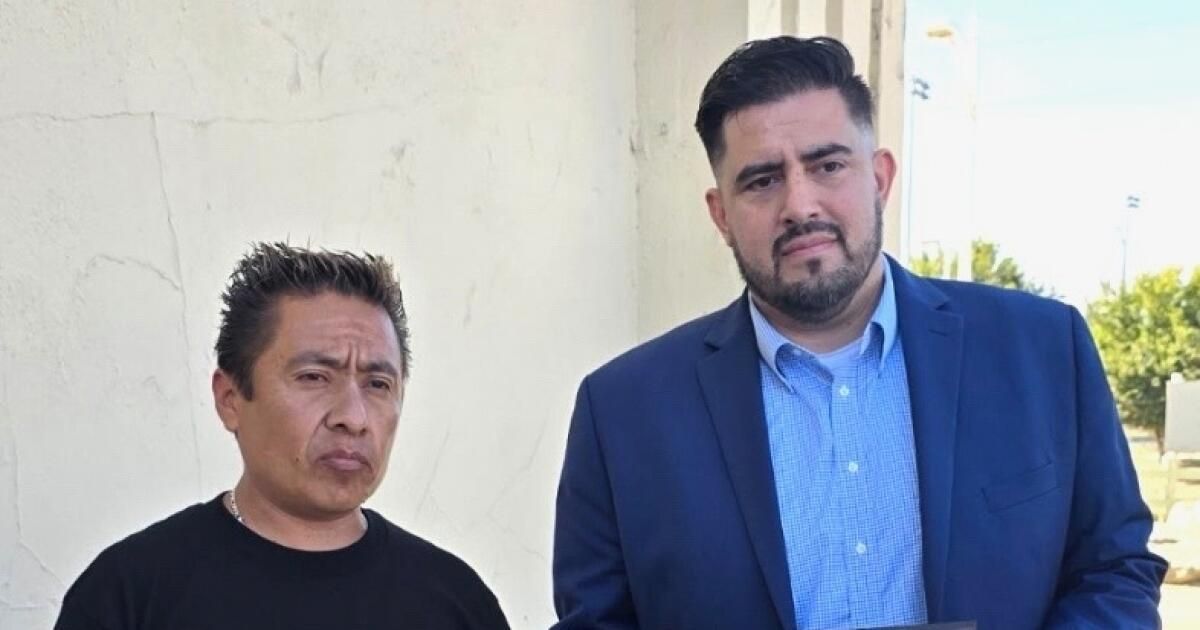
Federal Public Defender Cuauhtémoc Ortega and Deputy Federal Public Defender Gabriela Rivera, who represented Parias, said in a statement that they were “pleased that the court dismissed the charges against their client.”
“While we remain fairly confident that a jury would easily acquit Mr. Parias, the government undermined his right to a fair and speedy trial by denying him meaningful access to his defense team and failing to timely disclose the evidence they claimed supported the charges,” they said in the statement. “We are grateful that Mr. Parias' constitutional rights have been vindicated.”
Although the criminal charges against him have been dismissed, Parias could remain detained by ICE while his immigration case progresses.
Federal authorities attempted to arrest Parias on Oct. 21 with an administrative arrest warrant in conjunction with a federal immigration proceeding, according to a criminal complaint filed against him. Homeland Security officials have said Parias is in the country illegally.
A Department of Homeland Security official accused Parias of having “previously escaped from custody,” although video obtained by the Times appears to show federal agents letting him go during an incident in June.
In the recent incident that ended with a shooting, Parias was leaving his home and driving down the street when federal agents, including ICE and the U.S. Marshals Service, used their vehicles to corner him, according to the criminal complaint.
Body camera footage captures the ICE officer approaching Parias' passenger side door and saying he is going to “break the window.” When the officer breaks the window, the car begins to accelerate and smoke comes from the spinning tires. The officer draws his gun shortly after, holding it in his right hand while breaking the window at the same time.
The complaint alleges that when the rear of the car began to “slip,” it “caused the officers to fear that PARIAS might lose control of the Camry and strike them.” A Homeland Security Investigations agent wrote that Parias's acceleration of the Camry “caused debris (likely rubber dislodged from the tires themselves) to fly into the air, striking some of the agents.”
“Get down, we're going to shoot you“, warns the ICE officer in the video. “Get out, we are going to shoot you.”
Once the wheels stopped spinning, an officer reached through the broken window of the passenger door, “brandishing a gun in one hand while attempting to open the door with the other,” the judge wrote in his order.
As the officer yells at him to turn off the car, Parias says in the body camera footage that he has nothing and asks why he is being stopped. An agent appears saying that if Parias moves, they will shoot.
“Kill me, kill me,” says Parias. “Kill me.”
In the video you can see the ICE officer shooting shortly after and Parias begins yelling: “my hand.” My hand.
Shortly after the shooting, the officer opens his phone and sends a message. The content of the message is not visible in the images.
Parias was hospitalized for nearly a week after the shooting, before being transported to jail.
Although a federal judge later ordered Parias released on bail, once he was released from U.S. Marshals custody, he was immediately transferred to ICE custody on November 24, pursuant to a detainer order. He is detained at the Adelanto ICE Processing Center.
Olguín wrote in his order that “the government's decision to administratively detain Mr. Parias in Adelanto is when and where the constitutional violations in this case began.”
By placing Parias in immigration detention, Olguín wrote, the government “has jeopardized this court's ability to try Mr. Parias in accordance with the demands of the Sixth Amendment,” which provides for a fair and speedy trial.
Parias' attorneys filed a statement citing challenges to Parias' access to counsel as a result of his detention in Adelanto, which is at least a two-hour drive from the defense attorney's office in downtown Los Angeles.
With less than three weeks until trial, Parias' defense team had been unable to schedule any legal visits with Parias since the beginning of his ICE detention, Ortega said in a court filing. He mentioned the distance and difficulties in scheduling a video conference with his client.
“Here, the defendant's detention in Adelanto has effectively denied him access to his attorney for almost the entire month prior to trial,” Olguín wrote in his order. “In short, the obstacles and roadblocks that ICE has put in place at Adelanto make it difficult, if not impossible, for the defendant to meet with his attorneys, and have caused the defendant to suffer demonstrable harm or a substantial threat of harm.”
Olguín also noted that the government did not present any discovery to the defense until November 26, almost a month after the initial request. He said the government “has continued to contribute discoveries to defense well beyond the discovery limit.”
“Furthermore, prejudice toward Mr. Parias has been exacerbated by the government's conduct, especially with respect to meeting deadlines and making discovery,” he wrote.