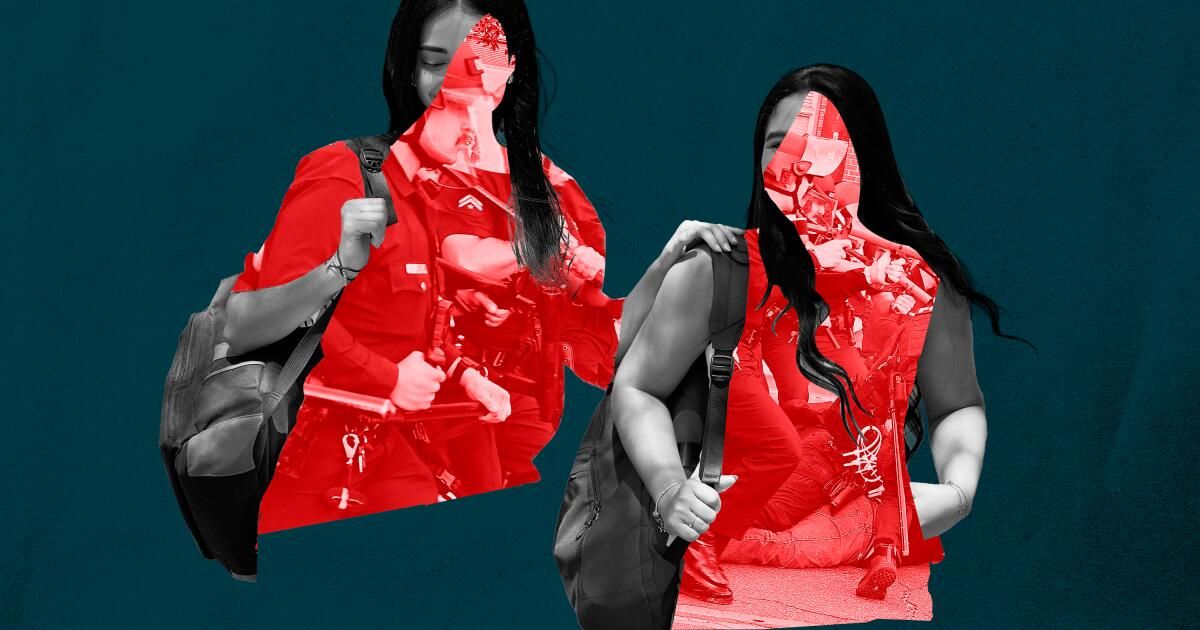
Alex immigrated to the U.S. as a young child and long felt tormented by his undocumented status.
In 2017, when she turned 15, she was finally old enough to apply for the Deferred Action for Childhood Arrivals program, only to have it slip through her fingers just before the process began, when it was rescinded by the Trump administration.
Then in 2020, Alex was set to graduate at the top of his class and had racked up a slew of college acceptances, including a full ride to Harvard University. He ultimately turned it down because of his status, worried about travel restrictions. Instead, he enrolled at a nearby University of California campus.
“It was almost like the system was making fun of me,” said Alex, who is now a graduate student at Cal State University and chose to use his middle name for fear of being attacked by immigration authorities. “No matter how much you excel, the system always comes back to haunt you, to remind you that you did all that and yet you really have no choice.”
A promise of work authorization and protection from deportation brought a generation of undocumented youth out of the shadows when DACA first went into effect in 2012. However, hundreds of thousands of today's students like Alex are largely left out because of the ongoing legal battle that has largely frozen applications since 2017.
These students' lives are further disrupted by the Trump administration's aggressive immigration enforcement strategy this year. DACA recipients and international students have been targeted, overshadowing the higher education achievements of undocumented youth with even fewer protections.
Gaby Pacheco, who was undocumented while in high school and helped spearhead the organizing efforts that led to DACA in the 2000s, said today's undocumented youth are “experiencing the same kind of anguish” and limitations that her generation experienced.
“It keeps people chained and, in a sense, blocks their potential and their dreams,” said Pacheco, who serves as president and CEO of TheDream.US, a scholarship program. Among the most notable barriers are exclusion from federal aid, certain scholarships and job opportunities, he said.
Many of these concerns are not new, but “they feel much bigger and closer than ever before” because of hostile immigration strategy and rhetoric, said Corinne Kentor, senior manager of research and policy at the Presidents' Alliance on Higher Education and Immigration.
Undocumented youth have long been at the center of the country's immigration debate. The result is an unstable and fragmented web of legislation determining their status, which is being challenged across the country.
DACA survived a legal challenge from President Trump in 2017 when the Supreme Court ruled in 2020 that his administration did not take adequate steps to end the program.
This year, the U.S. Court of Appeals for the Fifth Circuit issued a ruling that would uphold DACA nationwide but eliminate work authorization for recipients residing in Texas. Protections would remain the same in all other states and applications could be reopened. The ruling is pending a decision by a lower court judge on how its implementation will work.
Sen. Dick Durbin (D-Ill.), along with Sen. Lisa Murkowski (R-Alaska), reintroduced the Dream Act in early December, the most recent attempt by many in the past two decades to give young immigrants a path to citizenship.
The current Trump administration is attempting to further close the door to suing California in Novemberalleging that the state's decades-long offering of in-state tuition to undocumented students is illegal. The action follows similar legal measures taken by the federal government to end tuition fairness laws in states cross country.
“I feel like my family and I have been thrown into a video game,” Alex said. “Like the console turns on every morning, you know, and it's a challenge and it's a game and I have to survive.”
Who are today's undocumented students?
There has yet to be a notable decline in the 80,000 undocumented students enrolled in the state.
Undocumented students can apply for state financial aid through the California Dream Act, but applications have fallen 15% this academic year, with just over 32,000 applications submitted. Applications have steadily decreased since 2018.
Advocates warn that this drop is a result of legal challenges to DACA and young people becoming increasingly nervous about sharing their personal information with government-run programs.
More than half a million undocumented people are enrolled in higher education, but less than 30% of them qualify for DACA, according to the Higher Ed Immigration Portal. Most current high school students were born after 2007 and are automatically left out of the program.
The average age of the more than 500,000 active DACA recipients is 31 years old, and nearly 90% are over 26 years old. The population has also shrunk, from its peak of more than 700,000 beneficiaries, and some adjusted their status through marriage or children, said Javier Carbajal-Ramos, coordinator of the Dream Resource Center at Los Angeles Valley College.
“We call them the original undocumented students,” Carbajal-Ramos said. “These are people who really had an opportunity and probably took advantage of it. But then the system changed.”
Alex, who was brought to the country by his mother from El Salvador in the early 2000s, could not qualify for DACA because he was five years shy of the minimum age to apply.
“I grew up feeling silenced, and then there was a period of time where I felt like I could speak up and get my voice back… Now I feel like I've been silenced,” Alex said. “My story is being determined by everyone else except myself. My past, my present and my future are being negotiated by people who legitimately see no humanity in me.”
Higher education is a gamble
Attending college is a risk for undocumented students. Many choose to enter the workforce directly, a choice that Alex says “is pretty clear to most” of his peers.
Those who take that risk are often committed to the importance of education, said Iliana Pérez, a former DACA recipient and executive director of Immigrants Rising. Many immigrant families, like Alex's, initially come to the United States with aspirations for access to education and social mobility.
“My mom's biggest mistake has always been thinking that there would be people on this side of the border who would believe in her son as much as she did,” Alex said. “They have done everything they can to continue to believe for me and for themselves that something has to work.”
School has always been a “veil of protection” for Alex. Fear of entering the workforce was a factor that motivated him to continue in academia.
Often, an education can also give students more leverage in legal battles and allow them to pursue job opportunities abroad or paths such as self-employment and entrepreneurship, Perez said.
Many schools now offer support services and scholarships that can provide financial compensation in the form of stipends, largely due to the organizing efforts of previous generations of undocumented students, Carbajal-Ramos said.
An undocumented senior worked in a summer program for her Cal State University campus after her freshman year because she was paid through a stipend. A one-year academic position was also available, but he was paid an hourly wage, which meant he was ineligible.
Department leaders, however, agreed to offer him the position and instead paid him through a scholarship, he said, allowing him to generate income while in school.
“It wasn't something I asked for. They did it themselves. So I'm very, very grateful,” said the student, who asked the Times not to use her name because she does not have legal status. “It was amazing to see a group of people who really wanted to help me.”
Colleges and universities across the country have also established Dream Resource Centers, which provide services, scholarships, and support to immigrant students. There are 161 centers on campuses across the state, including nearly all community colleges and all Cal State and UC campuses; 14 private universities also have dream centers in California.
Carbajal-Ramos, regional representative of the centers in the Los Angeles area, said it is important to reach students where they are and not shy away from the precarious realities in which they live. He serves at least 1,000 undocumented students in his role as coordinator at Los Angeles Valley College.
“When someone really tells you that you can't, you either give up or you fight, right? And we came here for the fight,” Carbajal-Ramos said. “They have the desire. They have the momentum. It is my responsibility to keep it that way.”
Alex, who is now just months away from finishing his master's degree, hopes to enroll in a doctoral program next fall. Applications often require you to plan what the next five years of your academic career will look like, a task that has proven exceptionally difficult.
“I really can't think about my life for the next five years,” he said. “I can't even think about my life tonight. The drive home scares me. Coming to campus scares me. Walking from my car terrifies me. I live my life in breaths.”