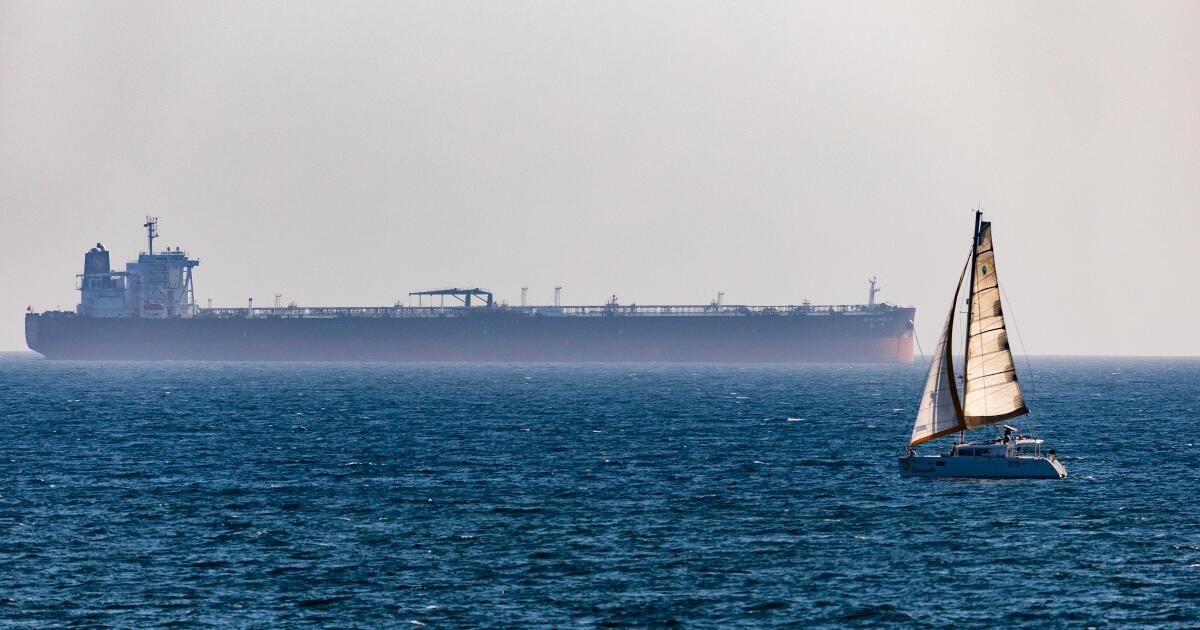
The last California-bound oil tanker to cross the Strait of Hormuz since the war broke out is in the port of Long Beach unloading its valuable cargo: 2 million barrels of crude oil destined to be transformed into gasoline, jet fuel and diesel.
The New Corolla was loaded in Iraq on February 24, just days before US and Israeli forces launched attacks on Iran, plunging the region into turmoil and triggering a double blockade of commercial shipping.
In two weeks, the Hong Kong-flagged tanker will have completely unloaded at the Marathon Petroleum terminal and set sail again for distant waters. After that, California must find a way to replace some 200,000 barrels of oil per day that will no longer arrive from the Persian Gulf.
California's own crude oil supply has been declining since the 1980s, due to aging fields and a geology that makes drilling particularly expensive. The state's gasoline refining capacity is also falling, increasing dependence on imports and highlighting California's status as an isolated energy island with no pipelines to bring in supply from other states.
With the end of the Middle East conflict nowhere in sight and the average cost of gasoline in California topping $6 a gallon, some lawmakers are warning of potential oil and gas shortages.
So far, during the war with Iran, oil shipments to California have remained relatively stable. The state imports about 75% of its oil from foreign countries and Alaska. last year brought a mix from Brazil, Iraq, Guyana, Canada, Ecuador, Argentina and Saudi Arabia as its main international suppliers, with around 30% coming from the Middle East.
In March and April, that mix didn't change much: California received about 21% and 14% of its foreign oil from Iraq and Saudi Arabia, respectively, according to data analytics firm Kpler.
Shipments that left before Iran blocked the Strait of Hormuz in late February have continued to arrive with a delay of one to two months, about the same time it takes for a tanker to make the trip. But if the Strait remains closed until May, “all bets are off,” said Ryan Cummings, chief of staff at the Stanford Institute for Economic Policymaking.
“Refineries have to source from other places and are struggling to find where to get that oil,” said Susan Bell, senior vice president at consulting firm Rystad Energy. “They don't have many options.”
It's too early to say how California refiners — the state's largest crude oil importers — plan to make up for the loss of Persian Gulf oil.
Refineries typically plan their supply about two months in advance, Bell said. But Chevron declined to share its supply plans, describing them as “materials for our business.” And the state's other major refiners did not respond to requests for comment.
Bell said refiners are likely looking to import or have already made plans to import more oil from countries where they already source crude, such as Ecuador and the west coast of Canada, where freight rates are lower due to shorter travel distances.
“They would definitely look at Brazil for medium grades,” Bell said, noting that the oil being lost is the medium and heavy grade crude preferred by most California refiners. “Guyana may be a little too light for them to want to increase, but you know, a barrel of liquid is a barrel of liquid, so maybe they are not too picky about quality.”
Cummings said it's possible that California refiners could outbid other countries competing for the same barrels over a period of time, but there is plenty to go around. “We're looking at a cumulative production loss of between 800 and 1 billion barrels,” Cummings said. “That's incredibly tight.”
China, Thailand, South Korea, Pakistan and other countries have already reduced or banned gasoline exports to protect domestic supplies in the face of oil shortages and rising costs that make it too expensive to produce.
Some California lawmakers have been sounding the alarm about possible oil and gas supply shortages in the coming months. The California Energy Commission said it is “working closely with refiners” and is “aware that they are identifying and utilizing alternative routes and sources of crude oil.”
Spokeswoman Nikki Woodard said the agency is confident about the state's oil supply outlook, which includes refinery stocks and additional storage, for the next six weeks.
“We came into this with pretty healthy inventories, but they're shrinking and that's when the situation gets really precarious,” Cummings said.
Data on shipments already traveling by water can give a preview of what's on the way. In addition to the New Corolla, an oil tanker that left Iraq a month before the war began has been anchored off Long Beach since March, but nothing else is arriving from the region. Saudi Arabia has been able to bypass the Strait of Hormuz with shipments from the Red Sea, but none of those barrels are headed to the West Coast.
Kpler analyst Matt Smith said Argentina, Ecuador and Brazil already have some crude on the way, but it's too early to see volumes increase to match what they're missing.
Unlike fuel coming from Asia or the Middle East, shipments coming from Canada or Latin America “could still be loaded now and unloaded next week,” Smith said.
California also imports gasoline in quantities that have increased sharply since the Valero Benecia refinery was idled in February and the Phillips 66 Wilmington refinery stopped operating in December. The PBF Martínez refinery, shut down by a fire in February 2025, has not yet been operational again. Whereas in 2024 California imported about 10% of its gasoline, now it imports 20%.
California's largest gasoline suppliers by far are South Korea, the Bahamas and India. As with oil, shipments continued to arrive through April, but that is set to change.

South Korea has virtually suspended shipments of jet fuel and reduced exports of gasoline and diesel. India has increased export duties on finished fuel products and is also shipping less. “We're seeing very little in the water heading to the West Coast,” Smith said.
The Bahamas, where gasoline is diverted from the U.S. Gulf Coast, could recover some demand, but how much remains to be seen. “There's a big question mark about where gasoline is going to go next,” Smith said.
The Energy Commission said the state forecasts liquid gasoline supplies through May. “We expect to see increased imports in June as the market adjusts to the new supply reality resulting from the conflict in Iran,” Woodard said.
Jamie Lewis, an oil analyst at Wood Mackenzie, a global research and consulting firm, said he would “expect to see a sharp rise in prices before we see shortages in California.”
Kate Gordon, who runs the economic policy nonprofit California Forward and previously served as a climate adviser to the Biden and Newsom administrations, said the only way for California to reduce its exposure to global oil price volatility is through strategies like investing in electric vehicles and infrastructure.
“Even in Texas, where there is obviously a lot of drilling and a lot of supply, prices are going up because sellers are selling to whoever pays the most during a time of restriction, and everyone is facing restrictions everywhere,” Gordon said. “The only way to be less dependent on this global system is to reduce the demand for oil.”