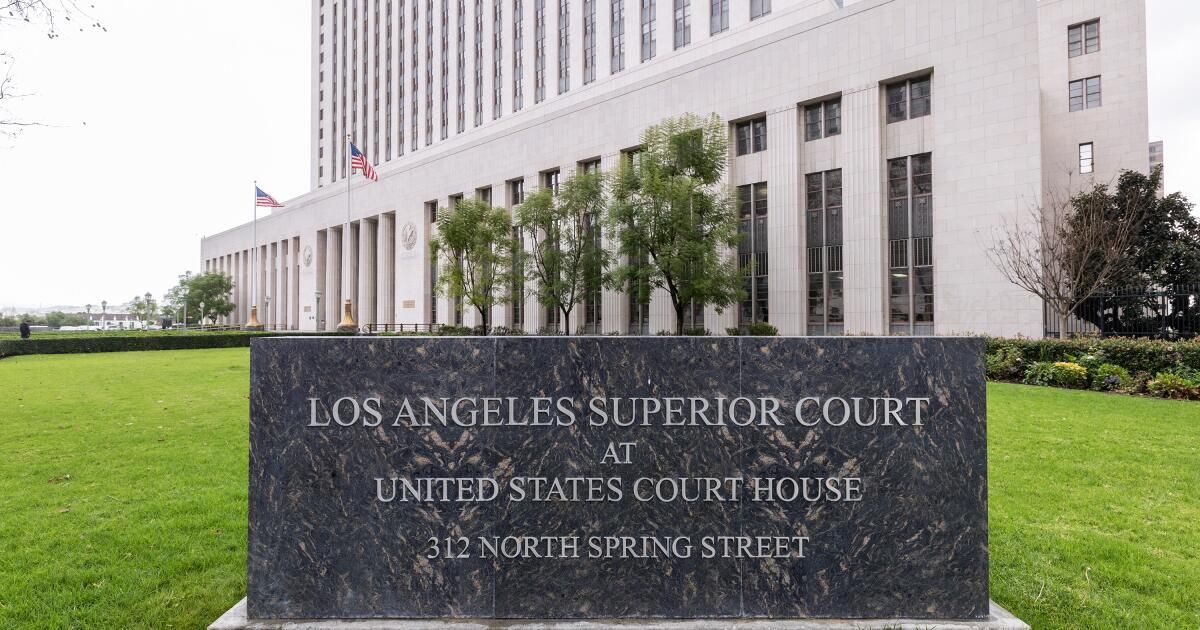
Judges in one of the country's largest court systems have begun using artificial intelligence, testing a tool that can quickly distill hundreds of pages of legal motions and use samples of a jurist's writing style to help reach conclusions and even draft interim rulings.
The program, which launched last month, gave a half-dozen Los Angeles County civil court judges access to artificial intelligence software called Learned Hand. While it could prove critical in an understaffed court system facing a workload crisis on many fronts, the announcement has also raised concerns among some members of the county's legal community who fear the technology could create errors and erode public trust in the legal system.
Court officials say judges in the pilot program must “review and edit the draft before adopting interim rulings” generated by Learned Hand, and touted the new effort to use the technology to help with basic court tasks and clear the backlog of cases.
“Court officials have long been supported by investigative attorneys and paralegals who assist with summaries, legal research, analysis and writing,” said Rob Oftring Jr., the court's chief spokesman. “This assistance does not replace the judicial officer's independent role in decision-making.”
Shlomo Klapper, CEO and founder of the company behind Learned Hand, said it is already used by court systems in 10 states. The Michigan Supreme Court began using the software last summer to review requests for permission to appeal in civil and criminal cases, according to a court spokesperson.
Klapper described the artificial intelligence tool as a co-intelligence, similar to a “judicial sous chef,” that will support members of the court without impersonating them.
Klapper, who worked as a federal attorney and paralegal before founding Learned Hand in 2024, said it's a needed boon to a judiciary drowning in a “paper blizzard,” especially with public access to artificial intelligence models like ChatGPT leading to more self-represented litigants filing cases in civil courts.
“This is what gives me so much urgency. We need to create the right tools so that the courts are equipped to deal with this tsunami,” he said. “The system is drowning and the flooding hasn't even started.”
Los Angeles County District. Lawyer. Nathan Hochman expressed some concern about the county's plan. He said AI could be useful in reducing the time judges spend on repetitive tasks, such as evaluating summary judgment motions in civil courts, which often cite the same case law and paragraphs over and over again. But he described the use of AI to generate sentences as “problematic.”
“Even when a judicial clerk or law clerk presents a tentative proposal about what position the judge should take, before the judge has taken his own position, that greatly influences what the judge's position should be,” Hochman said, warning that the AI-generated tentative decision could bias a judge before performing a legal analysis.
Recognizing growing public anxiety over the integration of AI into different facets of society, Klapper turned to pop culture to calm fears. He said he's not building Skynet, the artificial intelligence that brings about the end of days in the “Terminator” movies, but something similar to Jarvis, Iron Man's affable computer assistant.
“I don't come from a disruptive mindset… I'm here to build,” he said.
AI has caused incidents in the legal system that critics say warrant concern. Last year, a Los Angeles lawyer was fined for submitting a file full of ChatGPT-addled legal subpoenas. Last month, a federal prosecutor in North Carolina resigned after presenting a dossier produced almost entirely by the same artificial intelligence.
But a Reuters poll last summer also found that more than 70% of respondents believe AI is a positive force in the legal field that can dramatically reduce the number of human work hours spent on tedious tasks, including reviewing lengthy documents.
Klapper says Learned Hand has extensive guardrails to prevent the AI from inventing precedents and making other major mistakes. He said the program uses a fact-checking process called “Deep Check,” which interrogates each sentence of a generated order to ensure that the facts presented match the case law citations, which are available for review via hyperlink.
“We don't just tell judges to trust us,” he said. “We say you can check it yourself and see from particular sources where things come from.”
A Los Angeles County judge, who spoke on condition of anonymity because California court regulations largely prohibit judges from speaking to the media, echoed Hochman's concern that a tentative AI-generated ruling could create bias.
“Even if the AI's tentative decision is not necessarily adopted, psychologically it has become its reference point and any decision-making made thereafter could be based on it,” said the judge, who is not part of the pilot program and has not used Learned Hand.
According to judicial officials, judges would not have to reveal whether they used the program to assist in the investigation or in generating a ruling. David Slayton, executive director of the Los Angeles County Superior Court, said state court rules require judges to consider disclosing the use of generative AI in their proceedings, but there is currently no rule requiring them to do so.
The county's contract with Learned Hand will allow the pilot program to extend through early 2027 at a cost of just over $300,000. In the pilot program, the tool will be used largely to review and summarize a wide range of civil court motions, including summary judgment motions and motions approving class action settlements, although it may have limited future applications in criminal courts for post-conviction relief requests, according to the contract. The software is not used in criminal courts.
Klapper said he understands why there might be some hesitation among judges or the public, but he recalled cases that sat on his desk for nearly a year because he didn't have five free hours to read voluminous motions. Learned Hand, he said, is not intended to replace judges, but rather to give them more time to make decisions rather than being buried under an impossible caseload.
“There is no reason to fear that any technology company in the world, much less mine, will have to make important decisions for the public,” he said.