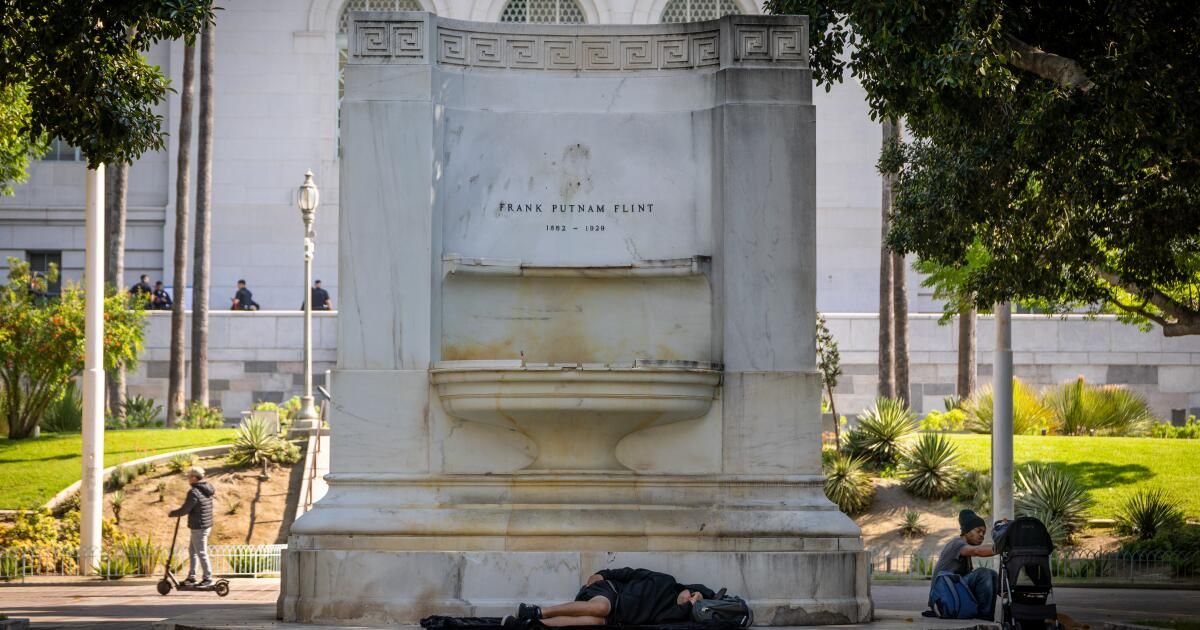
There was a time when Frank Putnam Flint's fountain on the south side of Los Angeles City Hall had three things going for it:
A picture of the former U.S. senator, a plaque detailing his service, and, of course, water.
The fountain has none of that today, nor has it for years.
While some of the light globes are broken, one remains with graffiti as a person walks in the Los Angeles Mall, in front of Los Angeles City Hall.
(Allen J. Schaben/Los Angeles Times)

Dead leaves hang from broken palm trees in Plaza Felipe de Neve, next to East Los Angeles City Hall and in front of City Hall.
(Allen J. Schaben/Los Angeles Times)
The marble structure remains, however, a monument of sorts. Graffiti and all, it is a monument to neglect, failed leadership, and the feeling of surrender that afflicts so many public spaces in Los Angeles.
This is an election year and it's fair for taxpayers to wonder if the care and maintenance of their neighborhoods will ever improve if the people who run the city can't manage their own properties.
By the way, the fountain didn't just dry up yesterday. When I told my editor what I was working on, he dug up a 1997 LA Times story titled, “On the Ruin Side.”
Times journalist Paul Dean noted that Flint helped harness water from the Owens Valley that irrigated the growth and prosperity of Los Angeles, but the fountain that bears his name had not been in operation for 30 years. It was later restored, but closed again about a decade ago. So, almost 60 years ago, the late Mr. Flint has had to suffer in silence the indignities of desecration and neglect, save for temporary intervention.
Dead palm fronds hang from broken palm trees in Felipe de Neve Plaza, next to East Los Angeles City Hall and in front of Los Angeles City Hall.
(Allen J. Schaben/Los Angeles Times)
A city analysis a couple of years ago cited repair costs as one issue and vandalism prevention as another. But with approximately 50,000 city employees and the nation's third-largest police department across the street, why is a simple security detail such an impossible challenge?
I would like Mayor Karen Bass, or her successor, to do one of two things:
Fix the fountain, perhaps with the help of Project Restore LA, a nonprofit that does good preservation work at City Hall, and arrange for its permanent maintenance.
Or tear it down, eliminating what is nothing more than a symbol of criminal indifference.
Plant a tree or something, although that could be problematic. The park surrounding the fountain has several native plants, but more than half of the plaques identifying them are broken or missing.
Across the street to the west, a two-acre parcel has been a dirt lot for years. To the east, the city's Department of Transportation plaza is a fenced-off eyesore. Nearby, a municipal flagpole is rusted, palm trees are dead, handrails are covered with stickers and a sign establishing a “Special Cleanup and Law Enforcement Zone” is covered in dirt and graffiti.

A person walks past a broken and graffiti-marked Los Angeles Mall sign in front of Los Angeles City Hall.
(Allen J. Schaben/Los Angeles Times)
If you travel northeast from City Hall, you'll enter “Mad Max” territory. Some remnants of an earlier civilization can still be seen in the underground hell known as the Los Angeles Mall, where, miraculously, a Quiznos and a pita shop cling to life, like barnacles on a sunken ship.
If you tunnel north, through the rows of dead underground storefronts, with long shutters, you can return to ground level at Fletcher Bowron Square. But in the southwest corner of the square, you might think that the square is called “le owro squ”, because of all the missing letters.
Just down the street, there's a sign that says “Los Angeles Mall,” with a hole in the facade that's big enough for Mookie Betts to walk through. Further up Main Street, planters are crumbling, with tree roots snaking up the wall, tearing up concrete and auditioning for roles in a sequel to “Invasion of the Body Snatchers.”

Homeless people and their belongings sit in the middle of the landscape as graffiti marks a wall in Fletcher Brown Square, near the Los Angeles Mall.
(Allen J. Schaben/Los Angeles Times)
Hello City Council. Can you send a team to clean up the mess?
Fill the shopping center with soil and open a community garden. Call the food trucks. Ask someone with imagination to create a model for workforce housing.
I am not suggesting that it would be easy to return the plaza or the shopping center to prosperity, or to achieve the goal set about a decade ago of redeveloping the area as part of the Civic Center Master Plan. At that time, by the way, councilor José Huizar represented the area. He currently resides in prisonSent packing for a series of offenses including, but not limited to, bribery.
Sure, the mall was dying even before the pandemic, and attracting new commerce would be difficult because the customer base (public employees) has disappeared and been reduced to remote workstations.
But here's the point:
That's no excuse to let things go to hell, not in this neighborhood or any other.
In August 2024, I hiked the Himalayan mountain ranges in Venice with Dennis Hathaway and his wife, Laura Silagiwho had suffered a hard fall on one of the countless volcanic sidewalks in his neighborhood. None of those disaster zones have been addressed, Hathaway tells me.

A pedestrian walks past a bus stop, marked by graffiti and dirty windows in front of Los Angeles City Hall.
(Allen J. Schaben/Los Angeles Times)
“To me, one of the biggest issues in this municipal election is the state of our infrastructure,” Hathaway said. “I mean, it's just terrible.”
In November I wrote about the shameful condition of Robert F. Kennedy Inspiration Park in Koreatown, where the monument and grounds had been vandalized, vandalized and fenced off. I visited him the other day and nothing had changed.
There is now a plan from the Los Angeles Unified School District to explore restoring the space, with a timeline of at least two years. But in a place that honors Kennedy, just a short distance from where he was assassinated in 1968, is it too much to ask that the district and/or city clean up the monument in the meantime?
There is nothing sadder than seeing people walk past that monument as if nothing was out of the ordinary, with our civic pride and our historical perspective crushed under the weight of indifference.
In MacArthur Park, long in troubleThe city last fall installed two rows of chain-link fences along the once-bustling Alvarado Street to deter crime. the fences They are still there, as are many of the problems in and around the park. As I headed east on 6th Street toward downtown, I saw about a dozen people getting hit in Yoshinoya Alley under a permanent cloud of fentanyl smoke.
Back downtown, on the edge of the Civic Center, Little Tokyo resident Steve Nagano says there have been fewer homeless people on the streets lately. But quality of life problems persist.
Utility boxes, street signs and maps of Little Tokyo attractions are covered in stickers and graffiti. Nagano is one of the organizers of Little Tokyo Shinean annual neighborhood cleanup scheduled for May 17 of this year.
“I think we've gotten to the point where we just go out ourselves and do it,” Nagano said.
In Los Angeles there is no ceasefire in the long war between problems and potential. The sprawling, splendorous, aging metropolis is not an easy place to manage and humiliates all its would-be saviors.
But Bass and all council members and all their successors need to be reminded that a civic sense of intractability is a dangerous thing.

A person walks past trash in a broken and empty fountain in Plaza Felipe de Neve, next to East Los Angeles City Hall.
(Allen J. Schaben/Los Angeles Times)
We cannot be comfortable with the idea that only incremental progress on homelessness is possible, or that it is acceptable to Los Angeles' poorly maintained parks will be located near the bottom in a ranking of the top 100 metropolitan regions, or that trash and debris will not be cleaned up unless residents do it themselves.
No one wants to hear about budget constraints from the people who helped create them, or that it's someone else's responsibility, or that making improvements is hard.
Fix the damn fountain now, not because the Olympics are coming in two years, but because 4 million residents deserve better right now.
And don't stop there.