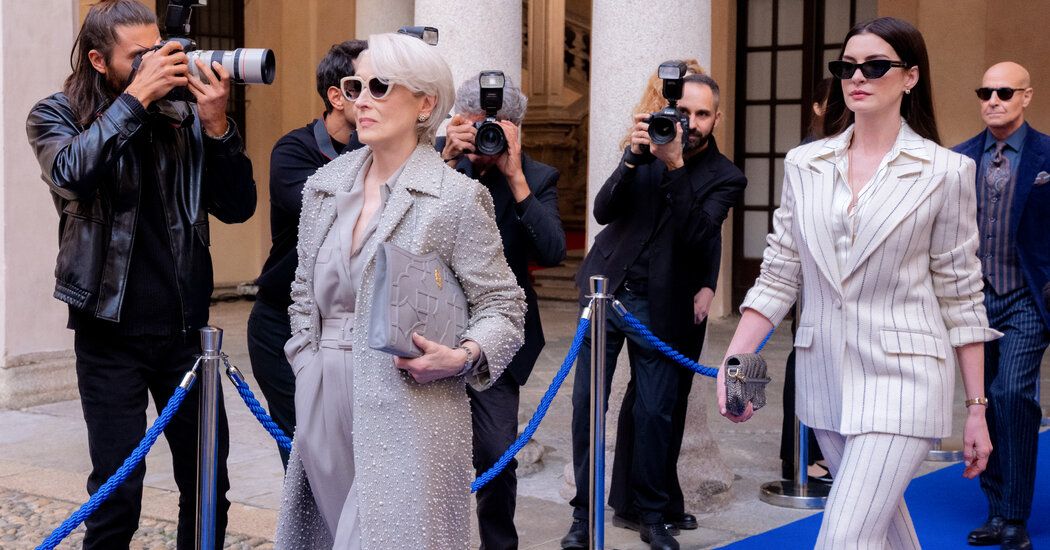
The last time Andy Sachs, the journalist heroine of “The Devil Wears Prada,” saw her main nemesis, she was in New York and heading into the unknown. It was 2006, George W. Bush was in the White House, the United States was at war in the Middle East and journalism was on the ropes. A Pew Research study that year had asked whether the era would be remembered as the moment when print journalism had begun to die. One seemingly undimmable bright spot for the industry was the September issue of Vogue, which that year, with Kirsten Dunst dressed as Marie Antoinette on the cover, ran 840 ad-rich pages.
Based on Lauren Weisberger's 2003 best-selling roman à clef of the same title, the first film is a frothy, catty professional coming-of-age story that centers on the pampered adventures of Andy (Anne Hathaway) after she is hired as an assistant at the fictional fashion magazine Runway. When the book appeared, Weisberger insisted that Runway's majestic terror, Miranda Priestly, was not based on longtime Vogue editor Anna Wintour, which no one exactly believed, but was tasty grist for rumors. In the end, it didn't matter much. Meryl Streep's turn as Miranda was so vivid, so strong, and so thoroughly detailed that the performance stood on its own; It was almost easy to forget that the character could have been inspired by anyone.
Andy and Miranda face off again in “The Devil Wears Prada 2,” but their antagonisms now pale next to the Internet-driven global change that is violently altering their lives. Like the first film, the second is a stylish romp with crisp, high-pitched laughs, truckloads of couture threads, and lashings of light drama. It's strategically aspirational, presenting a seemingly enviable world of unimaginable wealth that it earnestly criticizes before its characters get into a car with a six-figure price tag. Andy, now a serious, award-winning journalist, talks about how to score used couture finds and addresses the ethics of expensive apartments shortly before moving into hers.
One of the easy pleasures of the first film is that its self-conscious approach and nod to the hyperbolic excesses of Miranda and her henchmen discouraged you from thinking too much about the real costs (personal, social, environmental) of this high-flying world. The second film, by contrast, revolves around a series of crises, beginning with two grim family members (Andy loses her job when her publication closes and Runway finds herself caught up in a labor exploitation scandal) that set the stage for the larger existential catastrophe to come. Shortly after being fired, Andy returns to Runway to help repair its reputation, a rescue mission that becomes more intense due to the financial threats facing the magazine and its dominatrix-in-chief. There's also some filler (facial and otherwise) and a love interest, all inconsequential.
The agonies of journalism give the sequel a heavier feel than the original, although in truth the problems that continue to rock the Fourth Estate are only part of what has unsettled Andy and Miranda, as well as their colleagues. Also returning to the action is Emily Blunt's viperine Emily, another of Miranda's former assistants; and Stanley Tucci's Nigel, Miranda's suave and unfailingly faithful second. Emily now works at Dior, which means the brand features heavily throughout the film. She also continues to feel sorry for Andy, a role she embraces fiercely when she hooks up with a tech billionaire, Benji Barnes (an unrecognizable Justin Theroux as a Jeff Bezos type), a grinning boor who's far more monstrous than Miranda could be.
As the story jumps from New York to Europe and back, director David Frankel keeps everything moving quickly, interspersing conversation-based scenes between skyline shots and salivating shots of vast estates. Wisely, he gives his four lead actors plenty of room to show off their comedic timing; They're clearly having fun, which adds to the pleasure of watching talented actors enjoy their collective groove. And because Aline Brosh McKenna's script gives Miranda more to do, Streep finds new layers and nuances for a character who, the first time around, didn't do much more than quietly eviscerate terrified employees or smash her coat against an assistant's desk.
Miranda's transformation over the course of the two films, from an almost mythical power to a sudden, almost surprisingly vulnerable human target of more dangerous power, puts the film's themes into clear and recognizably contemporary relief. Like its predecessor, and like many other Hollywood films that harmlessly poke fun at the rich and famous, “The Devil Wears Prada 2” invites you into a realm of rarefied privilege that encourages you to covet and laugh about it. After all, lust is good for business and laughter helps ease class resentment. This sentiment may sound cynical, but compared to the dehumanizing world that Barnes, the smiling tech billionaire, threatens to unleash, it is positively utopian.
The Devil Wears Prada 2
Rated PG-13 for exploitation and desperation. Duration: 1 hour 59 minutes. In cinemas.