The giant Chinese boba has landed in Hollywood.
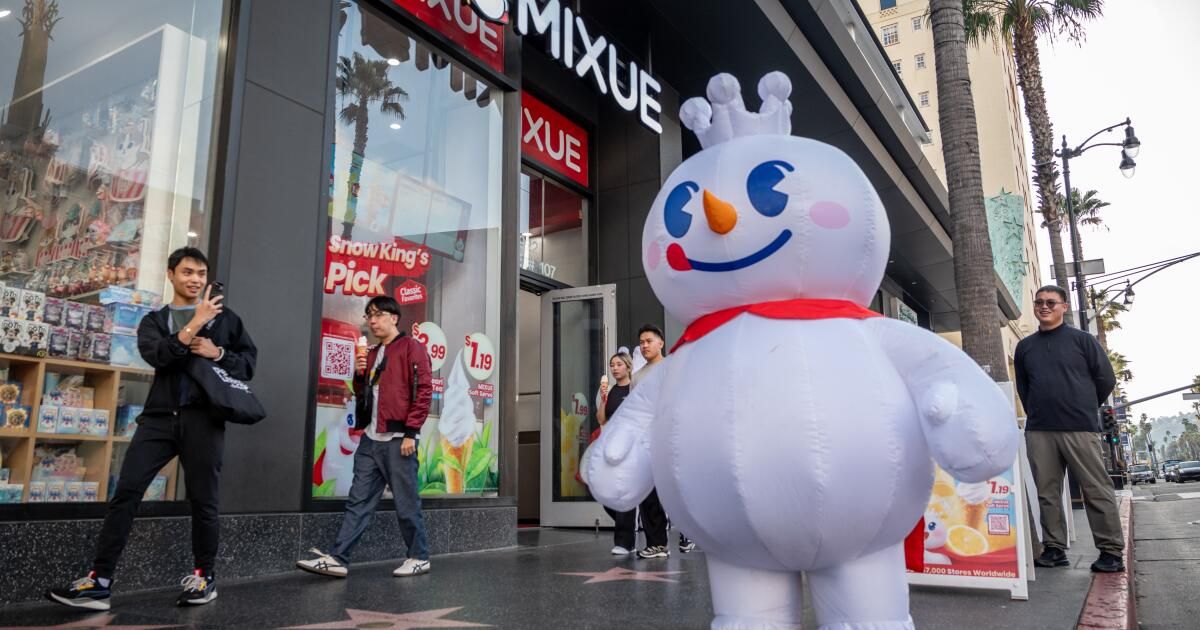
Mixue, the fast-growing mega-chain that has a larger global retail presence than McDonald's, opened its first U.S. outpost on the Hollywood Walk of Fame last month, selling drinks for less than $5 and ice cream for about a dollar.
Mixue spokesman Xu Ping said in a statement written in Chinese that the company chose Hollywood as its first U.S. location because the “movie capital of the world” attracts both international tourists and local consumers year-round.
The store, Ping added, “aims to serve a diverse global consumer base and demonstrates the brand's commitment to the U.S. market.”
The opening in Hollywood was followed in quick succession with locations in the Brooklyn, Koreatown and Chinatown neighborhoods of New York City. More Mixue stores are coming to California, Ping said.
The megachain's entry into the Los Angeles boba market comes at a time when local stores are struggling with rising costs driven by tariffs and economic uncertainty.
Mixue was founded as a shaved ice stand in 1997 in Zhengzhou, China, by college student Zhang Hongchao, using money borrowed from his grandmother. The store's Chinese name, Mi Xue Bing Cheng, roughly translates to “sweet snow palace.”
The store has more than 53,000 stores worldwide. Most of it is in China, but the company also has 4,700 locations in Australia, Japan, South Korea, Thailand, Malaysia and Singapore.
In comparison, McDonald's has more than 44,000 stores worldwide and Starbucks has more than 40,000.
Founder Zhang and his brother Zhang Hongfu, who control the company, have a combined fortune of $8.1 billion, according to the Bloomberg Billionaires Index.
Mixue is a fast-growing mega-chain with a global retail presence larger than McDonald's.
(David Butow / For The Times)
Mixue can keep costs down because it is vertically integrated, said Christopher Tang, a UCLA business professor and supply chain management expert.
Mixue owns the factories in China that produce its fruit powders, syrups and purees, giving the company greater control over pricing, Tang said. The grab-and-go store concept means lower rental costs. Having most of its locations concentrated in Asia means lower transportation costs.
Tang said the chain's U.S. stores may be operating as loss leaders to expand its global footprint, test the U.S. market and demonstrate growth to investors after its listing on the Hong Kong Stock Exchange last year.
“They can use profits in China to subsidize losses in the United States for the sake of expansion,” Tang said. “Once [they] If they get traction in the United States, they can grow a little more. “Once it reaches a critical mass, they will be able to sustain operations.”
On Thursday night, Mixue customers stood outside (the store does not offer seating) eating soft serve ice cream and drinking boba milk tea and the store's signature grape drink with taro balls.
Several passersby took photos with Mixue's inflatable snow “king” mascot standing guard outside the store's entrance. Across the street, actors posed on a red carpet, which had been rolled out on Hollywood Boulevard for the premiere of a Marvel television show at the TCL Chinese Theater.
Menu items range from $1.19 for the soft serve ice cream to $4.99 for their “super triple” milk tea with tapioca pearls, pudding and coconut jelly toppings. The self-service kiosks allow customers to place orders in Chinese or English and adjust the sweetness levels of drinks, which can range from 0% to 200%.
The chain appears to be aggressively seeking franchisees in California.

Mixue owns the factories in China that produce its powders, syrups and fruit purees. “They can use profits in China to subsidize losses in the United States for expansion,” said Christopher Tang, a business professor at UCLA.
(David Butow / For The Times)
QR codes placed on the store's front window, walls and sidewalk signs lead to a request website for potential franchisees in California and New York. Opening a store requires an initial investment of between approximately $220,000 and $920,000, depending on size and location, according to the website. Mixue does not charge franchisees any ongoing royalties or advertising fees.
Some Chinese customers were already familiar with the Mixue brand or were lifelong fans.
Tourist Kele Shi, a Washington-based tech worker from Shenzhen, China, decided to stop by his first U.S. location after watching videos on YouTube and the Chinese social media app Xiaohongshu.
Shi had been in the Miracle Mile neighborhood earlier in the day to visit a museum, but decided to go to the Walk of Fame to see if the affordable soft serve ice cream was better than Ikea's version.
“This is 80% of the reason we are here,” Shi said. “It's good, not too sweet. That's always a compliment for Asians.”
Torrance resident Olivia Y, who grew up in China, was buying five drinks for her friends after a climbing session in the neighborhood.
And he said he had fond memories of eating Mixue ice cream, his favorite menu item, and drinking fresh lemonade while spending sleepless nights as a student in Xi'An, China, and wanted to visit the US store after hearing about it on social media.
Other customers, like tourist Susannah Bartram from Nottingham, England, had never heard of the chain. She was strolling down the Walk of Fame, thirsty after taking a three-hour guided tour of Los Angeles, when the bright red colors of the stores caught her attention.
“It's colorful and accessible, and it's a quick fix,” Bartram said, holding a cup of iced tea with large slices of lemon.
With pearl tea gaining popularity in its home country, “it's just nice to see something new,” she said.
Across Hollywood Boulevard, the location of local business Bopomofo Cafe in the Ovation Hollywood shopping complex was relatively quiet Thursday night.
Earlier this month, the Asian-American cafe, which sells boba and snacks, including a sandwich Described by LA Times food columnist Jenn Harris as the “apotheotic” version of McDonald's Filet-O-Fish, he shared on social media that he was struggling with rising costs of products, including matcha powder and paper goods, due to “trade wars and economic uncertainty.”
The cafe initially considered a price increase but decided to first try removing some items from its menu and offering a limited food menu an hour before closing, said Philip Wang, who co-founded Bopomofo with partner Eric Wang in 2019. Philip Wang is also a co-owner of the Asian-American production company. Wong Fu Productions.
Bopomofo's classic milk tea is $6.50 and blended drinks like their guava matcha latte are $8. Toppings are an additional 75 cents.
“[We] They do not only pursue profits and a final result,” the cafe wrote in the Instagram post announcing the changes.. “We're also not a huge company with hundreds of locations (or thousands overseas) funding our stores.”
Bopomofo's Hollywood location opened in February as an experiment to see how it would work in a shopping center aimed at tourists, Philip Wang said.

The store is known for its ultra-cheap products, such as $1.19 soft serve ice cream cones and $4 boba.
(David Butow / For The Times)
As it approaches its first year of operation, the store, located on the mall's second floor, has seen less traffic than its four other locations in Southern California cities with significant Asian populations, such as San Gabriel and Irvine, he said. (A sixth Downtown Disney location will open this year.)
Philip Wang said he has yet to see a noticeable impact on the store's performance in the month since Mixue opened, noting that it is still early. The holidays increased traffic, Mixue opened in December and business slowed in January, a drop he said is typical throughout the food and beverage industry.
He hopes Mixue's presence in the United States can raise boba's profile here and encourage more people to “broaden their palette” and try local shops.
Bopomofo is no stranger to competing in dense markets: its original location is San Gabriel, where there are boba and tea shops on every corner. Philip Wang said he is confident that the drinks his cafe sells, which do not use artificial flavors, syrups or powders, will continue to attract customers.
But “I would be lying if I said that.” [Mixue’s] It’s not on our minds,” Wang said.