Every summer in Australia, millions of people head to the beach and every year, thousands are rescued by lifeguards or Surf Life Savers and even by surfers or other bystanders.
Tragically, many people lose their lives on our shores.
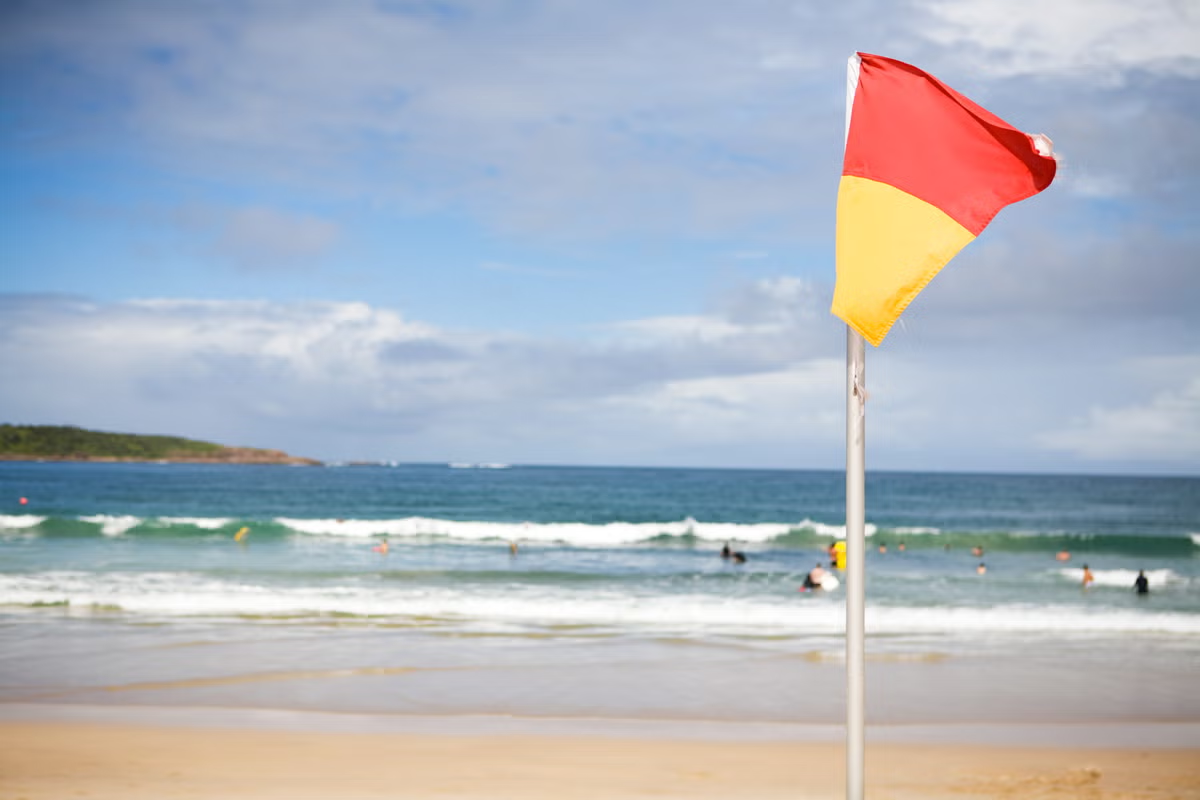
The red and yellow flags, iconic to many Australians, are intended to be a simple, easy-to-understand message. They indicate a safe and supervised place to immerse yourself in the water on the beach.
Surfers are supposed to surf outside the flags, while others swim (or wade or frolic) between the flags.
But for many international visitors the message is less clear. They may not make sense to people born abroad. Research shows that international students often misinterpret what beach flags indicate, rely on visual cues like other swimmers, or assume calm water is safe.
These flags are not universal. Around the world, beach safety is communicated in different ways, with different colors, symbols, messages and even patrol systems.
Despite significant efforts by water safety organisations, drowning rates continue to rise in Australia, with foreign-born people accounting for a substantial proportion of these deaths.
The system does not work.
What do flags mean and why are they important?
The red and yellow flags have been part of Australian beach culture and safety since the 1930s. They have been marking the patrolled area of the beach ever since.
The idea is that if someone swims between these flags, they are under the watchful eye of professional lifeguards and/or volunteer surf lifeguards.
Flags are usually placed in an area of the beach away from rip currents: the rapid channels of water that flow into the sea are responsible for an average of 26 drownings a year and the vast majority of surf rescues.
But recent studies found that about 70% of South Korean college students and 60% of Japanese students interpreted the red and yellow flags as an indication of a dangerous area.
about the authors
Samuel Cornell is a PhD candidate in Public Health and Community Medicine at the UNSW Sydney School of Population Health. Masaki Shibata is Professor of Intercultural Studies at Monash University. This article was first published by The Conversation and is republished under a Creative Commons license. Read the original article.
And a study conducted in the Netherlands showed that only 3.4% of participants surveyed correctly interpreted the red and yellow flags. About 40% thought they denoted danger.
These results should not be surprising. Other global safety systems, such as road or workplace signs, use red to indicate danger or prohibition, yellow for caution, and green for safety or permission.
Even half of Australian university students surveyed thought the red and yellow flags marked a safe zone, so surfers should also stay between the flags. In fact, surfers are not supposed to surf between the flags.
The global panorama
Globally, beach flag systems are not standardized.
For example, in Brazil, Spain, and some areas of the United States, beaches use a traffic light color system: green for safety, yellow for caution, and red for danger or closed conditions. Portugal sometimes adds purple flags to warn of marine stingers such as jellyfish.
In some parts of northern Spain, yellow flags are sometimes used to mark designated “refreshment” areas where people can swim or bathe to cool off, although there are also red “danger” flags.
The International Life Saving Federation recommends a global set of eight beach safety flags, including the familiar red and yellow for patrolled swimming areas, red for high danger, yellow for medium danger and black and white for boating areas.
Unlike some countries, the federation explicitly discourages green flags to indicate “safe” conditions, arguing that no beach or even patrolled area can ever be completely risk-free.
Communicating safety on the beaches
Although people don't know what the colors of the flag mean, in Australia beach signs often say “swim between the flags.”
But research at Bondi Beach in Sydney found that around 30% of foreign-born beachgoers misinterpreted this message.
They thought that “swimming between the flags” meant that only people who really knew how to swim should go there. In other words, if they weren't good swimmers, they believed they should stay out of the flags.
This is exactly the opposite of what the safety message intends.
Translation tools are not a reliable solution. A recent study found that Google Translate incorrectly translates key hazard terms.
Take, for example, the term “coastal spillway” (meaning a place where large waves can suddenly break and “throw” a swimmer underwater). This phrase is currently translated in simplified Chinese as “岸边垃圾场” (àn biān lèsè chǎng), which means “a place on the coast to throw garbage.”
“Shore break” (which means the same thing) appears in Korean as “해안 휴식” (haean hyusig), which means “relaxation on the shore.” This creates serious risks.
Where do we go from here?
Redesigning the flags could help.
A recent study in Europe developed and examined a modified version of the red and yellow beach safety flag, incorporating a pictogram of a lifeguard.
This study found that adding the pictogram almost doubled participants' correct understanding of the flags.
Some experts have also advised that changing “swim between the flags” to “stay between the flags” could improve the translation because “swim” has different connotations in different cultures and languages. Some people might think that you should only swim between the flags if you are a strong swimmer or plan to swim a few laps.
Simply changing the colors of Australian beach flags may not be enough.
The red and yellow flags are tied to a century of life-saving culture, volunteerism and community trust. But that legacy shouldn't stop us from testing whether green flags improve our communication about beach safety.