Olympia Auset's path to opening a health food emporium in one of Los Angeles' food deserts began with her own trips to the supermarket.
It was 16 years ago. Auset had just left college and was on a vegan diet. Her neighborhood was largely lacking in healthy options, and she ended up traveling two hours round trip by bus to buy nutritious food that fit her budget as a recipient of federal food aid.
“You spend all this time on the bus, you get somewhere that has healthy food, and then you have to debate with yourself: Can I afford this apple?” Auset recalled.
Hannibal Ali shops at Süprmarkt. Ali has been going there because of the organic options and because it is a black-owned business in the neighborhood.
From those demoralizing trips around the city, Auset founded Süprmarkt, a nonprofit organic produce company on Slauson Avenue in South Los Angeles that started as a pop-up store on the street in 2016 and grew into a grocery store in 2024 thanks in large part to a community crowdfunding campaign.
Inequity in access to healthy foods spans the county, but hurts its poorest residents and communities of color the most, USC researchers found in a study last year.
About 25% of Los Angeles County residents consistently do not know they will have enough food and even more, 29%, lack access to nutritious foods that can help prevent heart disease, diabetes and obesity. About 30% of Black and Latino residents, who make up the majority of South Los Angeles, have trouble finding healthy foods.
Among recipients of federal food assistance through this state's CalFresh program, 39% are food insecure and 45% are nutritionally insecure.
This in a state that grows nearly half of the country's vegetables and three-quarters of its fruits and nuts, according to the California Department of Food and Agriculture.
For Auset, this increasingly seemed more like an injustice than an inconvenience. With just $300 and help from loved ones when he started, Auset bought enough products to load the back of a friend's Suzuki and sold them in Leimert Park and other locations in South Los Angeles.
“The first time we came, we were practically sold out and people expressed a lot of gratitude,” Auset recalled. “It was crazy to hear people in their 40s and 50s say, 'I don't have this in my neighborhood.'”

Manager Chelsea Carson shares a warm moment with customer Eliana Vela after packing up her purchases at Süprmarkt.
Since opening, Auset has offered special discounts to customers receiving monthly food assistance, most recently during the November delay in federal SNAP disbursements. While thousands of low-income Angelenos lined up at food banks, Auset started the SNAP Back program, matching 125 donors with clients receiving food assistance, allowing them to purchase food in the store.
But it's not just those who are most vulnerable during delays or cuts in federal aid who are at risk, said Kayla de la Haye, director of the USC Institute for Food System Equity.
“There are also a lot of low-income, or even middle-income, people who are really struggling to make their budget work,” said De la Haye, whose team authored the food and nutrition study.
Food insecurity rates are consistently two to three times worse for black and Latino Angelenos than for white residents, he said.
For Auset, the insidious thing about food and nutrition insecurity is how it can start to feel like a part of life.
“That's something that was normal for me growing up” in Los Angeles, he said. “He always said, 'You have to go to the white neighborhood for that… I knew something was wrong, but I never thought about the underlying reasons.'


1. Organic Matcha Coffee and Mushrooms is available to buyers. 2. Organic caffeine-free drinks. 3. Various raw cane drinks are available to customers. 4. Malcolm
The first seeds of this growing awareness were planted while I was a student at Howard University, a historically black university in Washington, DC.
He met Will Allen, the former professional basketball player who became a leader in urban agriculture and food policy after buying the last remaining farm in Milwaukee and selling the produce he grew to underserved communities.
“Something clicked,” Auset said. “We have the capacity to feed everyone, but we don't.”
But if searching for healthy food in South Los Angeles was a challenge, navigating bureaucracies and food distributors as a young Black entrepreneur was even more daunting.
There was an inspector who, after observing the progress of the building's remodeling, asked, “Is this your husband's project?”
A vegan ice cream distributor was incredulous when she learned that Auset wanted to sell the items in her area of the city.
“He was like, 'Vegan ice cream in slauson?'” Auset recalled. “He just laughed at me on the phone and never sent me the price list.”
One supplier agreed to sell to Auset, but then refused to deliver in a neighborhood it deemed too dangerous for its drivers.

Olympia Auset, owner of the organic and vegan Süprmarkt, is inside the bulk room where shoppers have a wide variety of cereals and nuts to choose from.
(Genaro Molina / Los Angeles Times)
Driving west past Crenshaw Boulevard along the section of Slauson where Süprmarkt is located, auto repair shops and fast food restaurants dominate the scene.
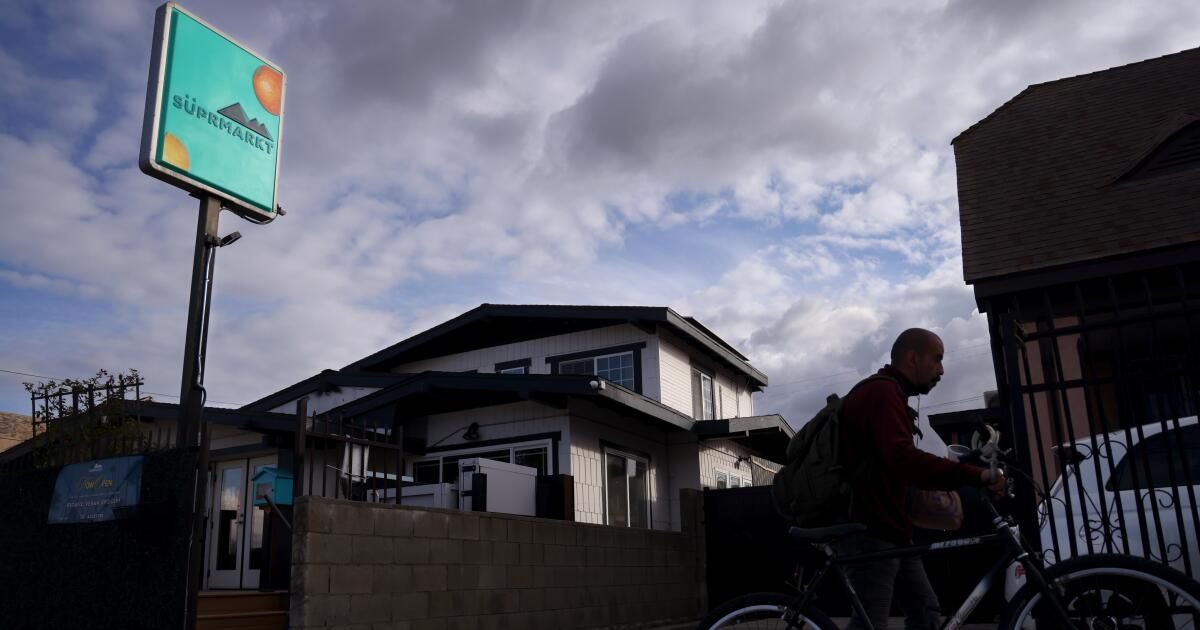
Next comes a Craftsman-style bungalow, freshly painted, black and white, with its imposing “Süprmarkt” street sign. Auset said the location is significant to her because the late rapper and entrepreneur Nipsey Hussle, whose community-minded approach to business she admired, operated his clothing store, Marathon, just down the street.
Joyful positivity and black consciousness prevail at Süprmarkt, a vestige of the building's former life as the home of Mr. Wisdom, a health-conscious store.
Patio furniture and a planter filled with fresh herbs, wildflowers and cherry tomatoes greet customers on a wooden platform at the entrance, along with a cabinet resting on a post containing a small library of Afrocentric books.
Celebrating the beauty of Black culture and Black people is important in promoting wellness in the community, Auset said.
That mentality also permeates the interior, where a wall of glazed tiles tinted a rich teal sets the mood. Some are painted with images of what Auset calls “ancestors,” including singer Nina Simone and activist Fred Hampton. R&B music plays. Incense fills the air.
Displays of fruits and vegetables, as well as nutrient-dense, vegan snacks and dry goods, anchor the small space. In a separate room, Auset has self-serve containers with bulk beans and grains. It just expanded with a juice bar in the back of the store.
The backyard “learning garden” is a work in progress, but Auset displays a collection of vegetables and herbs and says she plans to host workshops on farming and holistic health there.
Hannibal Ali, a fitness trainer, opted for fruits and vegetables for his raw food diet. He shops here because of its convenient location, he said, but as a fellow Black Angelino, he goes further.
“We don't have a lot of access to healthy foods,” said Ali, who also volunteers at the nearby Park Hill Community Garden. “If we don't support ourselves, who will support us? Self-preservation is a very important thing in our community.”
Dérly Barajas lives five houses away from Süprmarkt and comes every few days to pick up produce for her own raw food diet.
Barajas, an educator who works with adults with special needs, said that before the market opened, he also took the bus to get out of the neighborhood to buy food.
He describes the store as a blessing. For two years, Barajas has been fighting a mysterious illness that causes him to faint and have pressure in his head and chest. Thinking the illness might be related to her diet, she eliminated fast food and sugary, ultra-processed snacks.
He recently surprised himself by buying roasted jackfruit that looked like sloppy Joe's meat.
Part of the store's charm, she said, is that it introduces customers to a new way of thinking about ingredients, food preparation and what it means to take care of your body.
“If someone decides they want to eat well,” Auset likes to say, “that shouldn't be a luxury.”
That said, she added, shopping for your health can still feel special.