Dr. Abdirahman Mahamud, director of Health Emergency Alert and Response Operations at the World Health Organization (WHO), who returned last week after a month in the Democratic Republic of Congo, said 1,048 confirmed cases, including 267 deaths, had been reported as of Monday.
“This is the highest number of confirmed cases in the first month of an Ebola disease outbreak in Africa“, said.
During the current outbreak due to the Bundibugyo species of Ebola virus, declared on May 15, it took only 37 days to reach 250 deaths, Dr. Mahamud explained, while in comparison, it took 78 days to reach that number in the West African outbreak of 2014 and 2016, and 130 days in the 2018-2019 outbreak.
Families at risk
Ugochi Daniels, Deputy Director General of Operations at the International Organization for Migration (IOM), highlighted the dramatic impact of the disease on families, who bear “immense burdens.”
“Everyday life has become riddled with risks,” he insisted. “The journey to feed the family or earn a living can also become a journey into danger.”
The virus has become “more than a health crisis,” he explained. “It touches all aspects of daily life, generating uncertainty and fear..”
Ms Daniels said the outbreak is “centred in areas where people cross borders every day”. An effective response therefore requires maintaining vigilance while formal and informal cross-border movements continue, he explained, between communities affected by conflict and insecurity.
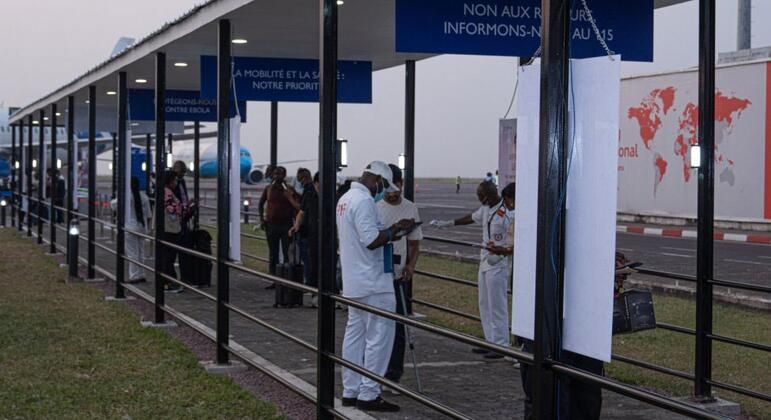
Since the start of the response, IOM and its partners have screened more than one million travelers “at key points of entry and along major mobility corridors,” he said.
The IOM official said that of the $55.8 million needed to support cross-border coordination and surveillance in 11 countries over the next six months, there remains a funding gap of about $35 million.
“What is needed for us to get ahead of the outbreak is a collective commitment to ensure that the effort is now fully resourced,” he insisted.
More hospital beds and tests
WHO's Dr. Mahamud noted encouraging signs that the response has been scaling up to keep pace with the spread.
The number of treatment beds has increased in the last two weeks, “going from a handful to more than 500 beds in 19 health zones,” he said.
At the same time, surveillance has expandedwith laboratory capacity increasing from 30 tests per day in Kinshasa at the beginning of the outbreak to more than 2,000 tests per day through a network of eight decentralized laboratories in Ituri, North Kivu and South Kivu.
Paolo Cravero, Senior Communications and Media Relations Officer at the International Federation of Red Cross and Red Crescent Societies (IFRC), highlighted safe and dignified burials as another pillar of the response. The International Federation has been delivering targeted kits and body bags to affected areas despite their remote location and security challenges, he said.
“As in any crisis, in any outbreak, like Ebola, tension tends to grow,” Cravero stressed. “And we have seen violence against our volunteers in [safe and dignified burial] sites.”
The IFRC spokesperson highlighted “a lack of confidence in the response”, insisting that the organization is “working hard with communities to close that gap”.
“Rumors and misinformation are creating some difficulties,” he acknowledged.