Imagine a chicken that could talk or a dove with a voice that rivals that of the most musical songbirds.
Of course, the world probably doesn't need gossiping chickens or pigeons that start singing. But why some birds learn to create a deep repertoire and others cannot has long been a topic of research by neurobiologist Erich D. Jarvis.
“Vocal learning, like spoken language itself, is a rare trait,” said Dr. Jarvis, director of the Language Neurogenetics Laboratory at the Rockefeller University in New York.
He studies the small group of species capable of speech, focusing on birds and mice, and has long hoped to genetically engineer an animal that can vocalize in new ways. Introducing engineered genes into the brain of a non-vocalizing bird or mouse could create that ability and provide new clues about the origins of speech. It could also one day help find treatments for people with speech problems or brain disorders.
Dr. Jarvis, 60, did not begin his career in neuroengineering. He once hoped to become a professional dancer, performing ballet at Manhattan's renowned High School for the Performing Arts and then studying at the Alvin Ailey School of Dance. He was a member of the Westchester Ballet Company when he began to wonder how the brain was able to create dance movements.
His mentor at Rockefeller was Fernando Nottebohm, the researcher who discovered in the early 1980s that the brains of songbirds generate new neurons each spring that allow them to sing. That revolutionary understanding of neurogenesis led to new discoveries that in all brains, including the human, new neurons grow throughout life. Until then, it was a scientific gospel that people came into the world with a fixed number.
From 2002 to 2005, Dr. Jarvis helped lead the Avian Brain Nomenclature Consortium, a project that renamed regions of the avian brain to show that it was remarkably sophisticated. The research undermined the use of the term “bird brain” as a pejorative.
That same year, he won the Alan T. Waterman Award and three years later he won the National Institutes of Health Director's Pioneer Award.
Dr. Jarvis's efforts to understand bird song have led him to other projects, including those working with high-quality genome assemblies: maps that allow researchers to identify which genes are linked to different traits. For this reason, he was named president of the Vertebrate Genomes Project, a global effort to sequence the genomes of 70,000 vertebrate species.
The project involved the construction of the Genome Ark, a reference database for research and conservation, especially of endangered species. The first sequencing phase of that project, involving 260 species, is almost complete. Dr. Jarvis is also working to sequence the genomes of all bird species, which number about 10,500.
Analyzing the smaller components of vocal learning is part of that work. Dr. Jarvis and fellow researcher Robert B. Darnell, also at Rockefeller, announced in February 2025 that they had discovered an amino acid in a single gene that could have contributed to the evolution of complex human language.
Swapping an altered gene into a mouse “changed the way the mice talked to each other,” Dr. Darnell said. “Baby mice called to their mothers differently, and male mice seeking to attract a female for mating attempted to attract her attention with altered vocalizations.”
The brains of mammals and birds descended from the same brain before a divergence occurred more than 320 million years ago. From there they took separate evolutionary paths and now appear very different: the structure of the human brain resembles a layer cake, while the brain of birds resembles a fruit cake. But some regions are remarkably similar, including those where vocal learning mechanisms are found. The independent acquisition of similar traits is called convergent evolution.
“If we study that convergence and find the similarities, it would mean we can understand human speech by studying these birds,” Dr. Jarvis said.
Matt Biegler, a postdoctoral researcher in Dr. Jarvis' lab, listed some questions that need answers: “What are the origins of speech? How did it evolve? Why did it evolve? And what are the mechanisms that make it possible?”
To that end, Dr. Jarvis and his colleagues were also able to engineer a new vocal pathway in a mouse, as documented in a paper published by the lab. “We have been able to change the expression pattern of that gene in the mouse brain, making it more human and songbird-like,” he said. “These mice sing with a greater diversity of variations.”
“The goal is to be able to translate this ability to species that wouldn't have it,” said Matt Davenport, a postdoctoral researcher in Dr. Jarvis' lab. “It opens up a brave new world in which higher-order traits can be engineered. It gives us new insights into communication disorders, autism and stuttering.”
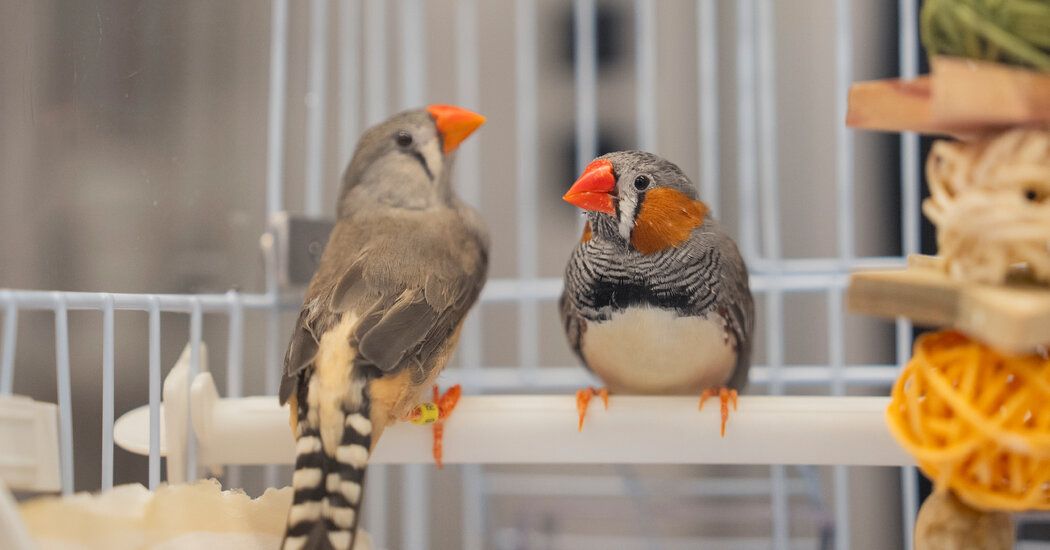
Captive-bred orange and gray zebra finches are the bird species chosen for this type of research, as their neural networks are strikingly similar to those of humans. But the lab has also studied the brains of wild birds. Dr. Jarvis used to attract hummingbirds to a feeder with sugar water. “They will find the food source and in the morning, as part of the dawn chorus, they will sing along with it” to claim their territory, he said.
The song activates a messenger molecule. If the brain were removed and examined quickly enough, within half an hour, Dr. Jarvis could trace the chemical that created the song.
Gaining a better understanding of vocal learning circuits is very promising, he said, adding that it was worth the sacrifice of some birds.
“If we can figure it out in birds, we can figure out how to similarly repair circuits damaged in strokes and trauma in people,” Dr. Jarvis said. Perhaps it would be possible to extrapolate the findings to aid in the discovery of new drugs that help people regain speech after a stroke, for example, or lead to a cure for stuttering, a brain condition that also occurs in some birds.
“I probably won't finish this in my lifetime, but I'm going to try,” he said.
Along the way, Dr. Jarvis has made other observations, perhaps drawing on his years of studying dance.
“Only species that learn vocally can learn to dance to music,” he said. “There is a relationship between learning to imitate sounds and learning to dance.”