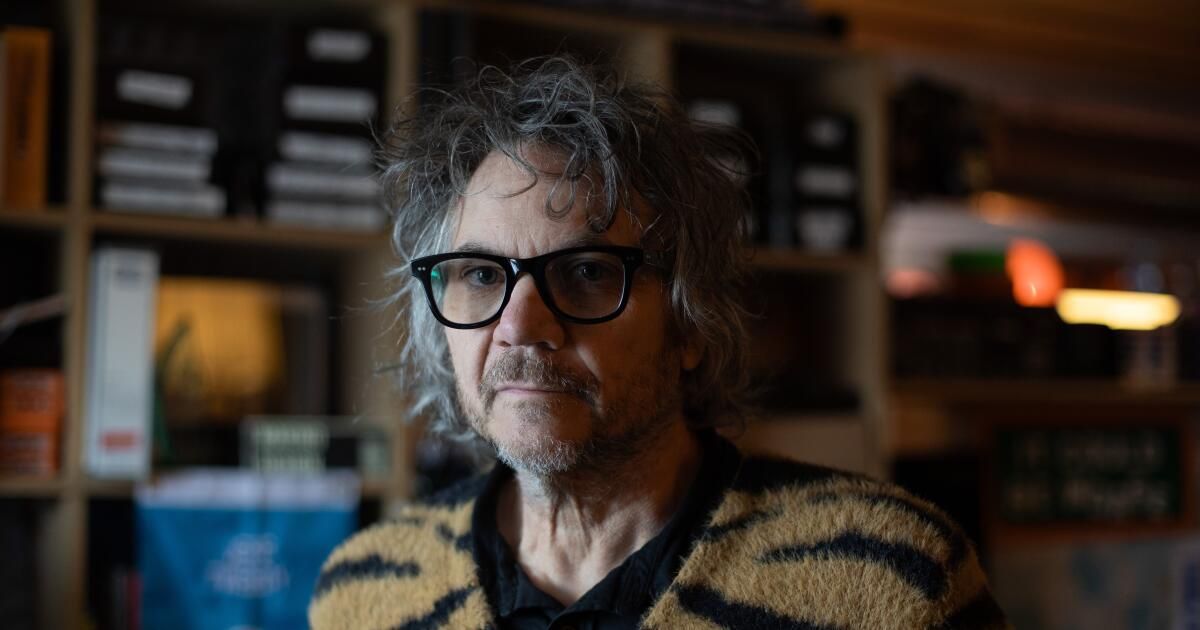
Not long ago, Jeff Tweedy made a surprising discovery: “There's more time between now and the start of my career than there is between the big band era and when my career started,” he said, eyes slightly wide behind a pair of thick glasses.
“How does that happen?”
In the late 1980s, Tweedy helped invent the idea of alternative country music with his band Uncle Tupelo; Today he is best known as the frontman of Wilco, who since 1994 has been steadily expanding the boundaries of American roots rock.
However, the 58-year-old has done much more over those four decades, including writing three books, producing albums by Mavis Staples and Richard Thompson, and hosting a COVID-era variety show on Instagram with his wife, Susie Miller Tweedy (former owner of historic Chicago rock club Lounge Ax), and their two children, Spencer and Sammy.
His latest project is “Twilight Override,” a sprawling, if homemade, triple album under his own name with no less than 30 songs about love, travel, music, family and childhood. Tweedy cut the record at Wilco's former Windy City headquarters, The Loft, with a band consisting of Spencer, 30, and Sammy, 26, along with Sima Cunningham, Liam Kazar and Macie Stewart; This weekend will bring those musicians to Los Angeles for a Friday night concert at the Belasco and another Saturday night at Broadway's United Theater.
To talk about it, I caught up with Tweedy in January when he was in town for his annual solo engagement at Largo at the Coronet, where he's been coming for years to try out new material and tell stories (and jokes) about old hits.
Does Tweedy, the devoted Chicagoan, like Los Angeles?
“I like everywhere except Indianapolis,” he said before one of Largo's concerts. Sitting backstage in a small dressing room, Tweedy smiled under a mop of fuzzy hair. “Indianapolis is fine. But, to be honest, I don't trust myself to judge any city.”
While we were talking, Spencer came into the room with a four-pack of Ardor cans, which Tweedy put in a cooler next to him. “This is really embarrassing: my decadent rock and roll lifestyle with the artisanal energy drink,” he said. “I don't drink coffee, but I like caffeine. And I like to be able to make sure it's the same amount because I have an anxiety disorder and I know how much I can handle.”
I saw your show the other night and was surprised by how natural you seemed on stage. At what point in your career would you say you reached that ease?
I think the ease you're referring to is simply the comfort of being uncomfortable. And I think that happened when it became easier to recognize that I'm awkward. I'm not David Lee Roth, although I'd love to be.
It's never too late.
It's too late for him.
Actually, it's not true. Look for some recent clips on YouTube.
Yeah? Honestly, he's like a strange hero to me. I'm not sure I could attest to that if I went deeper into his personal beliefs or something. But the level of trust and the purpose of the mission are very clear. I love that.
Then you feel comfortable being uncomfortable. But you must recognize that you have perfected your timing. You know when to turn it up and when to turn it down.
I've done a lot of solo acoustic shows. And I've done a lot of shows that are even more stressful than a solo acoustic show, and those are living room shows. Over the last 20 years, I've done dozens and dozens of charities in Chicago: 30 people, 30 songs, each one gets one request. And it wasn't always 30 rabid fans. In many cases it would be 10 rabid fans (friends of the rich man) and then another 20 people who are on the guest list or are relatives or neighbors.
I think a transitional moment for me was when I realized that the people in the audience who I thought were judging me were the people most like me. In fact, an audience entirely made up of people of my disposition would be silent.
His wife's comedic timing might be even better than his. When you asked him if he had any requests, his “No” from the crowd was perfect.
She is the funniest person I know. During those charity shows, I used to put my phone on the table and she would text me during the show, like, “Why are you playing all the saddest songs in the world?”
On the topic of rabid fans: I listened to an episode of “Wilco the Podcast” – these guys are deeply immersed in the story. Do you have a clear idea of when you became a musician with that kind of following?
I have accepted that it is a fact, but I have a hard time looking that fact directly in the eyes. What got me closer to being comfortable with the notion of having fans was the pandemic, when we were doing “The Tweedy Show” every night. I thought it was a moment when people would understand how connected we are: no stages, no hierarchy, we are all enduring this. When we canceled the tour dates at first, people were really sad and my wife's intuition was like, “You should let them know you're okay.”
I guess what I mean is: I didn't feel exalted, but I felt a purpose and that it was okay to have some responsibility, like a pastor with a congregation. It turned what is a parasocial relationship into something a little more real.
Five or six years later, has any aspect of that endured?
I think there's a lot to it, because I had to be seen, that's the part that opened my eyes. One of the reasons fandom is difficult to accept is because it is not you, it is your art, it is the person that has been projected onto you, a person that you have selected for yourself, consciously or unconsciously. But [“The Tweedy Show”] It was an acceptance of our flaws. Now I don't worry about sharing too much.

Jeff Tweedy, in white shirt, with his touring band: Macie Stewart, from left, Sima Cunningham, Liam Kazar, Spencer Tweedy and Sammy Tweedy.
(Raquel Bartz)
You've suggested that “Twilight Override” embodies hope in a dark time. But not everyone thinks this. is a dark moment People in the MAGA world have described a new era of American glory.
I'm sure they complain a lot because they think it's a time of glory. I don't even see Trump doing that; I see him saying, “These people are the worst” and talking about how nothing is right and that they have been given such unfair treatment. They are the whiniest sons of bitches I have ever seen in my life. There is no doubt that there are a handful of very rich people who think this is the greatest thing that has ever happened. And I don't give a damn what they think because they have nothing to do with the game. I have to respect that on some level I can't know them; I only have the information I need to continue. But it seems obscene.
When was the last time people didn't think everything was terrible?
Every generation has thought it was the end of the world and at some point one of them will be right.
You worked with your children on this album. Is there anything about his musicality that you had to prepare for?
No. But I don't think I approach other musicians like that, like I've cornered the market on the right way to do something. “These kids don't know where real rock and roll comes from”; I don't know. I have tried very hard not to give in to nostalgia.
That is an active effort on your part.
It's not a strict rule because that would be wrong too. I think it's okay for me to console myself with a Creedence Clearwater Revival record. But I also think it would be a mistake for me to judge that record as superior to a current record.
I saw a photo recently from you and Cameron Winter of Geese, which got me thinking about how you're between two phases: you're not a withered veteran yet.
It depends who you ask.
But it's clearly not the new sensation anymore.
I've been in that phase for a long time. There are times when Wilco looks around and we think, “How many other rock bands of this level are there?” There aren't that many. Certainly, when Tom Petty died and stuff like that, you start to feel like we might be one of the only places people go to hear guitar music of a certain kind.
What age is the dividing line that separates who you are from a Petty, a Springsteen or a Dylan? Is it 60? 65?
I am a bridge between a time when those people existed and a time when there are none. I approached Cameron when his album “Heavy Metal” came out. I think I saw his second solo show and said, “Hey, do you want to hang out?” He went from Sleeping Village in Chicago to Carnegie Hall in a year (less than a year) and throughout that time we stayed in touch. He's very talented and unique, but I also feel like it's nice that he accepts that I care about him. Geese is doing what a band should be doing. A young band should surprise people and divide them in a strange way. It's exciting.
What have you learned about aging from your friend Mavis Staples?
I've learned a lot from Mavis, but getting older… I don't know. Mavis and I curiously have a lot in common. It sounds very flattering to say it, but she is a baby of the family and was cared for like the baby of the family. But her role in the family was also to be the energy, that's why she doesn't look old. I would never think of growing older in relation to her. I don't think about it with me unless I have to have hip surgery or something. If I don't look in a mirror, I'm 18, maybe younger, maybe 10, sometime before my internal biography took over.
What is an internal biography?
The you that you tell yourself you are. At some point in development, you realize, Oh, I'm this thing, and then you're gathering information about how people see you. But that's what gets in the way of creation. Self-image reduces options and therefore the horizon becomes narrower. I don't know why I'm being so philosophical.

Jeff Tweedy at Wilco headquarters, The Loft, in Chicago.
(Kayana Szymczak / for The Times)
You're saying that we lock ourselves into an idea of who we are but it's not necessary.
Most of the people I love and respect (Little Richard, Howlin' Wolf, Captain Beefheart) have this amazing combination of confidence in who they are, but also the limitless imagination to become something that no one else is. Watch any clip of any musician that takes your breath away and the part that appears isn't even the music in many cases. Jimi Hendrix is off key in almost every clip you see of him! But it is undeniably something uplifting to witness, and therein lies its importance for other people.
The latest: you write in your book “World Within a Song” about learning to love “Dancing Queen” by ABBA. What is your second favorite ABBA song?
“DISCLAY CALL.” Incredible song.
That chapter explores the knee of a young punk.–Idiotic rejection of pop music. However, you admit that every once in a while you heard something on the radio that you didn't hate: the Bay City Rollers, for example. Why were you open to them if not ABBA?
The Bay City Rollers were the Ramones.
Is this how people thought about them?
That's how the Ramones thought about them. The Ramones had songs based on “Saturday Night” and wore the Queens plaid, which is black leather jackets. The big difference was that they didn't have the disco vibe.
While ABBA reveled in it.
I love ABBA now, and a part of me always did. The firing was the part that wasn't natural.
You describe “Dancing Queen” as “exuberantly sad.” Is that an emotional state you aspire to in your music?
Safely. I wish I was better at that. I've written a lot of songs that I thought were pop songs in my life that didn't end up being popular.
What is an example?
Almost all of “Summerteeth.”