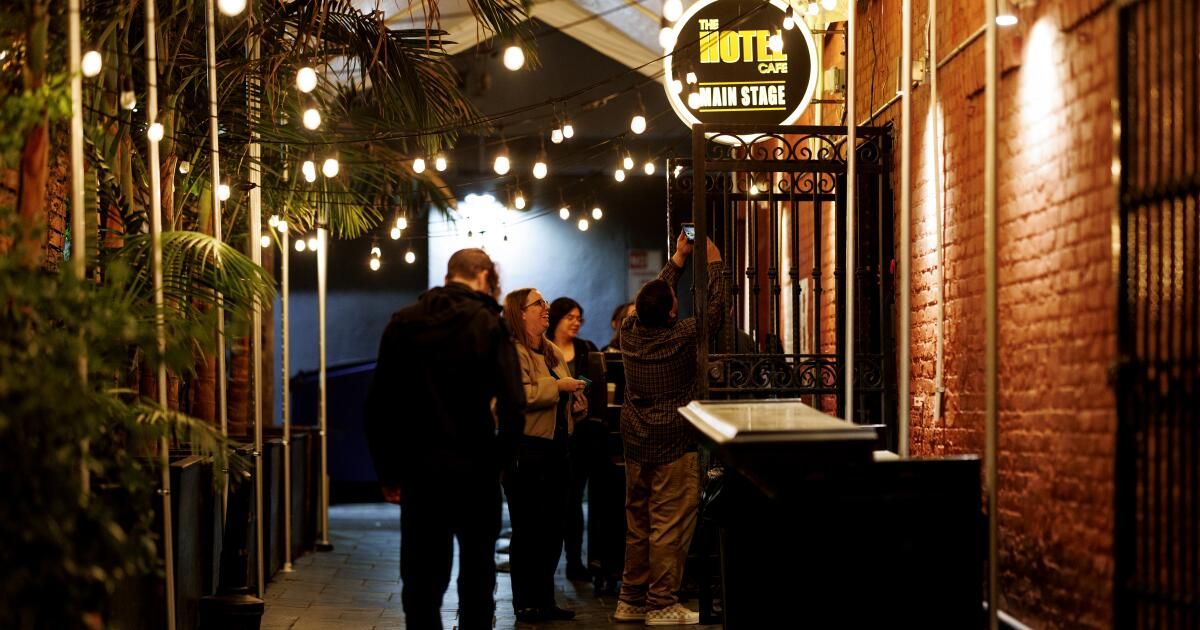
When musician Cary Brothers learned that the Hotel Café was closing, he felt as if he had been told his parents were selling his childhood home.
The beloved music venue, which launched the careers of then-little-known singer-songwriters Adele, Sara Bareilles and Damien Rice, will close its doors in early 2026, its co-founders Marko Shafer and Max Mamikunian announced in November. For those, like Brothers, who considered the Hotel Café a second home, the news of its closure was a hard blow.
Luckily for them, Shafer and Mamikunian plan to open a new location in the nearby Lumina Hollywood tower in early 2027. The brothers said it brings them solace, but not complete convenience.
“Yes, they are buying a big new house, but it is not ours,” he said.
-
Share via
Elected “mayor of the Hotel Café,” Brothers discovered the Hollywood haunt before it even had a liquor license. In those days, the café had a BYOB policy and sold ice buckets for visitors to chill the alcohol they brought with them, and jazz legends who emerged from local bars after last call capped their nights with a 3 a.m. jam session in the Hotel Café's piano room (or smoking room, depending on who you ask).
Every penny they earned went back into the place, Shafer said.
Brothers has always compared the Hotel Café of that era to “'Cheers' with guitars,” where he could show up any night and a dozen of his closest friends would be there. Eagles songwriter Jack Tempchin used to say it was the closest thing to the front bar at the Troubadour in the '70s.
“No one became the Eagles, of course, but the spirit was the same,” Brothers said.

Dave Navarro, left, and Billy Corgan perform with Spirits in the Sky at the Hotel Café in 2009. The venue was a launching pad for many notable singer-songwriters in the late 2000s and early 2010s.
(Tiffany Rose/WireImage via Getty Images)
Beginnings on Cahuenga Boulevard
The owners attribute much of the Hotel Cafe's success to good timing.
At the turn of the century, Mamikunian said, “The word on the streets of Los Angeles is that it's an industrial city and music venues don't work here.”
Mamikunian, on the other hand, believed that the city was full of raw talent, but there was no room for it to develop. Judging by the long list of musicians who flocked to the Hotel Café in those early years, his intuition was correct.
“We did it right when it needed to happen,” he said.
For independent artist Kevin Garrett, Hotel Café was a “gym” where he could flex his creative muscles and experiment with his sound, without judgment. For local folk singer Lucy Clearwater, it was her sign that moving to Los Angeles was the right decision for her career.
And for Ingrid Michaelson, the ad was ahead of its time in championing female artists. When Hotel Café asked Michaelson to headline their 2008 all-female tour, she thought, “When will that happen, except at Lilith Fair?”
In Michaelson's native New York, there were a handful of venues that harbored early-career musicians: the Living Room, the Bitter End, Kenny's Castaways.
“But in Los Angeles, there was really only the Hotel Café,” said Michaelson, behind 2000s hits like “The Way I Am” and “You and I.” “So it was this distillation of all the singer-songwriters from Los Angeles, who came through this one port.”

Customers enter Hotel Café through a back alley along Cahuenga Boulevard.
(Gina Ferazzi / Los Angeles Times)
Through musical generations
In its 25 years of operation, the Hotel Café has seen several generations of musicians wander through the space, Shafer said. Production director Gia Hughes calls them the “graduation classes.”
In Brothers' time, it was Joshua Radin, Bareilles, Meiko and other late-2000s singer-songwriters whose music regularly appeared on shows like “Grey's Anatomy” or, in Brothers' case, the indie cult classic “Garden State,” directed by and starring fellow Northwestern student Zach Braff.
Then came the residences of Johnnyswim and JP Saxe, and later, the people of Clearwater and his close confidant Rett Madison. Clearwater said that during his tenure, he often joined his fellow performers on stage to sing backup vocals or play a violin solo.
“Every four years it emerges as a different type of community,” Hughes said. “And it's different, but it's also not different.”
That's why Shafer and Mamikunian aren't worried about losing the magic they created in Cahuenga. In his eyes, he was never confined to space itself.
“I remember the first time we talked about expanding the Hotel Café and everyone said, 'Don't do it. You're going to ruin what you have,'” Shafer said, referring to the acquisition of additional space next to the venue in 2004. (They expanded again in 2016 with their Second Stage annex, about half the capacity of the main stage.)
“When we did it, it changed the room a lot for the better and gave us access to bigger artists, but we still didn't lose the intimacy,” he said of the expansion.
Shafer and Mamikunian thought they had outgrown the Cahuenga space and had been considering a move for a long time. This year, logistics were good, Mamikunian said.
“It wasn't anything dramatic,” he said. It was just the moment.
Hughes called the move “an opportunity to look for a space that can meet a lot more requirements for us, long term”: more parking, greater room capacity, greater accessibility.

Los Angeles singer-songwriter Maris performs at the Hotel Café's Second Stage performance venue.
(Gina Ferazzi / Los Angeles Times)
A new beginning just around the corner
Zoning clearances are still pending for the new location at Lumina Hollywood on Sunset Boulevard, a high-rise apartment building being upgraded by Morguard Corp. And although the new location is scheduled to open in 2027, the timeline depends on an upcoming zoning hearing, scheduled for March or April, Mamikunian said.
But Shafer and Mamikunian chose to announce the closure while the details were still being worked out rather than wait and risk the information leaking to the public. Furthermore, this way, both artists and patrons have time to say goodbye.
After Clearwater heard the news, she rushed to a weekly “Monday Monday” showing and immediately felt like she had been transported back to 2017, when she spent more than four nights a week at the venue.
“Many of my old friends from that time, some of [whom] I had lost touch with them, I saw them all there,” said the Bay Area-raised folk singer. “You could feel that everyone loved it.”
The singer said she couldn't help but wonder if things would have been different if people had shown themselves like this before Shafer and Mamikunian made their choice. But that night, as she drank red wine in the green room, she felt lucky to be there.
“It's the wood, it's the bar, the chairs behind the stage, the little lanterns,” he said. “I'm going to miss how it looks and how it smells, but people, that will never go away.”

The Hotel Café hosted its annual holiday display on Dec. 19, with proceeds benefiting the Recording Academy's nonprofit arm, MusiCares.
(Gina Ferazzi / Los Angeles Times)
goodbye for now
Earlier this month, Hotel Café hosted its final Christmas event in Cahuenga. Hughes, with the help of her interior designer sister, Nina Hughes, spent hours that day decking the halls with carnival lights and ribbons galore.
Even before the evening's presentations began, attendees were toasting drinks and giving each other lingering hugs, the kind typical of the last day of summer camp.
“It's going to be a love fest,” Hughes predicted.
No matter how sincere the musicians that night were in their speeches, bartender Dan Shapiro said getting sentimental on stage has been the norm for weeks.
“People always praise the place,” Shapiro said with a smile. As he looked at the posted lineup at the bar, he said he had bet his money on artist Lily Kershaw shedding a few tears. Fellow bartender Dave Greve agreed.
Against all odds, Kershaw didn't cry as he led the crowd through a rendition of Crosby, Stills, Nash & Young's “Our House” a few hours later. Later artists kept the theme going with songs composed of resonant lyrics like “See you later, stranger / I like to think I know you better” and “Hold on tight / Don't let go.”
As Brothers sang his own tribute, he closed his eyes, as if he were praying.

“It will never be what it was, but it will be something new and different, and I'm very excited to see what it is,” Lucy Clearwater said of the Hotel Café's relocation to Sunset Boulevard.
(Gina Ferazzi / Los Angeles Times)
James Babson, longtime doorman at the Hotel Café, said staff and patrons alike have always been reverent toward the artists. For some, he said, the listening experience is “spiritual.”
“Maybe they're not churchgoers, so they have this sense of community and transcendence, where that song touches them on this level, which takes them to another place,” he said.
Peter Malek felt it the first time he walked into the Hotel Café 20 years ago. Hooked on that feeling, he began visiting the facility several times a week. Sometimes he couldn't even get in, content to chat with Babson for hours at the door; Other afternoons were spent in the staff offices, studying for his medical school exams.
At Malek's last count, he has been to the Hotel Café 1,333 times. Although he was saddened when he heard the news of the relocation (several months before almost everyone else found out), he said he didn't expect Shafer and Mamikunian to replicate what they built at the Cahuenga site.
Instead, Malek said, he is “happy to have witnessed it.”

The Hotel Café was packed with regulars and first-time guests at its farewell Christmas performance in December.
(Gina Ferazzi / Los Angeles Times)
All night at the Hotel Café Christmas party, attendees wondered if penultimate performer Dan Wilson of the pop-rock band Semisonic would play “the song.” Nobody had to name it.
When Wilson finally sang the magic words: “Time to close, open all the doors / And let yourself out into the world,” the room erupted in cheers.
It was the closest the brothers came to crying, but they held back. There would be time for that later.