New York- Keke Palmer can make Jack Whitehall blush.
We're sitting in the green room at the 92nd Street Y on Manhattan's Upper East Side, just before Palmer hosts a live edition of her podcast, “Baby, This Is Keke Palmer,” with Whitehall and her other co-stars from the Peacock series “The 'Burbs,” which premieres Sunday.
In the show, Palmer and Whitehall play Samira and Rob, new parents who return to Rob's hometown of Hinkley Hills, a beautiful suburb where Samira immediately suspects something is wrong.
Palmer kicked off her high heels and tucked her feet under her on the couch where she sits next to Whitehall as I ask them about their chemistry reading.
“He was making me laugh, not just me, but everyone,” he recalls. “It was like, yeah, I can see how you fall in love with this guy because he's so funny and so sweet. It's so true, Jack. Seriously.”
Whitehall's face turns red, which I point out. He admits that's the case with a laugh. Palmer chimes in: “He knows how I feel. That's my boo.”
“The 'Burbs” reinvents the 1989 Joe Dante film starring Tom Hanks for a modern era. In the original, Hanks' character goes crazy, imagining that his neighbors in the creepy house across the street might be murderers.
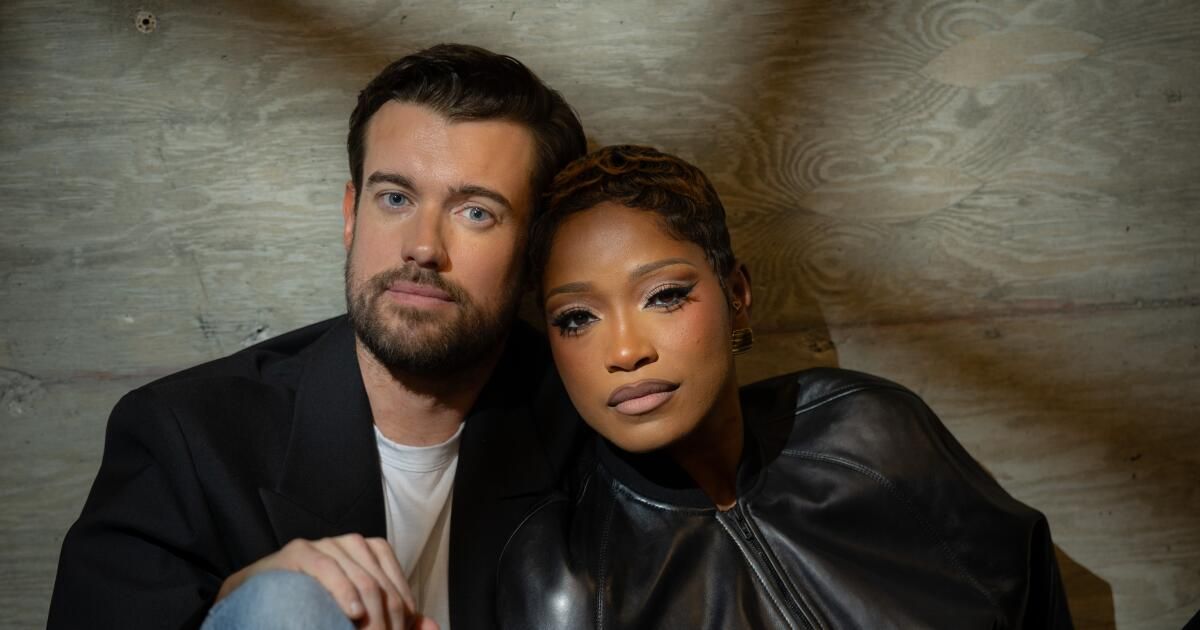
Jack Whitehall as Rob and Keke Palmer as Samira in “The 'Burbs,” a series reimagining of Joe Dante's 1989 film.
(Elizabeth Morris/Peacock)
Developed by Celeste Hughey, this version puts Samira de Palmer, a lawyer on maternity leave, at the center. Although she initially feels uncomfortable among the carefully manicured lawn, she quickly develops a friendship with a group of gossiping drinkers on her block (played by Julia Duffy, Paula Pell and Mark Proksch). When a creepy man (Justin Kirk) moves into the dilapidated Victorian mansion across the street, she begins to wonder if he has something to do with the disappearance of a teenage girl years ago. And then he starts to ponder how Rob could be involved. Is this a case of paranoia thanks to new motherhood? Or is there really something wrong in this paradise?
Initially, Imagine Entertainment's Brian Grazer, who made the original, and Seth MacFarlane's Fuzzy Door Productions had teamed up to make a new film version of “The 'Burbs.” During the COVID-19 pandemic, MacFarlane thought the title might make sense for the “dark, humorous, creepy vibes of our shared fear within our own communities,” Fuzzy Door president and show executive producer Erica Huggins explains in a phone interview. After it was reconceived as a series, they approached Hughey.
“When I thought about it for a modern version, I really wanted to focus on an outsider,” Hughey says, adding, “I grew up in Boston, a very white suburb, as a mixed-race kid; I wanted to focus it on a black woman who reluctantly has a new baby, a new husband, in a new neighborhood and see it through her eyes.”
Palmer was always the one Hughey wanted to play Samira, and Grazer had the same idea.

Keke Palmer says she was drawn to the idea of playing a mother after experiencing the reality of being a new mother.
(Jason Armond/Los Angeles Times)
“She's so versatile,” Grazer says, adding that she could be “very funny and very pretty and she could be the average person. You could live through her and that's a great thing. The great thing about Tom Hanks is that you could live through him.”
Turns out the timing was perfect. Palmer wasn't very familiar with the 1989 version, but she identified with Hughey's vision, especially since her son, Leo, was about 1 year old at the time.
“Thinking about playing a mother and now being a mother and also being able to use horror and comedy to play with the reality of what it feels like to be a new mother was very exciting to me,” she says.
Once Palmer signed on, Hughey and his team needed to find someone to match his infectious energy. Hughey says he imagined Rob as a “fully supportive partner” whose childhood guilt is putting a wedge in their marriage. She and her collaborators managed to find Whitehall, a British comedian who has appeared in blockbusters like 2021's “Jungle Cruise.”
Whitehall flew to Atlanta from the United Kingdom to meet Palmer, who was filming the upcoming Boots Riley movie, “I Love Boosters.” He tells me he's had bad experiences coming to the US to read with potential co-stars, but Palmer immediately put him at ease.
“I think I'm really curious and trying to get to know him, because at the end of the day we'll be together every day and we'll kiss and hug,” she says. “We have to get married. Is this my Desi? Am I your Lucy?”

Jack Whitehall, who is also a father, says he found elements of the script identifiable.
(Jason Armond/Los Angeles Times)
Whitehall also understood the nuances of the role because he also had a young child. Their daughter Elsie is now 2 and a half years old. (Leo is about to turn 3 when we speak.)
“A lot of the script was really relatable, with Rob's character and the slight guilt he feels about going back to work and his wife feeling trapped and wanting to be a protector and help, but she also doesn't know her place and how she can be helpful and caring,” says Whitehall.
For Palmer, portraying Samira's discomfort was not only about highlighting the disconnection between her and Rob, but also about portraying the specific fears of living in a postpartum state.
“You always have this kind of anxiety,” he says. “And I don't want to say it's disproportionate, but to some extent it is. You're constantly leaking, is this a real danger? You're constantly fooling yourself.”
Throughout the eight-episode season, which ends on a huge cliffhanger, “The 'Burbs” always tries to make its audience wonder what's really going on. That relates specifically to Rob, who keeps a lot of secrets that may or may not be dire. It's an aspect of the character that appealed to Whitehall, though he notes, “I think at one point in this series the finger is pointed at literally every member of our cast.”
“The 'Burbs” sets out to subvert expectations, and that also applies to the way it approaches Samira's career.
“It was very important to me not to make it a cliché,” says Palmer, who is also an executive producer. “We're expected to play up the 'Getting Out' aspect. So I think it was about not being unfaithful to that reality and how that plays a role in the story, but talking about something bigger, where it's really just about being a fish out of water.”
Samira finds a true community among the other neighborhood weirdos, which is true to Palmer's experience growing up in Robbins, Illinois, just outside of Chicago. Whitehall, for his part, says he grew up in the “British equivalent of Hinkley Hills,” in a town called Putney, on the outskirts of London.
“It was full of very appropriate, but very critical people, and there were secrets on the street,” he says. “There was also scandal.”
During our interview it is clear that Palmer and Whitehall have a good relationship. They go on a tangent about Palmer introducing Whitehall to the 1997 film “Soul Food,” which Whitehall proceeded to reference on set. Palmer grabs Whitehall with exuberance as they talk. While they have different speaking styles, their senses of humor are the same, according to Palmer. And they figured out how to make it all fit into the program.
“I think we found our timing and let ourselves have our moments,” Palmer says. “Like very telepathic. Like, 'Time of the moment'. We can feel each other's rhythm. I guess we really work well together.”