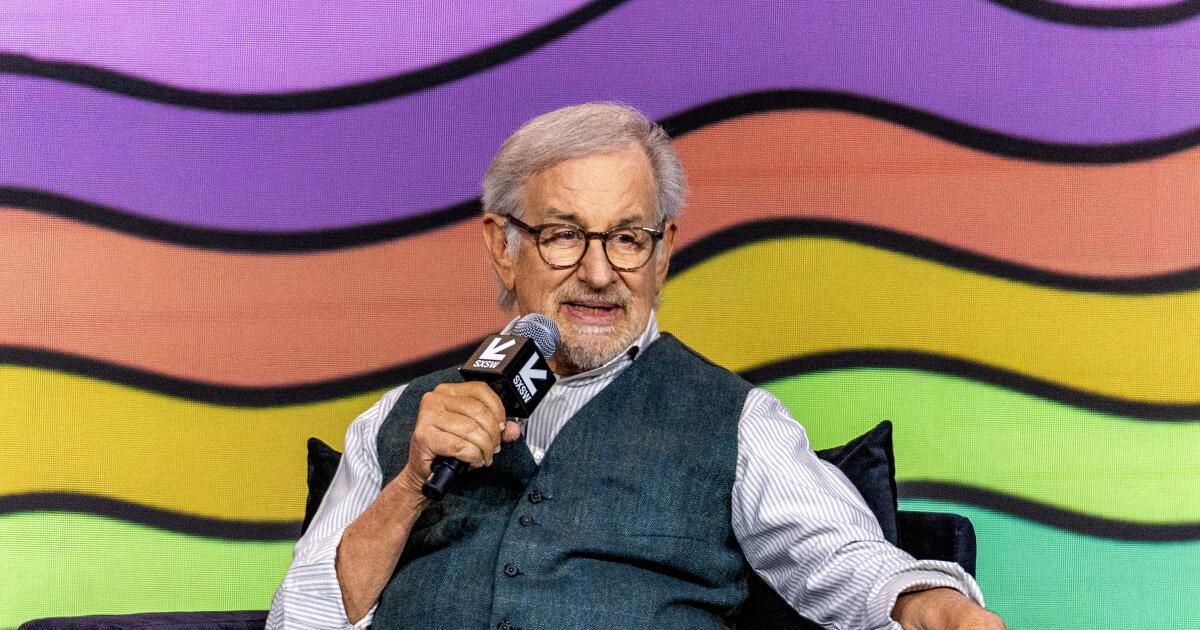
AUSTIN, Texas— One of the most anticipated events at this year's SXSW Film and Television Festival was not a movie at all, but an appearance by director Steven Spielberg. The talk, a live recording of “The Big Picture” podcast led by co-host Sean Fennessey, covered many aspects of the Hollywood legend's career, with a full line-up of sci-fi and aliens in conjunction with Spielberg's upcoming alien invasion thriller “Disclosure Day,” out June 12.
Although no real details about the new film were revealed, references to it peppered the conversation as if it were very much on Spielberg's mind: the film he was ostensibly there to promote.
For an audience that included filmmakers Robert Rodriguez and Daniel Kwan, the event began with a clip that served as a reminder (as if anyone in the packed hotel room needed one) of just how influential the 79-year-old filmmaker is. A selection of Spielberg's work acts as a preview of the very idea of films; This included “Jaws”, “Raiders of the Lost Ark”, “ET”, “Schindler's List”, “Jurassic Park”, “Sugarland Express”, “Catch Me If You Can”, “Munich” and many more.
Fennessey noted that Spielberg wanted to make 1977's “Close Encounters of the Third Kind,” his first science fiction film about the existence of aliens from other worlds, even before making 1975's “Jaws.” Spielberg went further and said he had actually wanted to make “Close Encounters” (then simply known as “The UFO Movie”) even before 1974's “Sugarland Express.”
When asked about President Obama's recent comments about the possible existence of intelligent life elsewhere in the universe and how his own feelings may have evolved over the years, Spielberg said, “I think on the one hand, when President Obama made that comment, I thought, 'Oh my gosh, this is great for 'Disclosure Day,'” and then two days later he took a step back from the comment and said that what he believed in was life in the cosmos, which of course everyone The world should believe because no one should ever think that we are the only intelligent civilization. throughout the universe. So I have always believed, even as a child, that we were not alone. So the big question is: are we alone now?
He added that this interest was “reinvigorated” by a 2017 New York Times article about US Navy pilots who saw an unexplained aerial phenomenon, and then by a 2023 congressional subcommittee hearing on the topic.
“I don't know any more than any of you,” Spielberg said, “but I have a very strong, sticky suspicion that we're not alone here on Earth right now. And I made a movie about it.”
Spielberg and “The Big Picture” co-host Sean Fennessey recorded a live podcast at SXSW on Friday.
(Tibrina Hobson/Getty Images)
As for how he feels about that possibility, Spielberg added: “I'm not afraid of any aliens, neither there nor here. I'm not afraid of that, at all. I think our film takes into consideration, without giving too much away, the social dislocation that could occur, theologically, if it were announced that there is evidence, not just evidence, of interaction that has been going on for decades, that we're not finding out about now. It's going to cause a disruption in a lethal alteration at all.”
Among other topics discussed, Spielberg revealed that he is developing a Western that would be filmed in Texas, although he was reluctant to discuss it in more detail except to say that it “would contain no tropes.”
He also said he's not on any social media, but he installed Instagram on his phone once for two weeks and felt like he'd been abducted by aliens during the time he was missing.
To that end, he also noted, with comical frustration, that he himself has never had any kind of extraterrestrial encounter.
“I made a movie called ‘Close Encounters of the Third Kind.’ I haven’t even had a close encounter of the first or second kind,” Spielberg said. “Where's the justice in that? If you're listening, I'm talking to you.”
There was a brief moment of confusion when Fennessey asked Spielberg what he thought about AI, and Spielberg wasn't clear whether she was asking about his own 2001 film or the broader topic of artificial intelligence.
Once that was cleared up (Fennessey was referring to the latter, a serious labor issue in Hollywood), Spielberg noted that he had not used AI in any of his films. “I don't want to rant about AI because I'm for AI in many different disciplines. I'm not for AI if it replaces a creative individual.”
Speaking of the theatrical experience, Spielberg briefly alluded to the outburst surrounding Timothée Chalamet's comments about the popularity of opera and ballet in relation to cinema.
He noted that he doesn't discredit the at-home streaming experience and that he works with Netflix, but that “for me, the real experience comes when we can influence a community to come together in a strange, dark space. We are all strangers and, at the end of a really good movie experience, we are all united with a lot of feelings with which we walk into the light of day or into the night. And there is none of that. I mean, it happens in movies, it happens in concerts and it happens in ballet and opera.”
Here there was applause from the public. “And we want that to stay and last forever.”
Spielberg noted that many of his favorite filmmakers, including David Lean and Billy Wilder and more recent examples like Paul Thomas Anderson and Christopher Nolan, always make movies that feel different from what they've made before. He sees himself as part of that same school.
“If we just don't make the same sequel over and over again and it's not the same Marvel title over and over again, we all have a real opportunity to experience something, which is freshness,” Spielberg said. “And that's why I don't judge my achievements based on just one movie.”