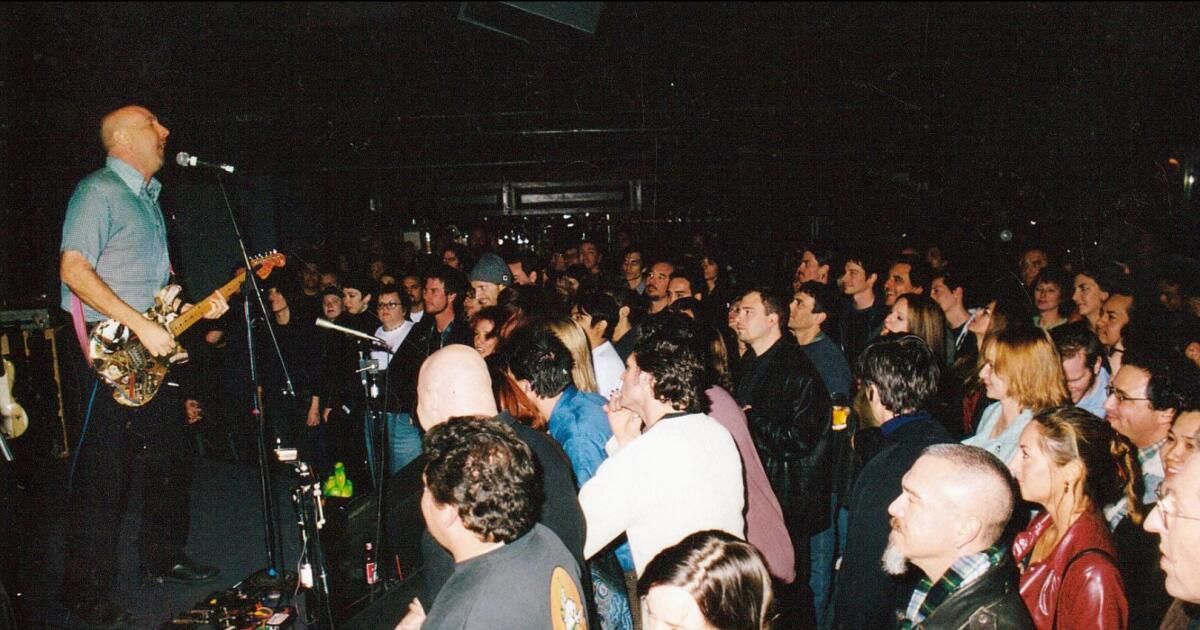
Silver Lake earned the nickname “hipster” long before Spaceland opened its doors. But when the club played its first show in March 1995 at the venue formerly known as Dreams of LA, it marked a notable shift in energy that made everyone take notice, establishing the neighborhood as a tastemaker and a hub for creative talent. The live music space was the right idea, in the right place, at the right time.
Atmospheric dive bars, funky/punky mom-and-pop shops, and reasonable rents began attracting artists, musicians, and bohemian slackers and set designers as residents in the early '90s. They joined its vibrant queer community and multigenerational (mostly Latino) family population, which combined to make it one of the best places to live in Los Angeles. It still is, although more expensive and pretentious, if you ask those who grew up there.
But 30 years ago things were different: the area was trendy, but it also felt naturally eccentric. The annual Sunset Junction Street Fair, which closed Sunset Boulevard between Fountain and Edgecliffe Drive beginning in the 1980s, began booking more traditional bands and trendy new groups, broadening the city's cultural awareness and attracting Angelenos from across the city to the area until it ceased in 2010.
Silver Lake's music mecca status was finally cemented when promoter Mitchell Frank decided to turn his weekly live music night at Dreams called Pan into a bona fide rock venue, taking what was bubbling on the streets, at parties in the hills and in nearby rehearsal spaces and providing a singular home for music creators to nurture and grow their followings.
Opening night marked a benefit for flamboyant noise rockers Lutefisk, who lived in the area and, like many there, rehearsed at Hully Gully on Fletcher Drive. After their equipment was stolen, they gathered a group of lively local artists to raise funds, including lead artist Beck, who got his start at the artsy coffee shop called Onyx next to the Vista Theatre, and later on Vermont Avenue in Los Feliz Village.
Rob Zabreckyn of Possom Dixon
(Arlen Hem)
Paired with the dark, melodic alternative rock of Possum Dixon as the opening act, the show was a hit. As luck would have it at the last minute, the night became even more monumental with the early addition of a show: the debut of Dave Grohl's new project called Foo Fighters.
“It was crazy. It was raining that night and both shows were sold out,” remembers Lutefisk drummer Brandon Jay. “It was that beautiful moment when KBLT started broadcasting and there was a growing scene in Silver Lake when everyone was saying, 'Oh, Silver Lake is the new Seattle,' only it was more diverse.”
Jay, who went on to play with other bands such as The 88 and Gwendolyn and the Good Time Gang, hopes to remind local music fans of the seminal scene in the Regent this Saturdaywhere Lutefisk reunites alongside Dixon's Rob Zabrecky (playing with several club luminaries) and Spaceland favorites Touchcandy, the Centimeters, Jon Wahl (Claw Hammer), Sissy Bar, WACO and more.
“This show is the closest thing to a real space night from the 90s,” says Frank. “Touchcandy, Lutefisk, Centimeters, Rob de Possum Dixon and Sissy Bar… this is the exact kind of beautiful symphonic chaos that defined the '90s era. Nights like this are what propelled a fractured Eastside music scene into a full-fledged scene.”
In fact, bringing together disparate genres, styles, and niches in one place was what made this scene unique. “There were so many wonderful, eclectic bands,” adds Jay. “A lot of them signed, but you know, fame is a fickle thing and you never know what might play on the radio.”
Many of those who played for the club did. In addition to Beck and the Foos, local artists who rose to prominence after playing there include Silversun Pickups (named after a nearby liquor store), Rilo Kiley and Airborne Toxic Event, while touring independent artists also earned their stripes in front of the mylar-curtained stage, namely White Stripes, Arcade Fire, Arctic Monkeys, Jet, Ween, Cold War Kids, Death Cab for Cutie, Amy Winehouse… the list goes on and on.
“There was a time when bands were coming through town on tour and playing Los Angeles for the first time and all their agents wanted them to play Spaceland's Monday residency,” former head of booking Jennifer Tefft recalls of the cover-less event, which became legendary in the early 2000s. “They played for free, but it allowed them to be seen. Everyone wanted to play there and not just locally, but internationally. NME in the UK was giving it so much press. to the club, that all these bands wanted to come to Los Angeles for it… Bloc Party, The Killers and My Morning Jacket made their debut at the club.”
Tefft booked the Bootleg Theatre, but then re-worked with the building's owner, Jeff Wolfram, to breathe new life into the Silver Lake space under the name Satellite. It closed due to the fight against the pandemic in March 2020 and remains closed. Meanwhile, Frank, along with booker Liz Garo, left the venue, which was still technically called Dreams, to focus on their new space, the Echo and its later addition, the Echoplex.
He sold the Echo Park complex, along with the Regent, to Live Nation in 2019, but remains involved in bookings and other club business. All three figures deserve credit for the cosmic alchemy and community spirit that made Spaceland and the world it created a game-changer. They really cared about the people who played there and often championed their favorites and helped build a following through promotion and advertising, specifically in the free print edition of LA Weekly.
“We all had the same kind of passion and curiosity for music and supporting local,” shares Garo, who booked at Spaceland when Tefft left, and really made a name for himself at the Echo. “I think that's why he maintained that integrity.”
There is no shortage of fond and slightly hazy memories in Spaceland. There were also plenty of pool games in their infamous upper level smoking room (which continued to operate even after smoking in bars was banned in 1998 due to a loophole).
Free Monday promotions were nothing new (Hollywood Lingerie Club had been doing them for years), but Spaceland's were magical for bands and fans alike because of the month-long residency model. In addition to being affordable and clearly well-organized, featuring up-and-coming artists and offering big-name surprises, it was a place to meet like-minded alternative types who liked the same fashion, art and pop culture references.
Most of the local musicians who played there seemed to know each other simply by spending so much time and those who proved themselves on stage were rewarded with new fans that grew every week.

The Centimeters perform in Spaceland
(The Wild Don Lewis)
“Jen had a really good formula: you did your residency, then you didn't do another show for about six weeks, and then you came back and did a ticketed show,” Garo explains. “Ideally, that worked and helped establish that bands could sell tickets. You know, when bands start, they play for their friends in the audience. When they get to that point where they don't know anyone in the audience, that's a big deal.”
Beyond the exposure and local notoriety, for Zabrecky, Jay and countless musicians who had residencies (many of whom will be seen for the first time in years at the Regent show) Spaceland was formative not only for their music but also for their life trajectories.
“Playing Spaceland with Possum Dixon was always unpredictable,” recalls Zabrecky, who became a revered magician and performer. “We never knew what direction a show would take. Each band was different, but they were all accepted and celebrated for who they were. Groups like Glue, Spindle, WACO and Abe Lincoln Story couldn't have been more different from each other, and that made each lineup exciting. And of course, we were all making them up as we went along, encouraged by the support of our peers.”
The transitional period between Spaceland and Satellite is marked by the band that helped put it on the map and inadvertently started the fervor to begin with. The Foo Fighters chose the venue for their series of surprise pop-up shows premiering new material in 2011, just before the venue was renamed.
The following year, Forbes called Silver Lake “America's hippest hipster neighborhood,” which meant it wasn't… that anymore. American Apparel stores had infiltrated, corporate coffee was everywhere, and artists were losing price, heading east toward Echo Park, Mt. Washington, Highland Park, and also downtown, with many of those regions' bars and clubs looking to capture the old Spaceland vibes. They still do it.

Brian Wilson on stage with the Wondermints at Spaceland
(Courtesy of Brandon Jay)
In this way, Spaceland's legacy has endured beyond Generation X's nostalgia for the good old days. Inspired by the fervent framework of musical discovery and social connection of the past, new bands now showcase their material at Echo, Regent, Zebulon, Redwood Bar and many more, eschewing Hollywood and the Sunset Strip in favor of more relaxed environments.
Frank continues to bring his experience to Live Nation; Garo is planning events and working with venues, from acoustic sets at his Stories bookstore in Echo Park to his just-announced concert booking for Grand Performances downtown; and Jay, who lost his home in the California wildfires, turned the tragedy into a beautiful music exchange program called Altadena Musicians. He's also involved in a new all-ages music venue called Backyard Party in Pasadena, and notes that a new generation of artistically minded musical rebels continues to thrive just as they did at Spaceland three decades ago.
Jay is also helping with the planning of the Regent show and called up David Willis from Touchcandy, who will be flying into the city from the UK just for the show. Beck and Grohl have also been notified (although no commitments have been made), and pirate radio station KBLT, whose documentary “40 Watts from Nowhere” features Jay and Jack Black as producers, will offer sets from their DJs among the live sounds.
The programming on the event flyer is meant to evoke the original '95 charity promotion, and represents the magnificent musical mix alone, harking back to an exciting era that Los Angeles music lovers who experienced it will never forget, a time when the scene was “young and free,” as Zabrecky recalls, and those lucky enough to be on the marquee played what he calls “the best club at the best time on Earth.”
“These bands were messy, loud, indie, real and somehow still innovative,” Frank adds of the 30th anniversary show, which is billed as a Vol. 1, hinting at more to come. “Programs like this are why all of this matters.”