Today it is an Italianate-style apartment building located between an Indian restaurant and a Target. But what stood half a century ago at 1454 5th Street in downtown Santa Monica was the Beach Boys' Brother Studio, a former porn theater turned recording complex where the preeminent American rock band of the 1960s tried to convince its resident genius, Brian Wilson, to return to the fold after a long period in the wilderness.
No one would consider the albums the Beach Boys made on Brother in the mid-'70s, including “15 Big Ones,” “The Beach Boys Love You” and the long-shelved “Adult/Child,” the band's most successful. (Well, no one except Wilson, who frequently cited the synth song “Love You” as his favorite.) A decade after 1966's “Pet Sounds,” which so shocked the Beatles that they had to respond with “Sgt. Pepper's Lonely Hearts Club Band,” the burly, bearded Beach Boys were far from the center of pop music; Wilson, in particular, had largely withdrawn from public life as he struggled with the effects of drugs and his fragile mental health.
However, Brother provided the stage for a creative reflowering, possibly the band's last moment of unity before the beginning of years of more serious infighting.
“It was like we all got back together and were the Beach Boys again,” says Al Jardine, who founded the group in suburban Hawthorne in 1961 with Wilson, Wilson's brothers Dennis and Carl, and the Wilsons' cousin Mike Love. Now, eight months after Brian Wilson's death in June at age 82, a new box set examines that era as an expressive outpouring led by the band's rejuvenated visionary.
“We Gotta Groove: The Brother Studio Years” compiles 73 tracks from 1976 and 1977, including outtakes, demos, a remastered version of the “Love You” LP, and the first official release of the widely bootlegged “Adult/Child,” which places Wilson's movingly emotional singing amidst orchestral arrangements in a brilliant big band style. Among the set's highlights are a voice-and-piano rendition of “Still I Dream of It,” which, legend has it, Wilson wrote in the hopes that Frank Sinatra would perform it, and a majestic version of “You've Lost That Lovin' Feeling” that shows just how brilliant Wilson remained as a record producer despite all the well-documented turmoil.
“Brian was recovering from his personal life and was ready to get back into the studio,” says Jardine, 83, whose final tour with members of Wilson's band will end Friday night at the United Theater on Broadway in Los Angeles for a full performance of “The Beach Boys Love You.” With quirky but heartfelt tunes about Wilson's daughter Carnie (“I Wanna Pick You Up”) and Johnny Carson (er, “Johnny Carson”), not to mention the propulsive “Honkin' Down the Highway,” which Jardine sang on, “Love You” has become something of a cult classic among Wilsonologists.
Says Jardine of the LP: “Brian's spirit, his soul as a songwriter, is really strong on that one.”
The Beach Boys opened Brother Studio around 1974, near the corner of 5th Street and Broadway, a few blocks from the beach. They had traveled to Holland to record their most recent album, “Holland”; Before that, they recorded several albums at Wilson's home on Bellagio Road in Bel-Air, although the group's former mastermind spent as much time upstairs in his room as recording music with his bandmates.
Wilson's retirement after the failure of his notoriously ambitious “Smile” project left room for the other Beach Boys to shape the band's music, as in the 1970s with the fondly remembered “Sunflower.” But the lack of success eventually took its toll: With a smile, Love, 84, says one of the reasons they founded Brother was because Wilson's wife, Marilyn, eventually “threw in the towel after years of having her house flooded with people” with less than spectacular results. “It was kind of a self-preservation thing,” he adds.
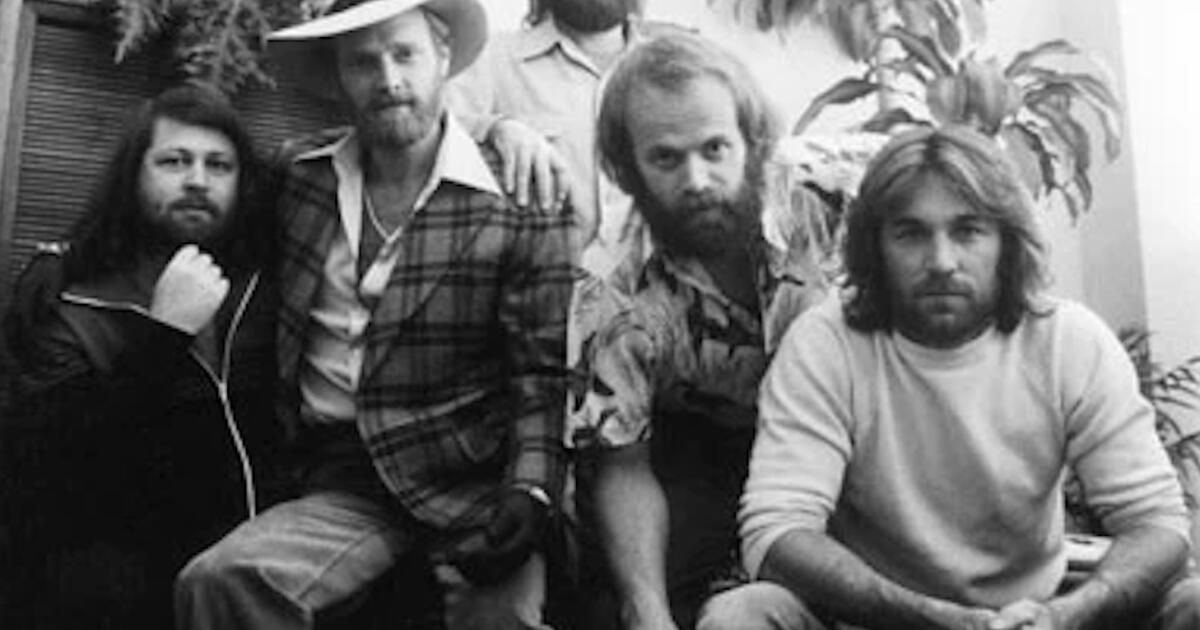
The Beach Boys backstage in New York's Central Park in 1977.
(Richard E. Aaron / Redferns)
In the liner notes to “We Gotta Groove,” engineer Stephen Moffitt, who designed Brother after previously working at Los Angeles' Village Recorders, remembers clearing “all the porn junk” from the building and installing a circular stained glass window to set the right mood. An old magazine ad boasts of the studio's high-end equipment, as well as its “big-screen video room” and “a game room with ping pong, pinball and pool.”
“It was a respite,” Love says. “A place to go and be creative.”
Just as the band was getting Brother up and running, the Beach Boys scored an unexpected hit with 1974's “Endless Summer,” a double-LP compilation of the group's early material – “Surfin' Safari,” “Don't Worry Baby,” “California Girls” – that topped the Billboard album chart on its way to sales of more than 3 million copies. A similar hits collection released in the United Kingdom, “20 Golden Greats,” fared just as well there. “A huge success,” says Love. “One in five families had it.”
Suddenly, having more or less ignored group efforts like “Holland” and “Carl and the Passions – 'So Tough',” the world remembered what it loved about the Beach Boys, and they were the songs written and produced by Brian Wilson.
The band got to work at Brother to record “15 Big Ones,” which featured a mix of Wilson originals and covers of older songs like “Chapel of Love” and “Blueberry Hill.” The first Beach Boys album since “Pet Sounds” to include a solo production credit for Wilson, it was accompanied by an aggressive marketing campaign known as “Brian Is Back!”; Wilson appeared on the cover of Rolling Stone – “The Healing of Brother Brian,” the cover read – and participated in a Beach Boys television special that featured his return to the Anaheim Stadium concert stage.
Earle Mankey, an engineer for Brother in the mid-'70s, says that “15 Big Ones” was not so much Wilson's attempt to reignite the flame as “everyone else's attempt to reignite the flame.” He remembers Wilson looking like a “scared rabbit” when he walked into the studio to find some of the session musicians who had worked with the Beach Boys in the old days. (This was the time of Wilson's first flirtation with psychologist Eugene Landy, who would re-enter Wilson's life amid much controversy in the early '80s.)

Fans watch the Beach Boys perform at Anaheim Stadium on July 3, 1976.
(Tony Korody/Sygma via Getty Images)
Even Love admits that “Brian's back!” It was a bit exaggerated. “Brian was back to a certain extent,” Love says now. “One hundred percent? Maybe not.”
The campaign worked, however: “15 Big Ones” peaked at No. 8 on the Billboard 200, the highest for a Beach Boys studio album in more than a decade, while the LP spawned the band’s first Top 5 single since “Good Vibrations” with a cover of Chuck Berry’s “Roll and Roll Music.”
More importantly, the commercial success prepared Wilson for a true artistic comeback with “The Beach Boys Love You,” which can still surprise you with the purity of its emotion and the strange textures of Wilson's production. Check out the beautifully twisted rhythm of “Mona,” which Dennis sings in a throaty stoner’s tone, or the lonely sound of electric guitar floating over the Wilson brothers’ harmonies on “The Night Was So Young”; listen to Brian and Marilyn exchanging marital assurances in their almost painfully innocent duet, “Let's Put Our Hearts Together.”
“Of all of Brian's material, I would say it's his most personal album after 'Pet Sounds,'” says Darian Sahanaja, who played with Wilson for the last two decades of his life. “Maybe even more so than ‘Pet Sounds,’ because Tony Asher wrote most of the lyrics to ‘Pet Sounds,’ and Brian wrote most of the lyrics to ‘Love You.’ The Brian I knew lives and breathes in these songs.”
Unlike “15 Big Ones,” “Love You” was not a hit and peaked at number 53, even lower than “Holland.” As much as he adores the album, Sahanaja finds it amusing that anyone in the Beach Boys group would have expected Wilson to try to give rock fans what they wanted.
“He wasn't listening to Top 40 at the time,” he says. “He just wrote what came out of him. There wasn't any 'I wonder what Fleetwood Mac is doing…'.”
In fact, Wilson went even further with “Adult/Child,” for which he commissioned orchestral arrangements from Dick Reynolds, who had worked in the '50s with Wilson's beloved Four Freshmen. Both Love and Jardine say they don't quite remember why the album didn't come out; Love says that “maybe it didn't suit the record company at the time” and notes that even “Pet Sounds” made the group's A&R rep wonder “if maybe we could do something more like 'I Get Around'.”
Whatever the case, the suspension of “Adult/Child's” led to another retirement for Wilson, who had much less to do with the band's subsequent albums and who eventually dedicated himself to a solo career. In 2012, Wilson produced a regular Beach Boys reunion album, minus Dennis, who died in 1983, and Carl, who died in 1998, but for much of the 2000s, he and Jardine toured under the name Wilson, while Love toured as the Beach Boys. (Love's band will play three shows at the Hollywood Bowl in July.)
When asked what it's been like performing with Wilson's band since his death, Jardine says, “I feel like he's still around.” Sahanaja says she has seen Jardine cry while working on songs from “Love You” on tour before Friday's show. But he's also been pleased to see the enthusiasm among younger fans for what he considers the Beach Boys' last great album.
“The reaction has been the craziest I've ever seen on any of the shows we've done with Brian,” he says. “It's like they feel like they found something secret that they really relate to.” He laughs. “I'm telling you, these kids are going crazy: they're jumping up and down, they're singing all the words. They're like jumping.”