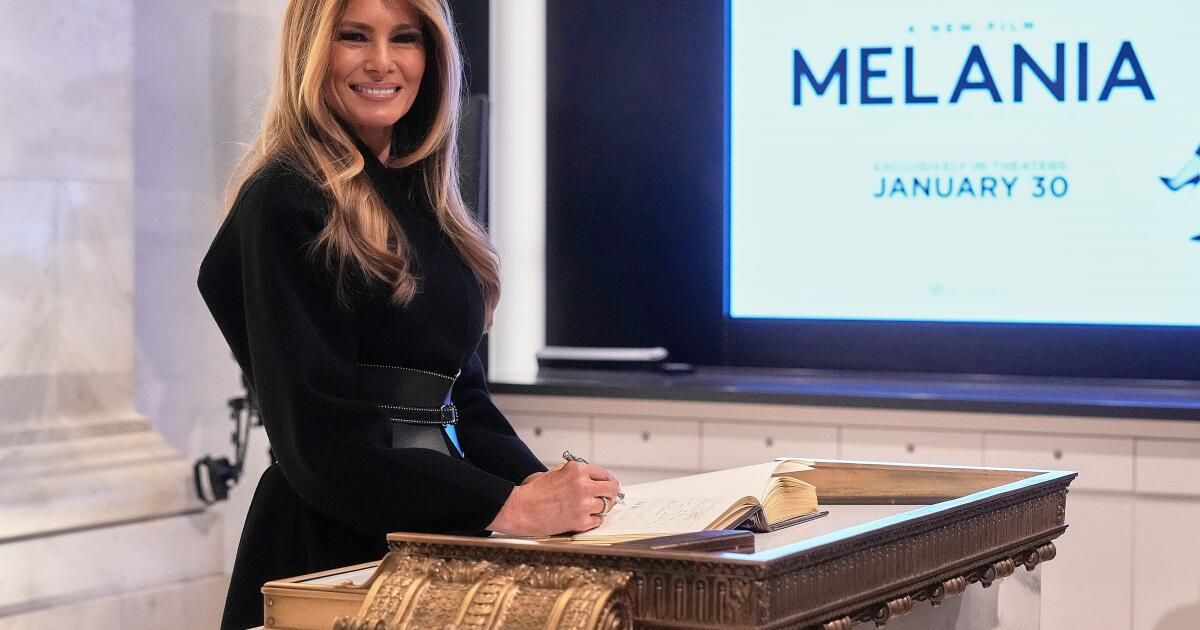
What is the difference between Brett Ratner and Leni Riefenstahl? Riefenstahl, for all her many sins, was technically innovative; Ratner (unless you count an almost fetishistic fascination with first lady footwear), not so much.
But in the end, both are political propagandists, collaborators if you will, of heads of state determined to create a narrative that, at best, is at odds with reality and, at worst, a selective attempt to distort it.
Am I saying that “Melania” is as terribly significant as “Triumph of the Will”? No, I'm not. But it's motivated by the same basic forces, and as fun as it is to watch Jeff Bezos lose most of the $75 million Amazon paid to purchase and then market the film, it's important to remember that.
As Melania Trump herself said at the film's premiere: “Some have called this a documentary. It is not. It is a creative experience that offers perspectives, ideas and moments.”
A “creative experience” for which the first lady, who serves as narrator and executive producer, would have received about 28 million dollars.
Money she doesn't earn much.
Anyone who goes into “Melania” hoping to get even a glimpse of what it's like to be first lady, or even Melania Trump, will instead find a super-long version of “we're still [fill in the blank] while they were preparing for the Oscars.”
Only in this case, it's Donald Trump's second inauguration, which Ratner (given his first big job since being accused by six women of sexual misconduct) frames as the Second Coming, from the lingering shots of the motorcade's graceful lines to the use of “His Truth Is Marching” from “Battle Hymn of the Republic” as the first couple takes the stage at one of the inaugural balls.
(And in case you think that's not servile enough, at the end of the inaugural festivities, Ratner, off-camera, says, “sweet dreams, Mr. President,” which honestly could have been the title of this movie.)
Most of the “action” involves the first lady making entrances: from private planes, big black cars, and well-appointed rooms. There, Trump and his designers gush over a dress designed to disguise any seams, admire an inaugural dinner menu that begins with caviar in a large golden egg, and discuss the furniture that will be moved as soon as the Bidens move in.
These numbing glories are interrupted long enough for Tham Kannalikham, an interior designer in charge of the White House transition, to talk about how her family immigrated to the United States from Laos when she was two years old: The opportunity to work in the White House is, for her, the ultimate American dream. At his side, Trump, also an immigrant, remains silent.
Other things happen. Trump has a video conference with French first lady Brigitte Macron to discuss initiatives to end cyberbullying, meets with Queen Rania of Jordan to discuss helping children in foster care, and comforts former Hamas hostage Aviva Siegel. Siegel, whose husband, at the time of filming, was still a hostage, provides the film's only truly emotional moment, despite clearly being included as an opportunity for Trump to reveal some personal kindness (and some political messages).
We follow Trump as she and her husband attend Jimmy Carter's funeral, during which her narration describes the pain of her mother's death the previous year, and as she “puts” the cameras into a room where her husband is rehearsing his inaugural address.
There she suggests, with a completely straight face, that he add the word “unifier” to “peacemaker” in his description of what he hopes his legacy will be, a term he then uses in his speech the next day.
Through it all, the first lady remains relentlessly poised and personally unavailable, giving new, literal meaning to the term “sculptural.”
Given the nature of the film's subject matter, and the fact that she's literally the one calling the shots, no one with half a brain could expect to see interesting or authentic “behind the scenes” moments (Melania wearing sweatshirts or counting breakfast almonds or, I don't know, sneezing). A brief scene in which the surprisingly deaf Ratner tries to get her to sing his favorite song, Michael Jackson's “Billie Jean,” elicits (finally!) a genuine laugh from her, and while his decision to repeatedly approach her admittedly well-shod feet becomes increasingly creepy, it at least offers potential for a drinking game.
Still, “Melania” is the most cynical piece of cinema that has existed since the art form began.
Listening to her describe the seriousness with which she takes her duties; his love, as an immigrant, for this great nation; and his dedication to improving the lives of all Americans, especially children and families, I was reminded of the climactic scene of “A Wrinkle in Time,” when young Charles Wallace becomes trapped in the reassuring rhetoric of IT's evil brainwashing.
The superficial softness of “Melania” is not boring; It's calculated, infuriating and horrifying.
The first lady describes an alternate universe of peace, love and unity as her husband has unleashed armed Immigration and Customs Enforcement agents to terrorize and detain children and adults (many of whom are citizens or here legally in this country) and, in at least two cases, kill American citizens who protest his actions. She wants to help children and families while her husband cuts federal aid programs and holds school funding hostage. She would have us believe that she is fighting cyberbullies, while her husband, the President of the United States, regularly engages in lies, direct threats, and defamation on social media.
President Trump is many things, but he is not a unifier: he believes, as he has assured us time and time again, that in victoriousand, as he has also said and demonstrated, he will always choose retribution over reconciliation.
Melania Trump, of course, is not her husband. But this film is little more than a 90-minute campaign ad. Which, given the fact that Trump cannot legally run for president again, should be a cause for great concern.
Many criticized the decision to release “Melania” just days after federal agents killed Alex Pretti and Renee Good in Minneapolis, and they criticized those notables, including Apple CEO Tim Cook, who decided to attend an early celebratory screening that included “let them eat” cookies with “Melania” scrawled in the icing.
However, for the kind of person who makes, buys and distributes a film that claims to be a “documentary” and is actually nothing more than old-fashioned propaganda, through the looking glass, it's actually perfect timing.
Why worry about the federal government killing its own citizens when we can all ooh and aah over the fact that the first lady's inaugural dress is made so that none of the seams show? Especially if it makes your husband happy.