“How to Make a Killing” features such a strong opening that it gains enough goodwill from the audience to carry it through almost its entire running time. That's priceless in a wacky murder movie where everyone's soul is for sale.
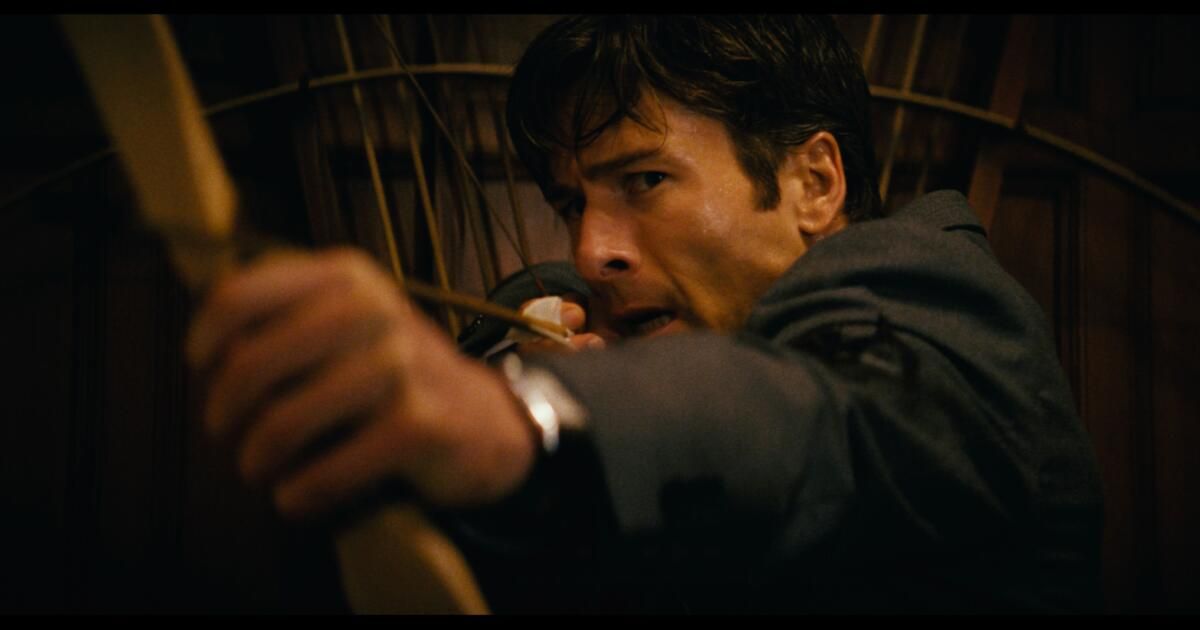
Death row inmate Becket Redfellow (Glen Powell) is four hours away from execution. A priest (Sean C. Michael) solemnly arrives to take his final confession and finds the condemned man resting with a sleeping mask, complaining that his last meal served him the wrong flavor of cheesecake. “Kill me now,” Becket jokes.
This will be a story of crime and punishment told in flashback, going back to Becket's mother, an heiress stripped of an eleven-figure fortune for having given birth when she was an unmarried teenager. And it will be, as Becket insists, “a tragedy.”
But while the story's framework is familiar, what gives this introductory sequence its speed is Powell's sly indifference, the little bounce he makes on his cot when Becket turns to give the astonished priest his full attention. He has ours too. Powell has yet to find his perfect role (this one's close), but his confidence is why the industry is convinced he's the reincarnation of a classic leading man: Tom Cruise or Cary Grant if we're lucky, or at least Bugs Bunny.
Writer-director John Patton Ford's morally bleak comedy is itself a reincarnation of the 1949 British caper “Kind Hearts and Coronets,” which incited an exiled father as he exacts revenge on his royal family by murdering everyone who stood between him and the dukedom. The 21st-century American privilege that Becket pursues in the remake is not based on formal titles. He wants cold hard cash, plus a couple of private islands, ultra-luxury planes and yachts. Plus, he already has a name that sounds like a surname, which means the American upper class.
This Dickensian montage of revenge gives us an enormous number of people to murder, all caricatures of the elite. The original “Coronets” attacked a posh feminist who scattered political leaflets all over London from a hot air balloon, Ford turns that old joke into a gag where Becket's spoiled cousin (Raff Law) flies overhead in a helicopter spraying money over a pool party and then, for good measure, shoots cannonballs into the water to stuff banknotes into the open, grateful mouths of the crowd. (For his next stunt, maybe Ford will remake Terry Southern's outlandish satire “The Magic Christian,” which has a scene like that but five times dirtier.)
Tradition has it that when Alec Guinness received the script for “Coronets” with an offer to play four of the hapless tycoons, he responded eagerly and said, “Why not eight?” For our good luck, Guinness did Play eights, even suffragette. “How to Make a Killing” shares the wealth, offering cameos to a very funny Zach Woods as the scion who fancies himself a hipster artist (he takes photos of the evicted) and Topher Grace as the Redfellow who found faith or, rather, a more prudish spin on the scam as a megachurch pastor. Comparing himself to Jesus, bleach-blond Grace snorts, “Don't hate me just because my dad is important.”
There's a hint of real-world criticism in how the preacher has decorated his office with framed photographs of himself with various presidents and drug dealers, alluding to the inescapable suspicion that the world is ruled by a powerful club whose only requirement for admission is a bank balance with a lot of zeros. The comments stop at allusions: they are entertaining but as thin as a communion wafer. Still, I laughed out loud when Becket returned to his current cell to mock his audience, the Catholic priest: “The last thing the Church wanted was an investigation,” he says with a smile. “I'm sure you know all about that.”
Like his title character, Ford himself had to rise in clout to direct this script, which he pitched to the Black List in 2014. Instead, he made his debut with the much smaller 2022 independent film, “Emily the Criminal,” starring Aubrey Plaza as an art student desperate to pay off her student loans. His heart goes out to the fighters who discover that our K-shaped economy makes it impossible to go in a straight line.
However, he has not clarified whether the corpses in “How to Kill” are victims themselves. The rich Redfellows are dispatched one by one in scenes that are fun but empty, neither cathartic nor comic, just boxes that need to be checked with big hits of thunder and harpsichords.
Surely, I thought, the movie will find out how it feels when it shows a Redfellow who is just ordinary-terrible: Bill Camp's cowardly, drunken banker. But that's not the case and the real victim of indecision is Powell, who is rarely given a reaction to play. (Guilt? Anger? Joy?) He needs to give us an extra clue as to how he feels: As an actor, Powell is so skilled that even his usual smile seems fake. I'd say he couldn't be sincere if he tried, except that Powell actually tries in one scene and the numb, terrified look in his eyes is devastating.
While the promise of that successful opening sequence is left a bit unfulfilled, “Killing” has two strong twists and plenty of reasons to enjoy the game. I suspect the film might be too clever for its own good, or perhaps surrounded by a cynicism that, everywhere we look lately, crime seems to does pay. As Becket says from the beginning: “We're all adults here.” Ford sees all the wrong moves and isn't sure he chooses the right one, although I think he does. Today's crowd wants to smash Marie Antoinette's cake and eat it too.
At least along the way, there's a fun love triangle between Julia (Margaret Qualley), the privileged nightmare who's had Becket around her pinky finger since grade school, and Ruth (Jessica Henwick), a lowly schoolteacher. Both characters play up their polarized corners (the rich bitch versus the girlfriend), and Qualley somehow always arranges her legs so they're seductively horizontal in her few scenes. Henwick has the most prosaic role and dialogue (“It's scary to dream small,” he says). However, her presence is so compelling that we root for Ruth every time she appears on screen.
I'm glad Ford is part of today's guillotine team cavorting about economic inequality. But the film's best shot shows his promise as a romantic comedy: Becket and Ruth meet in the rain and just as they make eye contact, the sun rises and they share a smile. It's a small moment of magic that gives you hope that these young lovers can work it out. Better yet, it even gives you hope for humanity, even if the film's overall forecast for society is stormy.
'How to kill'
Classified: Rated R, for language and some violent/gory images.
Execution time: 1 hour, 45 minutes
Playing: In wide release on Friday, February 20.