The next article contains spoilers Episode 7, “1:00 pm”, of “The Pitt” Season 2.
Education begins almost immediately. A young woman who has just suffered a sexual assault is undergoing treatment, and “The Pitt’s” Dr. Robby (Noah Wyle) recruits Dr. Al-Hashimi (Sepideh Moafi) to help charge nurse Dana Evans (Katherine LaNasa) with the patient.
“We can call a SANE,” another nurse suggests when Dana says she'll be busy.
“On a holiday? It could be hours,” responds Dana, a veteran who knows better, as the Fourth of July shift slips into the afternoon hours. “We're not going to keep this patient waiting. And since I'm the only SANE one on staff…”
A what? The quick reference sets in motion what “The Pitt” aims to shed light on: a sexual assault forensic examination, also known as a rape kit examination. The episode delves into the confidential medical procedure for collecting DNA and evidence and offers one of the most detailed descriptions of the process for television.
But before the cameras venture into the room with the patient, Dana gives recent nursing school graduate Emma (Laëtitia Hollard) and the audience an overview. A SANE is a sexual assault nurse; They carry out forensic examinations, collect evidence and hand it over to the police, if a report is made. They also provide resources, support, and can even testify in court.
The story serves a dual purpose, according to Kirsten Pierre-Geyfman, who co-wrote the episode with the show's creator, R. Scott Gemmill. “We wanted to highlight the important and incredible work of SANE, especially at the department level,” he says. “And we also wanted to see the bravery it takes for a survivor to come forward, let alone make a rape kit… It's not an easy decision for someone to make, and it's not an easy process for someone to follow.”
To help construct a realistic and sensitive depiction of the screening process, “The Pitt” writing team and actors worked with several consultants, including the UCLA Health Rape Treatment Center and Pittsburgh Action Against Rape (PAAR).
“I wanted people to understand the scope of the exam, I think that's a misconception among a lot of people,” said Dr. Kathleen Sekula, SANE at Duquesne University in Pittsburgh, who also consulted with the program team.
Ilana (Tina Ivlev) arrives at the emergency room in episode 7 of “The Pitt.”
(HBO)
The case in episode 7, “1:00 pm,” involves a visibly shaken young woman, Ilana, played by Tina Ivlev. The writing team knew they wanted to detail the process, not the trauma, Pierre-Geyfman said, so information about what Ilana experienced is minimal: She was at a barbecue with friends when she was attacked by a friend.
“What caught my attention was the fact that the other shows could focus on what happened and then dive into that,” Ivlev said. “What I loved about this is that the moment she starts talking about it, they cut off.” [away]. There is a lot underneath this. I wanted it to be similar to real life when a traumatic situation happens: sometimes you can be hyper-focused on certain details and then other things become murky. His head is spinning. “He's in shock.”
As with many of the cases on “The Pitt,” the story serves to reinforce the emotional arc of the show's healthcare providers, in this case Dana, who helps with the exam from start to finish as the department's certified SANE nurse. Last season, she was brutally punched in the face by a disgruntled patient while taking a smoke break. That violent attack left her nervous and contemplating leaving work, but after taking a few weeks off, she finally returned to work, although the lingering impact of the assault has sharpened her limits.
“With Dana's arc and her own offense last season, she's definitely a little calcified this season,” Pierre-Geyfman said. “She's trying to create a little bit of distance between herself and her patients, and she's really trying to prioritize her nurse's safety. You see she struggles with that a little bit with this patient. She wants to do more for her.”
On screen, the evaluation begins with Dr. Al-Hashimi checking to see if Ilana has any injuries that need immediate attention and taking prescribed medications and any known drug allergies. Securing two triage rooms to complete the exam as a way to ensure privacy in the busy emergency department, Dana, with the help of Emma, begins evidence collection while carefully describing the process to Ilana. For starters, once Dana opens the kit, Ilana can't leave the room, but she can take a break as needed.
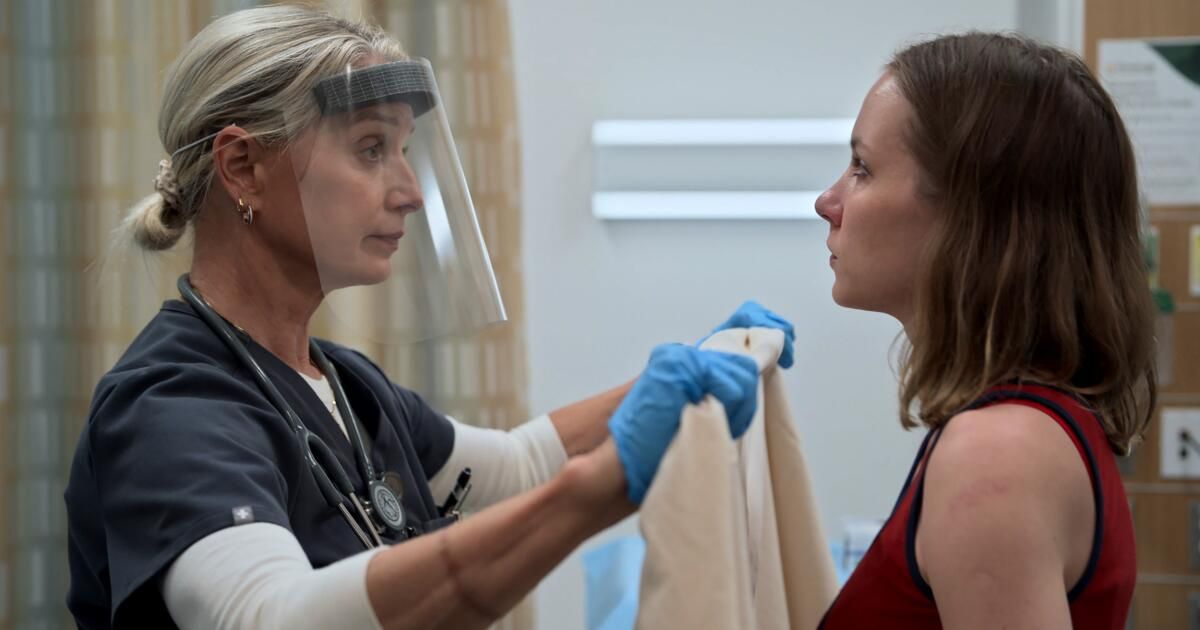
To prevent contamination, Dana puts on a face shield and opens the kit, which is a rectangle-shaped box containing items such as paper bags for storing evidence and swabs for collecting biological samples. The first step requires Ilana to put on a robe and undress on pads placed on the floor so that each item of clothing can be packaged into separate bags and collected as evidence. They'll give him new clothes, Dana assures him. Dana holds up a large piece of cloth to give Ilana privacy while she completes the process.
Finally, Dr. Al-Hashimi returns to examine Ilana, checking to see if there is any pain in her body or if she needs x-rays or imaging; notice two areas of bruising that Dana will document with photographs. Dana seals the camera's memory card in an evidence envelope. Then, with the lights off, Dana shines a black light over Ilana's body. Dana says that if there is a part of Ilana's skin that is shiny, she will clean it with a damp cotton swab and then dry it. Next, Dana takes a swab from Ilana's mouth (the inside of her cheek and along the gum line) and her nails. At several points, Dana is careful to gauge Ilana's comfort with each step, using statements like “This will not define you,” as Ilana shows signs of stress over the length of the process.

Emma (Laëtitia Hollard) helps Dana (Katherine LaNasa), who runs the exam as SANE (sexual assault nurse) on duty.
(HBO)
At one point, an advocate from Pittsburgh Action Against Rape, also known as PAAR, arrives to further detail the resources and assistance they can offer, a service that is available regardless of whether a patient chooses not to complete the rape kit exam. Throughout the process, Ilana is assured that she can complete the exam even if she doubts whether to file a police report; that decision can be made later and none of it is included in your permanent medical record. But when the exam moves on to external and internal vaginal collection, Ilana panics when she's told to put her feet in stirrups to get into position. Dana suggests a break.
“I don't want a break, I want to stop,” Ilana proclaims. “He's my friend. He knows all my friends. It was just stupid: he was drunk. He didn't mean… it didn't mean anything.”
This brings a pause to the process, which will continue until Episode 8. In trying to show the scope of the exam, the medical drama takes liberties in its completion time. Sekula said it is rare for an exam to be completed in less than three or four hours.
Not all nurses are SANE certified and certification requirements vary by state, according to Sekula. It is a role that requires extreme attention to detail and thoroughness, as your work bridges the legal and health systems. While preparing for the episode, Hollard said he marveled at the precise protocols involved and the support provided.
“On a technical level, he's very meticulous,” Hollard said. “There are so many parts, so many envelopes. You have to take these swabs and they can't touch each other. And the legality of all this: the way this kit is made is like they would do it with PAAR in Pittsburgh, but it's not the same way they do it in California, or [the way] They do it in different states.”
While “The Pitt” is often recognized for its hyper-realistic medical procedures, the episode's director, Uta Briesewitz, knew she wanted to film the exam in a way that reflected the sensitivity that healthcare professionals strive to exhibit, with shots that weren't invasive or fixed on Ilana's body. For example, when Ilana is undressing, the camera is fixed on Dana, being conscious of giving her privacy even when they are very close; an out-of-focus glimpse of Ilana's bare bottom comes only as a reaction is elicited from Emma taking in the weight of the moment. Later, as the blue light sweeps over Ilana's body, she carefully puts on her hospital gown to avoid exposure. In addition to a SANE consultant who was on set to help with questions about the process, there was also an intimacy coordinator to help with the comfort level when filming the scenes.

“On a technical level, it's very meticulous,” Laëtitia Hollard said of the process. “There are so many parts, so many envelopes. You have to take these swabs and they can't touch each other.”
(HBO)
“It was a very delicate line because women can be re-traumatized,” Briesewitz said. “I remember one of our most detailed conversations with our SANE nurse was about when Dana had to look for bodily fluids with the black light. How do we make sure nothing is missed and at the same time give the victim the feeling that they are still protected? It was very helpful to have our SANE consultant on set to tell her how she would do it. 'One arm comes out of the sleeve, then I lift her gown like this and I would do it like this…'”
LaNasa considered her time at the UCLA Rape Treatment Center crucial in recording both her character's ease in the room and her sensitivity to the task at hand: “I came back a second time because I knew I was going to have to use the kit…I wanted it to look like I had used the kit many times and knew what I was doing.”
Reflecting on the case as a mirror of her character's journey, LaNasa noted that Dana never pressed charges against Doug Driscoll, the man who assaulted her.
“It's different in this situation,” LaNasa acknowledged. “I thought that was a great piece of information that we got out of this, which is that you can go and make a rape kit, you can collect the evidence, and you don't have to decide that day when you're traumatized whether you want to press charges or not. I think part of Dana's hypervigilance is probably because there was no justice for her. I think the reason she's broken this season is because she didn't take care of herself. She's recovering from that. She let him hit her. At the same time, no. “She wants Tina's character to feel no pressure, but I think she wants it for herself, she wants her to have the ability to change her mind later.”
“We're going to hear Dana, later in the season, refer to this process that these people have to go through, in defense of a sexual assault victim,” LaNasa joked. “It's something he's very aware of. He's been doing it for quite some time.”