HBO's new dark comedy, “DTF St. Louis,” chronicles a deadly suburban love triangle between middle-aged adults hoping to spice up their sex lives through a hookup app (hence the series title), or with their spouse's best friend.
It was inspired by a real scandal covered in the 2017 New Yorker article “My Dentist's Murder Trial: Adultery, False Identities, and Lethal Sedation…”, but its connection to real, common crime plots and plans ends there.
The seven-part limited series, which aired its second episode on Sunday, subverts expectations at every turn, from its quirky characters to writer, showrunner and director Steven Conrad's layered storytelling and nuanced performances from an enviable cast.
David Harbor (“Stranger Things”) plays serious ASL interpreter Floyd, a once handsome but now portly guy who suffers from Peyronie's disease, a condition that results in a bent penis, after a mysterious accident. Putting his heart and soul into his work, Floyd infuses hip-hop dance moves into his signing sessions to better serve deaf and hard of hearing audiences (he learned the moves in his son's dance class). Nothing, anywhere, beats Harbour's stage-side interpretive dance at a pop concert.
Jason Bateman (“Ozark”) plays WTGK weatherman Clark Forrest, who strikes up an unlikely friendship with Floyd. The bespectacled local celebrity seemingly has it all together: riding his recumbent bike to and from work every day, drinking healthy green juices, and playing board games with his family on the weekends. But look again.
Linda Cardellini (“Dead to Me”) plays Carol, Floyd’s pragmatic wife. He has big dreams, like being able to pay the mortgage. and sends his troubled son Richard (Arlan Ruf) to a private school. But that won't happen with her salary as an accounting clerk at Purina, much less with Floyd's meager earnings. When Carol and Clark meet at a cornhole party, she discovers that Clark could be her ticket out.
Executive producer Harbor began development on the series in 2022 with Pedro Pascal (also attached as star and executive producer), but two years later it was announced that Pascal was no longer involved in the project and that the creative direction had evolved beyond the New Yorker article that inspired the series. “DTF St. Louis” also features Peter Sarsgaard as an unlikely encounter, Richard Jenkins as a seasoned detective and Joy Sunday as the young crime officer he would like to ignore, but can't.
Harbour, Bateman and Cardellini talked about how the series turns common true crime themes like sex, love and murder into a smart, funny and empathetic crime novel. This conversation has been edited for length and clarity.
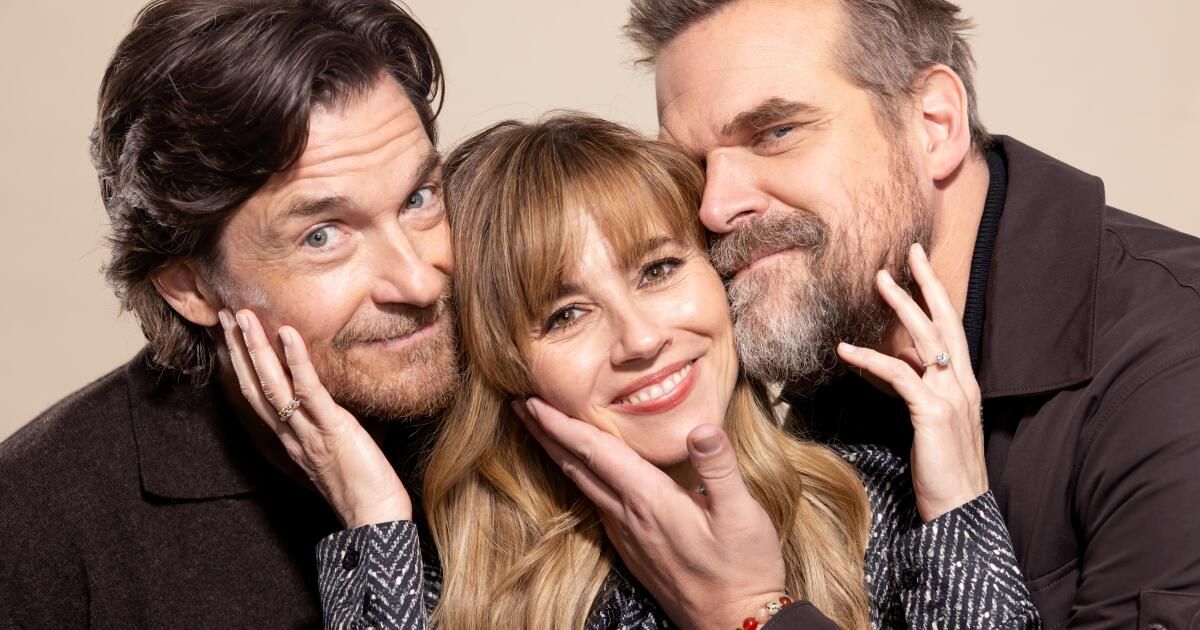
Jason Bateman, Linda Cardellini and David Harbor in a scene from HBO's “DTF St. Louis.”
(Tina Rowden/HBO)
“DTF” means something I can't print here. How much fun did you have sending important work emails back and forth with that acronym in the subject line?
Cardellini: Very fun.
Port: It's a provocative title… but Floyd [is so earnest] which has a line later in the series where it says: “DTF. That 'F' doesn't have to mean f. It can mean 'Feeling good together.'” [Laughs]
bateman: You look at the title and you think it's going to be something lewd, something exciting. People want to flirt, they misbehave, they try to get their way. Then it turns out to be the opposite: it's not sexy, it's actually awkward to watch the hookup scenes because they're so awkward. But they are charming and maybe even funny. Everything is so raw and human in this.
Particularly the character of Floyd. He could be described as a lovable loser, but he is much more than that. What was it like finding nuance in a character who, on many other shows, would probably be a goofy sidekick or a punchline?
Port: I don't know if I've had a better character to play in my career. I've played extraordinary characters, but there's something about this guy that's very vulnerable. He has a very open heart, funny and tragic at the same time. There are moments that define the character and make him an absolutely unique soul. I adored it from the moment I read that first scene, which you see in the pilot, with me and my [step]son [at a therapy session].

“He has a very open heart, funny and tragic at the same time,” David Harbor says of Floyd, who is at the center of “DTF St. Louis.”
(Christina House / Los Angeles Times)
The romance between Clark and Carol required some pretty ridiculous, kinky, and specific acts in a hotel room. he wants to play a role–play as a sex robot, for example. Then a pool boy. Was it helpful to have an intimacy coordinator?
Cardellini: I found it really useful. Jason, I've said that big sex scenes haven't really been a big part of our careers. So now I'm 50 and I do maybe the most sexual thing I've ever done in my life. But once we did that first scene, I freed myself. Like, okay, here I am. This is me. This is my body. It was a new kind of freedom that, having been in this business for many decades, was fun to find. And in the show, they're trying to find this. [sexual] freedom at a certain age. Things you didn't explore before and you think, what if I do that now?
bateman: Often in a sex scene, they just turn on the camera and say, “Okay, guys, kiss and get passionate.” It's very embarrassing. But this was different. Steven was very descriptive about the shot or angle I needed. The acts they attempt to perform are very specific. [They’re] It's even described by my character: “I'm going to want you to do this.” It was all very clinical, so there was never the apprehension of freestyle, the camera will just watch and the director will say, “That was really cool when you did this and that. Let's do another one.” That gets weird.
Cardellini: Every time we did it, something funny would happen that immediately relaxes you, as a human being. The robot, shouting “power!”, or whatever.
Can we talk about Floyd's most fluid dance moves? He buys a hip series–hop dance lessons for your child. But his son doesn't want to go, and so he does. The movements are inspired, even with the prosthetic belly you wear.
Port: Directors have defined me as a fairly physical actor throughout my career, but I have always considered myself an intellectual. I went to a fancy college. I used to read a lot of books before the Internet came along. on this [series]I really focused on the physical. [Floyd] He wanted to bring something special to this ASL performance that he does, and there is something about what he does with his hands that functions as intimacy for him in his work. And on top of that, having this appetite where you're clearly eating all the time, burying your feelings in that, you're very connected and then disconnected from your body. It was fun to let loose, with a fat prosthetic belly, have a good time and dance.


As Floyd, David Harbor gets to show off his dance moves in the series: “It was fun to let loose, with a fat prosthetic belly, have a good time and dance.” (Tina Rowden/HBO)
There are many intriguing, slow-moving revelations in “DTF St. Louis,” making it an incredibly fascinating crime novel.
bateman: David's character dies early, so you know it's going to be a murder mystery. There will be crime and danger, but there won't be any because it's really not that tragic in the lives of these characters. Like no one really cries and it's not annoying. [The show] He subverts the genre every time he approaches it. If you think it's going to be sexy, comedic, or dangerous, go in a different direction. It's exciting, as a performer and then as a viewer, to be constantly off balance.
Cardellini: There are many mysteries, like the story of what happened to Floyd with the Peyronies. [disease]. There are smaller mysteries, bigger mysteries, and they are all tied together so well that it becomes like a tapestry. And in the end that is really rewarding.
bateman: It's also really compelling to see the characters throw themselves into something they're not prepared for but think they can handle. Often what we see in these true crime documentaries is that people bite off a bigger piece than they can really handle and they get caught. There's a kind of vicarious pleasure in watching someone do something that you, as a viewer, think, “I'm too smart to do that.”

“There are smaller mysteries and bigger mysteries, and they're all tied together so well that it becomes a tapestry,” says Linda Cardellini. “And in the end, that's really rewarding.”
(Christina House / Los Angeles Times)
These characters are supposed to be very disconnected from each other. Is it more difficult to create chemistry as actors when the characters' Are your own emotions or bonds so buried?
Port: For me it's a lot easier to create chemistry when you have multiple layers like that. I used to do soap operas. I was in “As the World Turns” when I was a kid. It wasn't a big role, but it was recurring, so I was in it a lot. And occasionally you had a scene where it ended with you, having to look away. [flashes an intense, thoughtful expression]. But you're actually doing that thing of thinking about whether you left the oven on or not. When a character is thin and only has a single intention, it's hard to look another person in the eye and stick with it, whereas when I have multiple things going on, I can always find and play different things at that moment. When you rest on a really good material, you can really live in it, rest in it and enjoy it.
You've all been in comedies and some darker dramas. How did that prepare you for this series?
bateman: What comedy gives you is the comfort of playing flawed people. There's nothing really funny about someone who has it all together, and that's helpful in this, because these people are No together.
A great example is when Clark initially flirts with Carol. He's so out of his depth that he comes up with this ridiculous lie that he's not just a meteorologist, but the owner of an underwater demolition company, and his nickname is tHe Bang Master.
bateman: I've played a lot of arrogant jerks who are funny because they're really not that arrogant deep down, but they know how to play with it. But I thought it would be really fun to see a guy disappear. Like he was freestyling correctly and it occurred to him underwater demolition? God. This guy has no idea about lying. As actors, we are professional liars. We know how to pretend we know what we're doing, and this guy has no skill at that. Clark would be the worst actor in the world. He just doesn't know how to be full of shit, so I loved that.
David, does any part of you relate to Floyd?
Port: The search for meaning in a certain moment in life, especially in his friendship with Clark, somehow unlocked a certain [part of] I who had been asleep. While filming, it was fun to make these discoveries where you think, oh, this exists in me. This desire for male friendship because it becomes more difficult as we get older. And like Floyd, I would like to further my career in hip-hop.