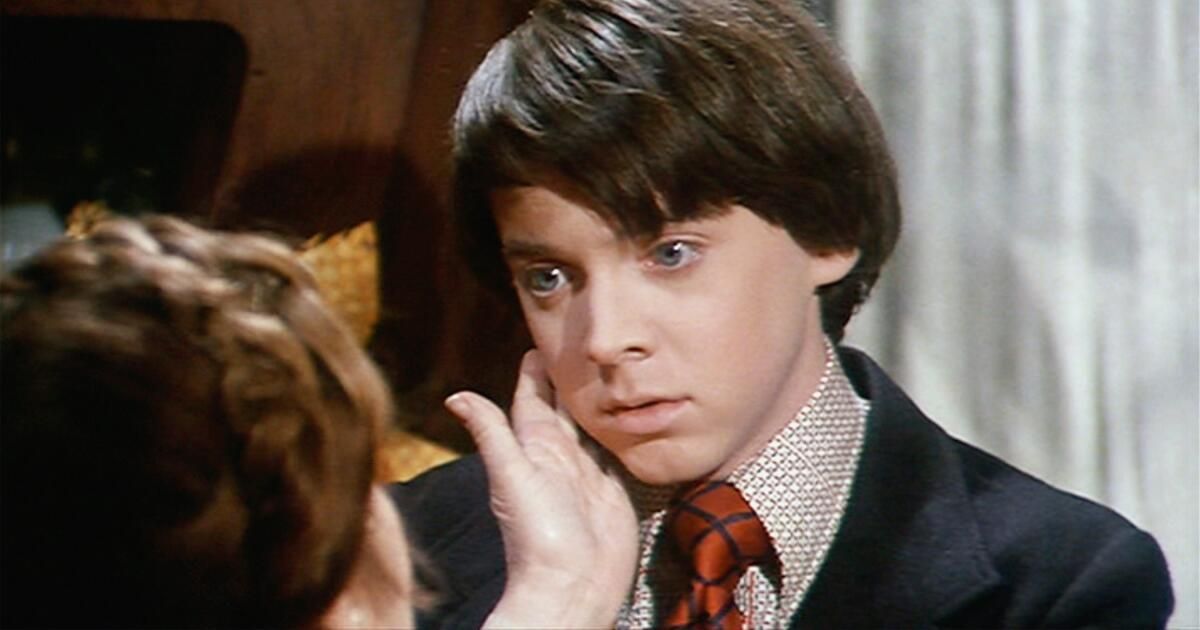
Bud Cort, whose portrayal of a troubled young man who finds unexpected love with a 79-year-old free spirit in “Harold and Maude” helped turn the 1971 film into an enduring cult classic, died Wednesday morning in Norwalk, Connecticut, after a long illness. He was 77 years old.
His death was confirmed by Cort's old friend Dorian Hannaway, who met the actor in 1978.
Born Walter Edward Cox on March 29, 1948 in Rye, New York, Cort adopted his professional name early in his career after falling in love with theater. After landing small roles in a few television series, he was discovered by director Robert Altman while performing in a nightclub comedy act and cast as Pvt. Boone in the director's hit 1970 anti-war satire “M*A*S*H.” That same year, Altman also gave him the lead role in his “Brewster McCloud,” an eccentric fable about a Houston loner determined to build a pair of wings and take flight.
Cort's breakthrough role came the following year in director Hal Ashby's “Harold and Maude.” As Harold Parker Chasen, a rich, death-obsessed young man obsessed with staging elaborate suicide drills, Cort brought a wounded, wide-eyed seriousness that gradually softened into wonder as his Harold falls in love with Maude, a feisty, life-affirming Holocaust survivor played by Ruth Gordon, then a recent Oscar winner for “Rosemary's Baby.” The film was not a huge hit upon its initial release, but slowly grew to become a midnight favorite and an international cult touchstone. Cort received Golden Globe and BAFTA nominations for his performance.
The role launched and complicated his career. “I was typecast to the point that I didn't make a movie for five years after 'Harold and Maude,'” Cort told The Times in 1996. “I only worked in theater where I wasn't typecast.”
The film, he said, “was a blessing and a curse. It closed a lot of doors in terms of my development as an actor, but on the other hand, it gave me the prestige to walk through a lot more doors than I would have been able to walk through if I hadn't.”
Cort resisted roles that leaned too much toward eccentricity, turning down a role, much to his later chagrin, in the 1975 Oscar-winning film “One Flew Over the Cuckoo's Nest.” “I should have done everything they offered me,” he said. “But I didn't want to be [a character type like] “Tony Perkins, Maynard Krebs or Peter Lorre.”
His career was further interrupted in 1979 when he was seriously injured in a car accident on the Hollywood Freeway, suffering fractures and severe facial injuries that required multiple plastic surgeries. The accident interrupted his work for years.
Cort later re-emerged as a distinctive supporting presence in film and television. He voiced a sentient computer in “Electric Dreams” (1984), appeared in Michael Mann’s “Heat” (1995) as an exploitative restaurant manager, and played a homeless man who reveals himself to be God in Kevin Smith’s “Dogma” (1999). He played art patron Howard Putzel in “Pollock” (2000) and was part of the cast of Wes Anderson’s “The Life Aquatic With Steve Zissou” (2004). In 1991, Cort directed, co-wrote (with former Times writer Paul Ciotti) and starred in “Ted & Venus,” a low-budget romance about a Venice Beach poet.
In television and animation, he voiced Toyman in several DC series and appeared in projects such as “And the Band Played On,” “Ugly Betty” and “Criminal Minds.”
Looking back on his life, Cort described acting less as a career choice than as an inevitability. “I don't know if I believe in past lives or not,” he told The Times. “I don't think so. But whatever my background was, I was an actor.”
He is survived by his brother Joseph Cox, sister-in-law Vickie and daughters, Meave, Brytnn and Jesse of Rye, New York; his sister Kerry Cox of Larchmont, New York; his sister and brother-in-law, Tracy Cox Berkman and Edward Berkman, and his sons, Daniel and Peter. He is also survived by his sister, Shelly Cox Dufour, his brother-in-law Robert Dufour and his nieces Madeline and Lucie.