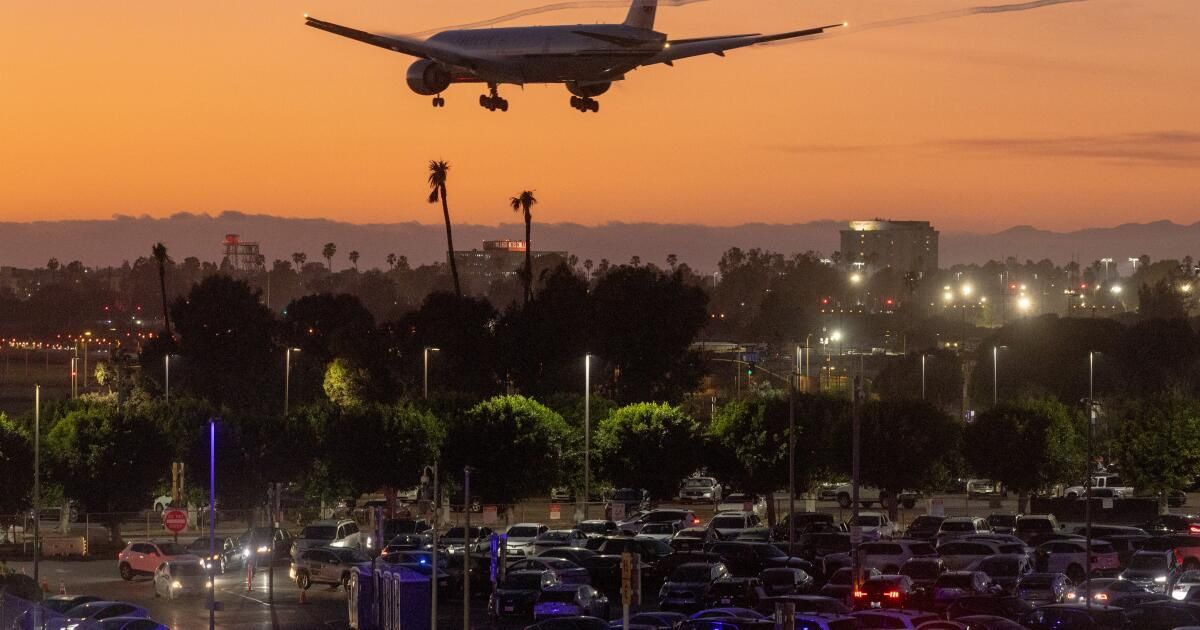
As the war in Iran chokes the flow of oil around the world, California's jet fuel reserves are running low.
The state, which refines much of its own fuel in El Segundo and elsewhere but still relies on crude oil imports, has seen its jet fuel stocks decline by more than 25% from last year's peak to a level not seen since 2023, according to data from the California Energy Commission.
Supply is shrinking as global shortages are already impacting travelers' summer plans with canceled flights and higher fares. It could even affect plans for people coming to Los Angeles for the 2026 World Cup, which begins in June, said Mike Duignan, a hospitality expert and professor at Paris 1 Panthéon-Sorbonne University.
“People don't know exactly how this is going to escalate,” he said. “There is a huge black cloud over the sea from the World Cup and the drop in travel we are seeing is related to this oil shortage.”
As fuel supply dwindles, flight prices increase. Airlines are adding baggage surcharges to cover fuel costs. Several routes departing from smaller California hubs have already been canceled, including Sacramento and Burbank.
Air Canada has suspended flights for this summer, cutting routes from JFK to Toronto and Montreal.
“Jet fuel prices have doubled since the start of the conflict with Iran, affecting some less profitable routes and flights that are now no longer economically viable,” the airline said in a statement last week.
Europe had just over a month of jet fuel supplies left last week, the International Energy Agency said. In an effort to cut costs, German airline Lufthansa this week cut 20,000 flights from its summer schedule.
Without new oil supplies flowing through the Strait of Hormuz, the situation is unlikely to improve, experts said. The oil reserves that countries and companies have in storage are helping to cover shortfalls, but the tight supply chain could still wreak economic havoc.
“When there is a shortage somewhere, everything is affected,” said Alan Fyall, associate dean of the Rosen College of Hospitality Management at the University of Central Florida. “Airlines are being cautious and I would say it's a very smart strategy right now.”
California's jet fuel reserves last week hit their lowest levels in 2 1/2 years at 2.6 million barrels, down from a high of more than 3.5 million barrels last year.
The California Energy Commission, which tracks fuel inventory, said the state's current jet fuel stocks are still sufficient.
“Current jet fuel production and inventory levels are within historical ranges,” a spokesperson said. “Although supply is tight, no structural deficit has yet emerged. The current shortage reflects near-term global market stress. As long as refinery operations remain stable, California is positioned to meet regional jet fuel needs.”
Europe has been most directly affected because it depends on the Middle East for the vast majority of its crude oil and many refined products, experts said. California sources crude oil from the Middle East but also from Canada, Argentina and Guyana.
The state has the capacity to refine about 200,000 barrels of jet fuel per day, most of it coming from refineries in El Segundo and Richmond.
The amount of crude oil originating in the state has been declining since the early 2000s, as state regulations and drilling costs have led to more imports.
California has become particularly vulnerable to supply chain crises, such as the war in Iran, says Chevron, one of the companies that supplies jet fuel in the state.
“The conflict in the Middle East Gulf has exposed the danger of California's decision to produce offshore energy,” said Ross Allen, a Chevron spokesman. “Taxes, bureaucracy and burdensome regulations cost the state nearly 18% of its refinery capacity last year alone, and we urge policymakers to protect remaining manufacturing capacity.”
In 2025, 61% of crude oil supplies to California refineries came from foreign sources, according to the California Energy Commission. About 23% came from upstate, up from 35% five years ago.
The state's refining capacity has also been declining, said Jesus David, senior vice president of energy at IIR Energy. The West Coast region's refining capacity has fallen from 2.9 million to 2.3 million barrels per day since 2019, he said.
“California had problems before the war,” David said. “Nothing new has been built in the last 30 years and California has closed a lot of capacity.”
The result is higher prices for both gasoline and jet fuel in the state. Jet fuel at LAX costs about $15 a gallon this week, compared to nearly $10 at Denver International Airport and $11 at Newark International Airport.
Gasoline prices have also been greatly affected by the global conflict. Average gas prices in California are near $6 per gallon, about $2 higher than the national average.
The West Coast is a “fuel island” because it is not connected by pipelines to the rest of the country, United Airlines CEO Scott Kirby said in an interview last month. This means that oil and refined products must be transported by ship.
“Fuel prices are more susceptible to supply weakness on the West Coast than anywhere else in the country,” Kirby said.
Some airlines may not survive the crisis if oil prices do not stabilize soon, he said. Spirit Airlines, a Florida-based low-cost carrier, is reportedly facing imminent liquidation if it is not bailed out by the Trump administration.