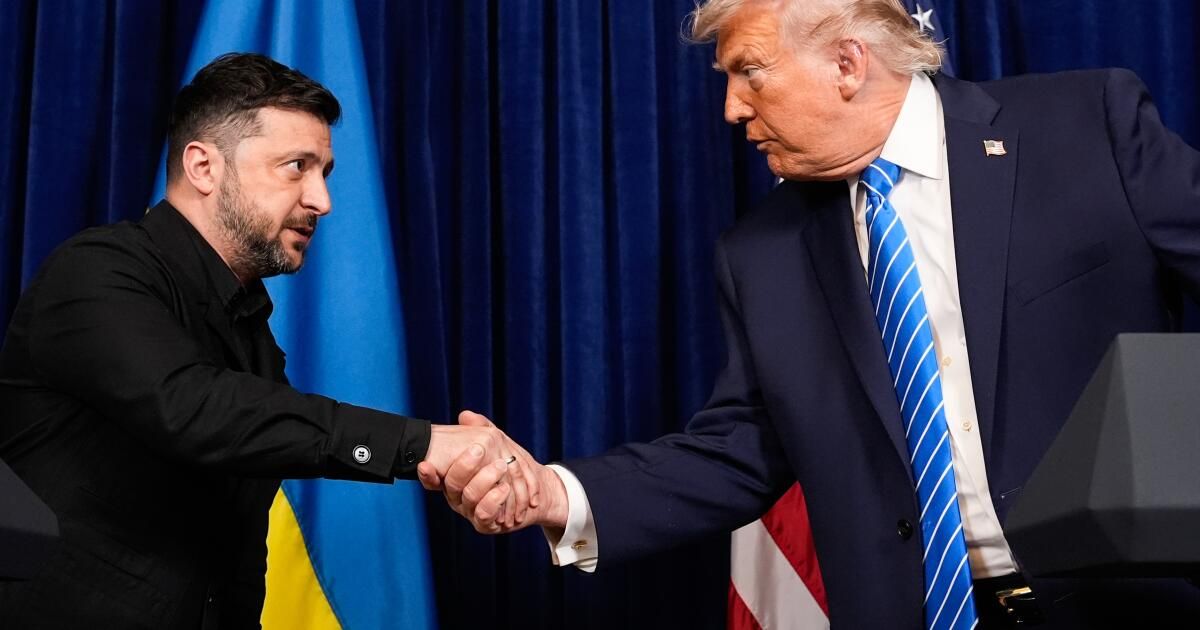
WASHINGTON- Standing next to President Trump at his Palm Beach estate, Volodymyr Zelensky could only smile and grimace without openly offending his host. “Russia wants Ukraine to succeed,” Trump told reporters, surprising the Ukrainian president before claiming that Vladimir Putin is genuine in his desire for peace.
It was just the latest example of how the American president sympathizes with Moscow in its war of conquest in Europe. However, Zelensky emerged from Sunday's meeting once again assuring that Ukraine could fight another day, maintaining critical if uncomfortable support from Washington.
Few signs of progress toward a peace deal materialized at the meeting at Mar-a-Lago, where Zelensky traveled with major commitments – including a plan to put territorial concessions to Russia to a vote of the Ukrainian people – in order to appease the US president.
But Zelensky won his own concessions from Trump, who for weeks had been pushing for a ceasefire before Christmas, or threatening to isolate Ukraine from American intelligence, which would leave kyiv blind on the battlefield. “I have no deadlines,” Trump said Sunday.
Throughout Trump's first year in office, Zelensky and other European leaders have repeatedly worked to convince Trump that Russian President Putin is, in fact, an aggressor opposed to peace, responsible for an unprovoked invasion that sparked the deadliest conflict in Europe since World War II.
On each occasion, Trump has proven right, even going so far as to question over the summer whether Ukraine could recover the territories it lost on the battlefield to Russia, and promising allies in the North Atlantic Treaty Organization: “we will be with them every step of the way.”
Yet each time, Trump has changed course within days or weeks, re-embracing Putin and Russia's worldview, including a proposal that Ukraine preemptively cede sovereign territories that Russia has sought but failed to occupy by force.
Zelensky's willingness to offer concessions in his latest meeting with Trump has succeeded, at least temporarily, in “preventing President Trump from tilting further toward the Russian position,” said Kyle Balzer, a scholar at the conservative American Enterprise Institute. “But Trump's position – his repeated insistence that a deal is necessary now because time is not on Ukraine's side – continues to favor Putin's negotiating line and tactics.”
U.S. intelligence agencies have assessed that Putin's revanchist war goals—conquering all of Ukraine and, beyond, recapturing parts of Europe that were once part of the Soviet empire—remain unchanged.
However, Trump's director of national intelligence, Tulsi Gabbard, whose own sympathies toward Russia have been scrutinized for years, recently dismissed the assessments as products of “deep state” “warmongers” within the intelligence community.
On Monday, hours after speaking with Trump, Putin ordered the Russian army to advance toward Zaporizhzhia, a city of 700,000 people before the war began. The city is a long way from the Donbas region that Moscow says would meet its war goals through a negotiated settlement.
“Trump's instinct is to favor Putin and Russia,” said Brian Taylor, director of the Moynihan Institute of Global Affairs at Syracuse University. “Ukraine and its European partners still hope to convince Trump of the obvious fact that Putin is not interested in a deal that does not amount to a Ukrainian surrender.
“If Trump were convinced of Putin's intransigence, he could further tighten sanctions on Russia and provide more assistance to Ukraine to try to pressure Putin into reaching a deal,” Taylor added. “It's an uphill battle, you could even say Sisyphus, but Zelensky and European leaders have to keep trying. So far, almost a year into Trump's second term, it has been worth it.”
On Monday, Moscow claimed that Ukraine orchestrated a massive drone attack on Putin's residence that would force him to reconsider his stance in the negotiations. Kyiv denied that an attack had taken place.
“Given the final degeneration of the criminal regime in kyiv, which has moved into a policy of state terrorism, Russia's negotiating position will be reviewed,” Sergei Lavrov, Russia's foreign minister since 2004, said in a Telegram post.
Another senior Russian official said the reported attack shocked and angered Trump. But Zelensky, responding on social media, said Russia was “at it again, using dangerous statements to undermine all the achievements of our shared diplomatic efforts with President Trump's team.”
“We continue to work together to bring peace closer,” Zelensky said. “This so-called 'residential attack' story is a complete fabrication intended to justify additional attacks on Ukraine, including kyiv, as well as Russia's own refusal to take the necessary steps to end the war.”
“Ukraine does not take measures that could undermine diplomacy. On the contrary, Russia always takes such measures,” he added. “It is critical that the world not remain silent now. We cannot allow Russia to undermine the work to achieve lasting peace.”
Frederick Kagan, director of the Critical Threats Project, which collaborates with the Institute for the Study of War to produce daily assessments of the battlefield conflict, said the meeting did not appear to fundamentally change Trump's position on the conflict, a potential victory for kyiv in itself, he said.
“Negotiations between the United States and Ukraine appear to be continuing as before, which is positive, as those negotiations appear to be getting into the real details of what would be required for a meaningful set of security guarantees and long-term agreements to ensure that any peace agreement is durable,” Kagan said.
Gaps remain between Kyiv and the Trump administration in negotiations on security guarantees. While Trump has offered a 15-year deal, Ukraine is seeking 50-year guarantees, Zelensky said Monday.
“As Trump keeps saying, there's no deal until there's one,” Kagan added. “We'll have to see how things go.”