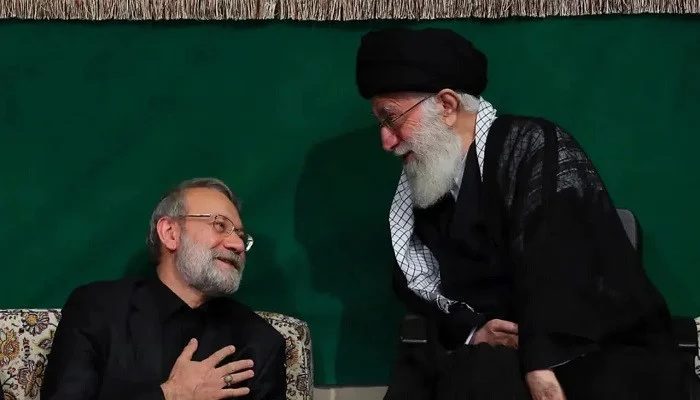
- Khamenei's senior advisor, who shapes Iran's foreign and security policy.
- Chief nuclear negotiator, who diplomatically advances Iran's program.
- President of Parliament for 12 years, uniting moderate and hardline factions.
Veteran Iranian politician Ali Larijani was one of the Islamic Republic's most powerful figures, an architect of its security policy and a close adviser to Ayatollah Ali Khamenei until the supreme leader was killed in an airstrike last month.
He was martyred at the age of 67, Iranian media said on Tuesday. Israeli Defense Minister Israel Katz said earlier on Tuesday that he had been killed in an Israeli strike.
The scion of a prominent clerical family with brothers who rose to high office after the 1979 Islamic Revolution, Larijani was seen as astute and pragmatic, but always fiercely determined to defend Iran's theocratic system of government.
A commander of the Revolutionary Guard during the Iran-Iraq war, he became head of Iran's national broadcaster before leading the Supreme National Security Council on both sides of its membership in parliament, where he was president for 12 years.
His role as Khamenei's top insider on Iran gave him responsibilities across a broad portfolio that included critical nuclear negotiations with the West, managing Tehran's regional ties and suppressing internal unrest.
After attacks between the United States and Israel began on February 28, he was one of the first major Iranian figures to speak out, accusing Iran's attackers of seeking to disintegrate and loot the country. He also issued stern warnings against potential protesters.
The attacks represented the definitive failure of a nuclear policy he had helped design, which attempted to build atomic capacity within the limits of international rules without provoking an attack.
In pursuing that policy, he projected the supreme leader's voice, using his skills as a communicator to build rapport with Western negotiators and lay out Khamenei's vision in frequent television interviews.
Even if he had survived the current war, that role may have been restricted. In the fight for control after Khamenei's death, it was the Guards who played an increasing role, leaving fewer decisions to powerful politicians like Larijani.
Rise after the revolution
Ali Larijani was born in 1958 in Najaf, Iraq's large Shiite Muslim shrine city, home to many prominent Iranian clerics, like his father, who had fled what they saw as the shah's oppressive rule.
He moved to Iran as a child, then focused on his studies and earned a doctorate in philosophy. But his family's clerical environment would have made him very aware of the revolutionary religious currents that emerged in his homeland in the 1970s.
When Larijani was 20, the Islamic Revolution overthrew the shah and installed Ayatollah Ruhollah Khomeini as supreme leader.
When Iraq invaded Iran along an 800-kilometer (500-mile) front months after the revolution, Larijani joined the Islamic Revolutionary Guard Corps, a new military unit ideologically dedicated to Khomeini.
As the war with Saddam Hussein's Iraq became the great crucible testing the mettle of a new generation of Iranian leaders, Larijani rose to become a staff officer, a commander focused on the behind-the-front organizational tasks that dictated the war effort.
His success in that role, along with his family connections, helped fuel his rise in the new Islamic Republic. They also ensured his close ties with the Guard, a military institution whose importance would continue to grow throughout his life.
After the war, Larijani became culture minister and then head of Iran's state broadcaster, IRIB, a critical role in a country where ideological messages have always been central to the exercise of domestic power.
Larijani was appointed to the cabinet by mercurial President Ali Akbar Hashemi Rafsanjani, serving from 1989 to 1997. Meanwhile, Khamenei became supreme leader in 1989, following Khomeini's death.
Larijani would have a front-row seat to the years-long power struggle between Rafsanjani and Khamenei, an incomparable lesson in Iranian high politics.
His time at IRIB was followed by a period as head of the Supreme National Security Council, Iran's main foreign and security policy body. An unsuccessful presidential bid followed in 2005, before his election to parliament two years later.
Two of his brothers also enjoyed high positions: signs of a family in the making.
His older brother, Mohammad-Javad, was a member of parliament before becoming a senior adviser to Khamenei. A younger brother, Sadiq, had become a clergyman and had risen to head the judiciary.
Chief nuclear negotiator
As chief nuclear negotiator from 2005 to 2007, Larijani was responsible for defending what Tehran says is its right to enrich uranium, a process necessary to produce fuel for a nuclear power plant but which can also produce material for a warhead.
Pressure on Iran over its nuclear program had increased after the discovery in 2003 that the country had enrichment facilities that it had not disclosed to international inspectors, raising fears that it was searching for a bomb and leading to sanctions.
He has always denied wanting a bomb.
Larijani compared European incentives to abandon nuclear fuel production to “trading a pearl for a bar of chocolate.” Although generally considered a pragmatist, he said Iran's nuclear program “can never be destroyed.”
“Because once you've discovered a technology, they can't take that discovery away from you,” he told PBS's Frontline in September 2025. “It's like if you were the inventor of a machine and it was stolen from you. You can still recreate it.”
Larijani made repeated visits to Moscow and met with President Vladimir Putin, helping Khamenei manage a key ally and world power that acted as a counterweight to pressure from the first and second administrations of U.S. President Donald Trump.
He was also tasked with driving forward negotiations with China, which led to a 25-year cooperation agreement in 2021.
As speaker of parliament from 2008 to 2020, he had the role of ensuring that a nuclear deal with six world powers in 2015 met the requirements of Iranian leaders. Trump withdrew the United States from the hard-negotiated deal during his first term in 2018.
Larijani was reappointed head of the Supreme National Security Council last year, after a 12-day air war launched by Israel. He was working to prevent an attack on Iran until shortly before the war began.
“In my opinion, this issue is solvable,” Larijani told Omani state television earlier this year, referring to talks with the United States. “If the American concern is that Iran should not move toward acquiring a nuclear weapon, that can be addressed.”
But Washington also denounced him for the council's role in addressing mass anti-government protests in January, even after he and other senior politicians had initially said demonstrations over the economy were allowed.