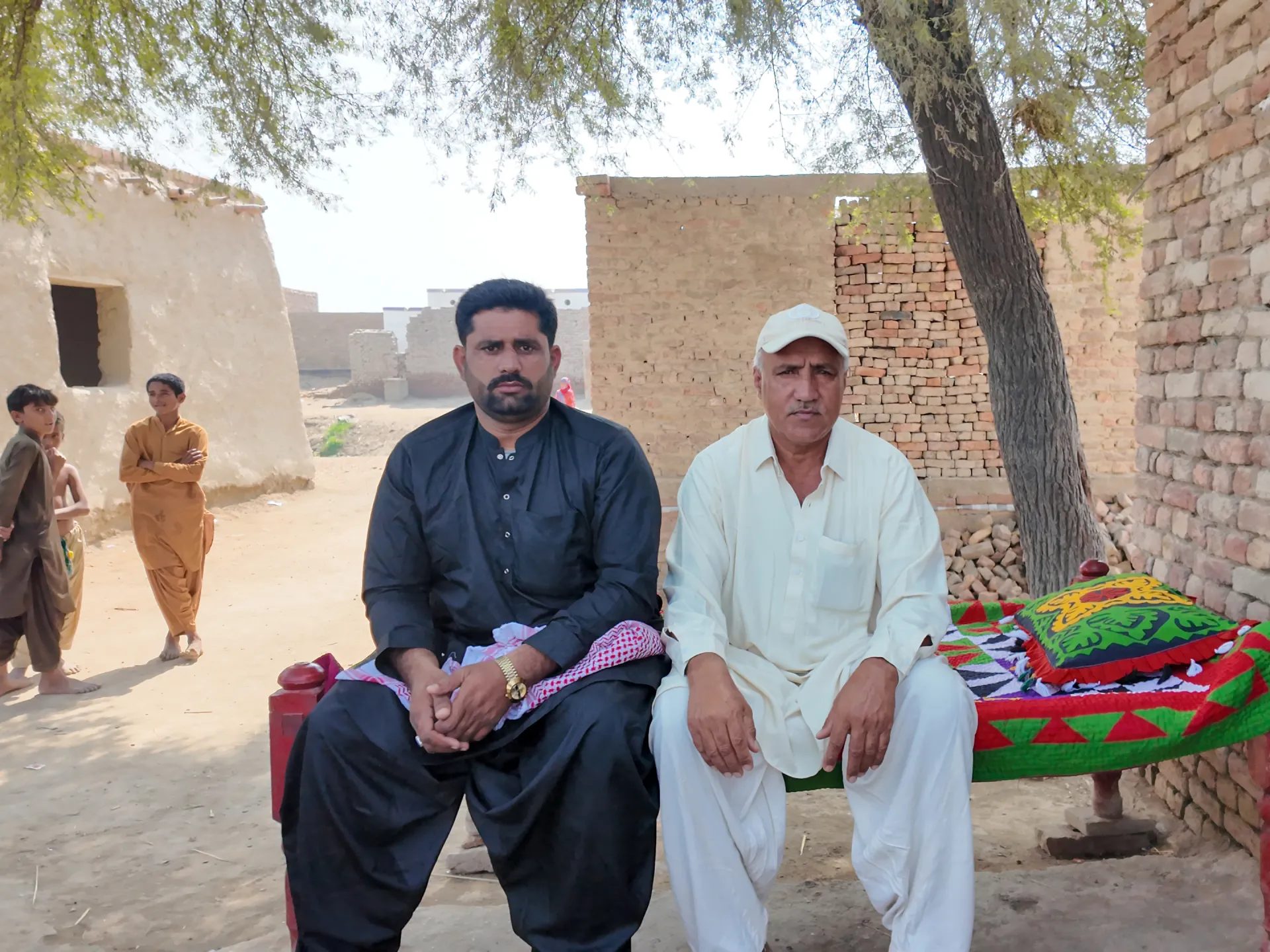
Dadu, Pakistan – Inayatullah Laghari stands on tiptoe to point out a faint line on the school wall, a watermark left by floodwaters that submerged the building and surrounding villages during the catastrophic floods in Pakistan four years ago.
For him, it is a reminder of how high the water rose in his village of Baid Sharif, in the Dadu district of Sindh, the hardest-hit Pakistani province, where agriculture is the mainstay for millions of farmers like Laghari.
Recommended stories
list of 4 itemsend of list
The 40-year-old farmer walks towards a nearby stretch of road, an area that had not been underwater in 2022. Whatever harvest Inayatullah was able to salvage from his flooded warehouse was kept on the stretch, while he slept next to the pile for a month to keep it safe.
“I had decided that if the water rose any higher, I would throw all the material on the roof of the school that was still above the water and pray that the water would not reach there,” he says. “Fortunately, I didn't have to do that, but most of what I salvaged was spoiled later.”
The 2022 floods – the worst ever recorded in Pakistan's history – displaced 30 million people, killed more than 1,700, inundated millions of acres of farmland, and destroyed or damaged more than a million homes, with total damages estimated at a staggering $40 billion.
The devastating floods were a climate disaster in a country that contributes less than 1 percent of global carbon emissions. Pakistan's government attributed the disaster to the country's vulnerability to climate change, with Climate Change Minister Sherry Rehman calling the floods a “climate-induced humanitarian disaster of epic proportions,” while United Nations Secretary-General Antonio Guterres described it as “a monsoon on steroids.”
Today, Laghari is among 39 Pakistani farmers in Sindh, the hardest-hit province, who have taken two German companies, RWE and Heidelberg Materials, to court over their greenhouse gas emissions, which they say contributed to the historic flood of 2022.
RWE, headquartered in the German city of Essen, is one of the largest electricity producers in Europe. Heidelberg Materials, headquartered in the German city of the same name, is one of the largest construction materials manufacturers in the world. The two companies are among 178 industrial producers around the world responsible for 70 percent of global carbon emissions, according to data from Carbon Majors, a climate change think tank that tracks historical emissions from the world's largest oil, gas, coal and cement producers.

Miriam Saage-Maab, legal director of the European Center for Constitutional and Human Rights (ECCHR), which represents farmers, told Al Jazeera that the companies were selected for being “two of the three largest emitters of carbon dioxide in Germany”, according to the Carbon Majors database.
The Pakistani farmers filed their lawsuit against the two companies last December before a court in Heidelberg, which is currently reviewing the case.
Saage-Maab said neither company has land operations in Pakistan, but the lawsuit argues that despite the lack of physical proximity, the effect of the greenhouse gases they emit in Germany is felt thousands of miles away. She says the farmers' lawsuit has a good chance of going to trial.
For her, she said, the importance of the case lies in helping to define how responsibility for climate damage can be calculated and assigned, not only in the courts, but also in future political negotiations related to climate finance.
The case is inspired by a Peruvian farmer who, in 2015, sued RWE on similar charges. While a German court dismissed that case in 2025, it also ruled that companies can, in principle, be held liable for specific climate-related damages caused by their carbon emissions.
Saage-Maab said rulings like these make Germany a favorable jurisdiction for climate litigation “to some extent,” adding that these types of transnational climate cases are increasingly being pursued around the world.
Turning to German courts to hold companies accountable is not new in Pakistan.
After a fire ripped through a garment factory in Karachi in 2012, killing more than 250 workers, one of the survivors and relatives of the victims filed a lawsuit in Germany in 2015 against KiK, a company that sourced much of its products from the Pakistani factory. The petitioners argued that the company failed to ensure basic fire safety and building standards.
While the case was rejected on procedural grounds, it led to KiK paying compensation to victims and helped spark debates about corporate responsibility in global supply chains. In 2023, Germany introduced a supply chain law aimed at addressing human rights violations by companies operating abroad.

The Pakistan-based union that helped the garment factory victims fight their case is now helping the 39 farmers, gathering and translating testimonies and evidence before sending them to the legal team in Germany.
Nasir Mansoor, general secretary of the National Federation of Trade Unions, told Al Jazeera that the farmers' lawsuit is Pakistan's first cross-border climate litigation.
“There needs to be accountability,” he said. “We need to knock on their doors and tell them that whatever they are doing is causing us suffering here in Pakistan. This lawsuit is a campaign for justice and to raise awareness about what is happening.”
In a January statement, RWE said the litigation was “yet another attempt to move climate policy claims to German courts,” arguing that climate cases like the one in Pakistan are “hugely damaging to Germany as an industrial location” and undermine legal certainty that German companies will not be sued from other parts of the world even after complying with the law.
Heidelberg Materials confirmed having received a legal notice about the Pakistan case, but has not issued a public statement about the lawsuit.

Laghari says local authorities in Pakistan did not help them recover from the floods. People were left to fend for themselves or received help from NGOs, he says. The farmers also believe that there is nothing they can do to hold the Pakistani government accountable, especially in a court of law.
“What is the point of filing a case against them in court here?” asks Laghari. “We have some cases in the villages that have been stuck in the courts for 15 or 20 years, some that our grandparents filed years ago. You don't get justice here from the local courts. They are courts in name only. That's why we filed our case in Germany.”
While farmers see foreign courts as their best chance for justice and compensation, some in Pakistan feel the responsibility for tackling climate change cannot fall abroad.
Hammad Naqi Khan, director of the World Wildlife Fund-Pakistan, told Al Jazeera that while it is important to hold major global emitters accountable, local authorities must also be questioned about how well they are helping communities become climate resilient.
“Yes, our emissions are low, but that doesn't mean we continue to allow coal-fired power plants or tell our industries to do whatever they want,” he said.
“Our focus needs to be on building resilience and adaptation. Preparing our farmers to deal with this crisis, preparing our fishermen, the people who live in the mountains. We need to build their capacity and ensure that our own local governance has improved.”
Pakistan's climate and disaster management authorities did not respond to Al Jazeera's requests for comment on the lawsuit.
Gul Hasan Babar, a retired schoolteacher and farmer who is also among the 39 litigants, says any compensation arising from the lawsuit will help not only individual farmers but entire villages.
“The money we will receive will help those who lost their homes and are still living in tents. They will finally have the opportunity to build a house to live in,” he told Al Jazeera, adding that it would also allow farmers to improve their land by investing in supplies that revive soil fertility damaged by the floods.
Babar, 55, said that even if they lost the case, he hoped the lawsuit would spark the kind of ripple and awareness that the Karachi garment factory case helped produce. “Then these companies will control their pollution and our country will suffer less. People will suffer less,” he said.
Laghari is hopeful about the outcome, but also recognizes that things may not go their way.
“All we can do is try to fight the case. God willing, we will win. If we don't, at least we will still have our lands, in whatever condition they are in now,” he says. “Regardless of what those lands provide, our families will try to survive on them.”