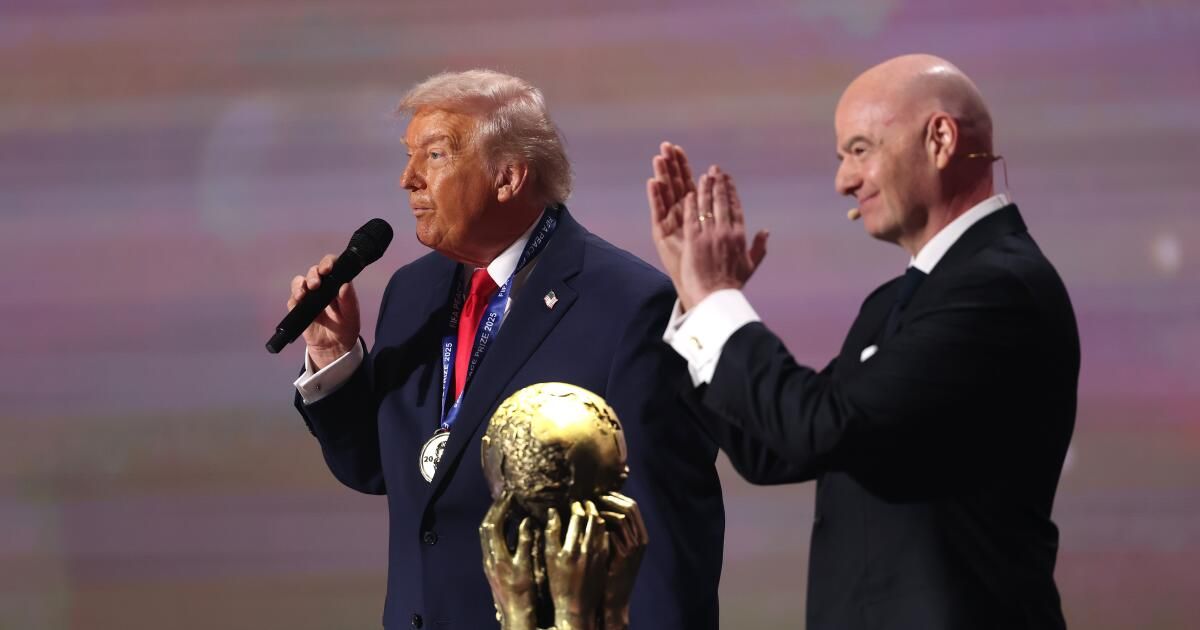
About 30 minutes after Friday's World Cup draw at the Kennedy Center, a landmark that Donald Trump would like to rename, the president was called to the stage to receive an award from FIFA chief Gianni Infantino.
The so-called FIFA Peace Prize did not exist five weeks ago. And when Infantino created it, there were never any candidates for the prize beyond Trump, who has campaigned hard but unsuccessfully for the Nobel Peace Prize. That made Friday's presentation seem awkward and uncomfortable for almost everyone except Infantino and Trump.
“You definitely deserve the first FIFA Peace Prize for your action, for what you have achieved in your own way,” Infantino said as Trump grabbed his medal and placed it around his neck.
“This is truly one of the great honors of my life,” Trump said.
President Trump receives the FIFA Peace Prize from FIFA President Gianni Infantino during the 2026 World Cup draw at the Kennedy Center on Friday.
(Kevin Dietsch/Getty Images)
For the two men, the exchange was just the latest in a strange bromance that has deepened in equally beneficial ways as June's World Cup approaches.
“These are two huge egos that stroke each other,” said a former U.S. soccer official, who asked that his name not be used to avoid possible retaliation. “I assume that Infantino's ulterior motive is to get as much support as possible from the government and make sure that Trump, despite some unhelpful comments, does nothing to interfere with the tournament.
“For Trump, the opportunity to claim credit for hosting the world's largest sporting event in front of a global audience is irresistible.”
A FIFA spokesperson said Infantino must maintain collaborative relationships with host countries, noting that he has forged strong ties with Trump along with the leaders of Mexico and Canada.
“According to the FIFA Statutes, 'the President shall seek to maintain and develop good relations between FIFA, the confederations, member associations, political bodies and international organisations,'” the FIFA statement read. “In addition, the FIFA President must maintain good relations with the leaders of the host countries to ensure a successful event for all.”
For FIFA and Infantino, a veteran soccer executive who used his connections and intelligence to rise to the top of the world's most popular sport, the partnership is intended to win the president's backing and limit his meddling in what could be the most lucrative World Cup in history.
In recent months, Infantino, who was front row at the president's inauguration in January, invited Trump to present Club World Cup champion Chelsea players with their championship medals (one of which Trump pocketed), followed the president to Egypt in October to attend a summit to finalize a ceasefire deal between Israel and Hamas, and rented space in Trump's Manhattan office building.
Infantino has also been a frequent guest at the White House and Mar-a-Lago, and was able to greet Trump on stage at the Kennedy Center on Friday only because he abruptly moved the World Cup draw from Las Vegas to Washington, D.C., at Trump's request, erasing months of planning.
For Trump, America's biggest sports fan, the relationship means a role in the biggest, most complex sporting event in history and the attention and praise that comes with it.
At the same time, Trump's mercurial management style and tendency to break with allies mean Infantino cannot take anything for granted. As a result, says David Goldblatt, a British sports journalist and visiting professor at Pitzer College in Claremont, Infantino's actions have been shrewd, if at times humiliating.

Chelsea's Reece James and Robert Sanchez join President Trump as they celebrate their FIFA Club World Cup victory on July 13.
(Chip Somodevilla/Getty Images)
Faced with a powerful but unpredictable leader in a country about to host a World Cup that could generate revenues of more than $9 billion, the FIFA president, a former Trump critic, has chosen to set aside those differences and appeal to Trump's love of tributes and trinkets rather than risk his wrath.
“This is a different world,” Goldblatt said of Infantino's fears that Trump could damage the World Cup if he so chooses. “This is not how states and heads of state used to operate.”
Infantino, 55, became president of FIFA, world soccer's governing body, in 2016, when he was chosen to replace scandal-ridden Sepp Blatter in a vote led by Sunil Gulati, then president of the U.S. Soccer Federation. At the time, Infantino, who was born in Switzerland to Italian immigrant parents, was seen as a progressive reformer who would take the conservative and reticent organization, the most influential and powerful governing body in world sport, in a different direction.
And it has delivered on some of that, expanding fields for the men's and women's World Cups, increasing prize money for the women's tournament, expanding other competitions like the Club World Cup and nearly quadrupling FIFA's cash reserves. At the same time, he is also comfortable forming alliances with autocrats.
During the run-up to the 2018 World Cup in Russia, Infantino developed such a close relationship with Vladimir Putin that he was called to the Kremlin after the tournament to accept the Order of Friendship medal, one of Russia's highest awards. That friendship has apparently endured: On Friday, investigative outlet Follow the Money reported that FIFA has ordered several European clubs to pay transfer fees of up to $30 million to Russian teams despite international sanctions and banking restrictions imposed on the country following Putin's invasion of Ukraine.
Before the 2022 World Cup in Qatar, Infantino moved to the emirate, rented a house and enrolled two of his children in local schools. He dismissed well-documented human rights abuses as Western hypocrisy and, on the eve of the tournament, sided with the country's leaders by banning team captains from wearing rainbow armbands and long-time sponsor Budweiser from selling beer at World Cup venues.
During Trump's first administration, Infantino sharply criticized the Muslim ban the president attempted to enact, fearing the possible effect it would have on international sports. This time Infantino has all but ignored Trump's decision to limit entry into the United States to citizens of 19 countries (including World Cup qualifiers Haiti and Iran), something that will have a very real impact on next summer's tournament.
“Infantino is intoxicated by the elite circles of power, status and wealth to which he has been elevated,” Goldblatt said. “He's king of the universe now and he's been moving in some pretty hotheaded circles. How does he get by in that world?”

FIFA President Gianni Infantino, right, smiles as he greets Russian President Vladimir Putin on July 14, 2018, at the closing of the World Cup in Russia.
(Yuri Kadobnov / Associated Press)
Infantino's move has caused concern and unease among many world soccer officials, who fear he has abandoned FIFA's mandated political neutrality. Delegates from UEFA, European soccer's governing body for which Infantino used to work, walked out of May's FIFA Congress in Paraguay after Infantino arrived hours late, delayed by a trip to the Middle East with Trump.
The FIFA president's “private political interests do not benefit the game,” the delegates said.
Or maybe it does, says Adam Beissel, an associate professor of sports leadership and management at Miami University in Ohio and the author of several books and studies on the inner workings of FIFA.
“Maybe it was worth it to get the federal subsidies for the World Cup, to get the kind of support to host an event that will generate $9 billion in revenue,” he said.
By all indications, the friendship between Trump and Infantino is genuine, if ultimately transactional. Trump calls the FIFA leader “Johnny” and “my boy,” while Infantino has taken his own staff by surprise by announcing the creation of the FIFA Peace Prize and giving it to a president whose administration continues to bomb suspected drug trafficking ships in the Caribbean and threaten military action against Venezuela.
The FIFA president would surely like Trump to stop threatening to pull World Cup matches from blue cities (an impossibility so close to the tournament, but a threat Trump loves to make anyway) and ease his travel ban on visitors who want to attend the World Cup.
But at this point he would probably settle for the president to simply allow the show to go on. And if the cost of that is a trophy for Trump, that's a price Infantino seems willing to pay.