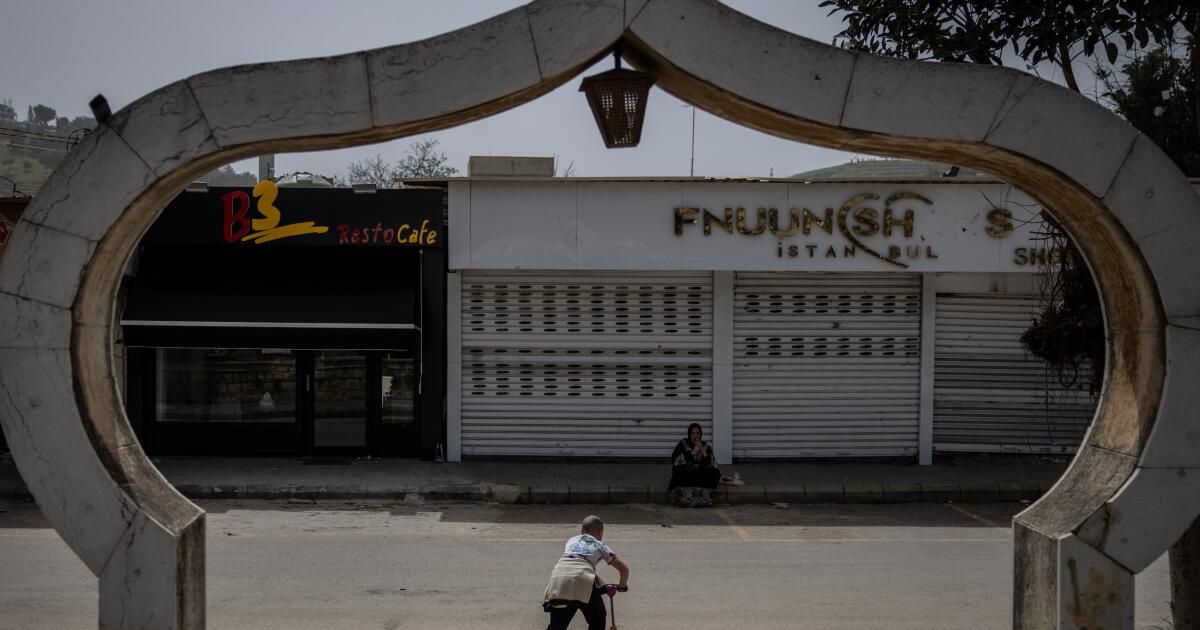
KFAR CHOUBA, Lebanon — The fear is always there, but it is worse at night.
That's when Israeli troops stationed a few hundred meters from the road arrived in this mountain village less than a mile from Lebanon's border with Israel, searching homes and detaining residents at will.
“When it gets dark, the horror begins,” said Walid Nasser, a retired police officer and municipal board member.
He stood up and pointed out the window to a place hidden among the gray clouds that enveloped the mountains overlooking Kfar Chouba.
“If there was no fog, you would see the Israelis up there,” he said. “They're watching us all the time… You keep thinking, 'Now they'll knock on the door, now they'll break into the house.'”
Hussein Abdul-Aal has similar fears. His house on the eastern edge of Kfar Chouba was one of the closest to the Israeli position. In recent days, Abdul-Aal said, they searched the three houses near him, causing their owners to leave. The last remaining residents of the neighborhood are Abdul-Aal, his wife, their two cats, and the abandoned dogs they feed.
The destruction caused by Israeli airstrikes can be seen in Kfar Chouba, southern Lebanon, on September 20, 2025.
(Lea Thomas/Hans Lucas/AFP/Getty Images)
“My dream now is to completely surrender to sleep, to be relaxed and sleep peacefully at night,” Abdul-Aal said.
Such is life now in Kfar Chouba since fighting between the Lebanese Shiite militant group Hezbollah and Israel intensified last month, triggered by the US-Israeli war against Iran.
Abdul-Aal, a 72-year-old retired high school sociology teacher with a fatherly smile, compared the behavior of residents around Israeli troops to that of a lazy student hoping not to be called on in class.
“You try to make yourself small, to avoid your teacher's gaze. We do the same: stay at home, stay away from the windows, so the Israelis don't come to us,” he said.
“The night they came to our neighborhood, we held our breath for three hours and didn't move,” said Afaf Awadhah, Abdul-Aal's wife.
Every day, the soundtrack of a war that no one here wanted (the roar of fighter planes, the drumbeat of machine guns) grows louder. Israeli military leaders repeatedly vow to invade all of southern Lebanon (an area slightly smaller than Los Angeles) and expel hundreds of thousands of Shiite residents they consider Hezbollah supporters and occupy what they call a “defensive buffer zone.”
Although much of southern Lebanon is predominantly Shia, Kfar Chouba and its neighbors comprise a cluster of Christian, Druze and Sunni Muslim communities. These residents insist they are neutral and refuse to leave, even as fighting threatens to engulf their towns and villages.
In recent weeks, Israeli military officials contacted the area's mayors, telling them that they could remain in the buffer zone on the condition that they did not allow displaced Shiites to remain in their villages, or allow them to be used as staging grounds for Hezbollah attacks.
“They called me from the Israeli Defense Ministry on Wednesday and told me that if we didn't keep Hezbollah and the displaced people out, they would order us to leave and raze the village,” said Qassem Al-Qadri, mayor of Kfar Chouba. Like others, he felt he had no choice but to accept.

Israeli soldiers patrol a rural area in Kfar Chouba, a city in southern Lebanon, on February 17, 2025.
(Ramiz Dallah/Anadolu/Getty Images)
However, this neutrality has not freed Kfar Chouba and neighboring villages from attacks.
In the first weeks of the war, Israeli bombings killed three people: a police officer and two pastors. During one of their midnight raids on the village, residents said, Israeli soldiers broke into the homes of three residents, interrogated them and detained one of them overnight at his outpost before letting him go.
A few days later, the mayor said, in another raid in the nearby village of Halta they shot and killed 15-year-old Mohammad Abdul-Aal (a distant relative of Hussein) as he left his house to check the noise.
Residents say the Israelis have prevented residents (most of whom work in agriculture) from accessing their farmland near the border; Other fields were bombarded with white phosphorus, Lebanese authorities said, destroying vegetation and thousands of trees.
“All of us here are just waiting: waiting for the Israelis to come and kill us, waiting to see where they attack or where they come in,” Al-Qadri said.
He added that the Lebanese army withdrew from its position over the village at the start of the war, despite residents' pleas for it to remain.
“We even offered the army soldiers accommodation in the village and providing them with food, but they were ordered to leave,” he said. “We need the Lebanese state here.”
War returned to Kfar Chouba and Lebanon on March 2, after Hezbollah launched rockets and drones into Israel in response to the assassination of Iranian Supreme Leader Ayatollah Ali Khamenei and near-constant attacks despite a ceasefire that ended its last conflict in 2024.
The aftermath of that earlier fight can still be seen in Kfar Chouba, in the houses and mosque destroyed by bombs. And when a trail of dust rises from a road, residents say, it's another Israeli tank advancing.
So far, more than 1,300 people have been killed in Lebanon and more than 1 million people have been displaced, the Lebanese government says. Israel's plans for a buffer zone have sparked fears of a longer displacement that would essentially amount to an ethnic cleansing of southern Lebanon.
On a cold morning in Kfar Chouba, Al-Qadri, Nasser and a few others who remained gathered at the town's main municipal building. It was a relatively calm moment, a stark contrast to the day before, when F-16 fighter jets sliced through the clouds while conducting bombing raids over southern Lebanon.
Sitting around a wood stove and sipping cups of coffee and tea, residents reflected on the disruptions that had become a regular feature of their lives.

Afaf Awadhah, left, and her husband, Hussein Abdul-Aal, give treats to their adopted dogs. They are the last remaining residents of their neighborhood of Kfar Chouba.
(Nabih Bulos / Los Angeles Times)
Al-Qadri, 81, had seen the bucolic mountains here become a battlefield since Israel's creation in 1948. After Syria's loss of the Golan Heights in 1967, Israel razed chunks of Lebanese and Syrian territory, cutting off land where Kfar Chouba residents would grow wheat and olives.
In 1969, Palestinian fighters used this area – with Lebanon's blessing – to launch attacks against Israel, leading Israeli soldiers to dynamite 17 houses in Kfar Chouba. The village was nearly destroyed during Lebanon's hugely destructive war in 1975, when southern Lebanon was taken over by an Israeli-backed militia, which attempted to forcibly recruit residents of Kfar Chouba into its ranks.
“I refused and they put me in jail for a year. After that I left,” Nasser said.
Residents rebuilt their homes, but then Israel's occupation in 1982, which triggered the rise of Hezbollah, forced them to leave once again until Hezbollah overthrew Israel in 2000. Only then did people like Abdul-Aal and Nasser return.
In subsequent clashes with Hezbollah in 2006, Kfar Chouba was completely destroyed. The villagers rebuilt. But in 2023, another war killed 27 people here and three-quarters of the village fled.
“I have spent more than half my life forced to leave my home,” Abdul-Aal said.
Now there are just over 500 people left, a fraction of the 2,000 who were here before 2023. Young people are no longer staying and looking for opportunities in Beirut or outside Lebanon. Many houses have the unkempt appearance of rare dwellings.
“Back then we had big dreams of liberating Palestine and we were willing to help,” Al-Qadri said, adding that in the past there were several Hezbollah positions in the mountains around Kfar Chouba.
“Then our dreams became more humble, to liberate our own lands. Now it is even less. We don't want to liberate anything. We just want to stay at home and not leave our homes,” he said.
As elsewhere in Lebanon these days, the conversation inevitably turned to Israel's plan for a new long-term occupation of southern Lebanon.
Nazih Yahya, a septuagenarian resident with the weary tone of someone long accustomed to conflict, hoped the Israeli military would treat residents of non-Shiite villages differently from areas it considers strongholds of Hezbollah support.
“We have two models: Gaza and the West Bank,” he said. In Gaza, he explained, the Israeli army razed cities and prevented residents from returning; In the West Bank, the pace of destruction was slower, with Palestinians still in place but under constant threat of attack.
“What they did to Gaza they will do to most of southern Lebanon,” he said. Kfar Chouba, will be “like the West Bank.”
For Abdul-Aal, the only form of resistance he still had was to stay at home, no matter what.
“What is nationalism? Is it a political idea? Or is it a house, a land, the memory of a place?” asked.
“No matter who comes and rules this place, as long as we stay here, they can't take away the fact that I am Lebanese.”