KHARTOUM, Sudan — The diggers were efficient, excavating so many graves that, from above, the field near the Sudan University medical campus looked like a frieze of a rolling sea of gravel brown.
“There's another one there that's even busier than this one,” said a campus caretaker, pointing to an adjacent lot a few hundred yards away. He trudged back to his post by the campus gate before giving a terse response to a reporter's question.
“How many corpses are there here?” he repeated. “Hundreds? Thousands? Who knows.”
More than a year after Sudan's army overwhelmed a rival paramilitary faction and seized Khartoum, gaping holes in the walls and shattered pavement bear witness to the fierce battles that turned the boulevards of this Nile-facing capital into a charnel house.
-
Share via
In some neighborhoods, it appears that no surface was left untouched by explosive devices and shrapnel. The commercial district is destroyed, looted and burned. Not even the ancient statues in the capital's National Museum, those that were not stolen, were saved.
Its international airport, which recently reopened, has the remains of propeller planes carelessly dumped on the side of the runway, their bodies riddled with bullets and their wings twisted. Upon takeoff, the corpse of an exploded plane is seen, with the fuselage open like a fish.
But, above all, Khartoum is a city of tombs.
It took nearly two years of cruel, prisoner-less fighting for the army to finally expel the militia that was once its ally, the Rapid Support Forces, or RSF, from Khartoum. Residents who were unable to flee the city after war broke out in April 2023 found themselves trapped in houses that had become a front line.
Since cemeteries were inaccessible, they turned to schools, mosques, backyards and sidewalks. All became makeshift burial sites, even as the death toll ran into the tens of thousands. The fighting was so bloody that many bodies were left in the streets.
“I saw it all: arrested, tied up and executed. RSF militiamen buried with their mats as a shroud. Corpses half eaten by dogs, cats, rodents and birds,” said Hisham Zain al-Abidin, head of the State Forensic Authority, in a calm but tired voice.
“This is war.”
Sitting in a worn-looking office painted beige and brown, al-Abidin said his agency sent forensic experts along with officials from the Civil Defense, the Sudanese Red Crescent and neighborhood committees in July to scour parts of the capital for hundreds of mass graves. Since then, some 23,000 bodies have been collected from roads, houses and looted areas and reburied in cemeteries.

Authorities have yet to remove the two graves near Omar Abdullah's home. None of their neighbors know who they belong to or where their families may be.
(Nabih Bulos)
But there are still untold numbers of bodies. Some estimates put the death toll at 400,000 since the conflict began four years ago, more than 61,000 of them in and around Khartoum state. More than 12 million have had to flee their homes, earning Sudan the unfortunate privilege of suffering the world's worst displacement crisis.
The mass grave next to the University of Sudan, which was near a building the RSF requisitioned as a detention center, likely contains thousands of bodies, al-Abidin said.
“They buried the prisoners they killed and also their fighters. You see a grave on the surface, but you dig and you will find five bodies inside,” he said.
“Assume there are 500 graves there, we're talking about approximately 2,500 people.”
Shortages of material and equipment – including body bags – meant that exhuming and reburying all the remaining bodies in Khartoum exceeded his agency's resources, al-Abidin said. There were plans for fundraising campaigns in the coming months.
As for the identification of the dead, this will also have to wait, probably for years. All DNA analysis laboratories of the State Forensic Authority were looted and destroyed during the fighting.
“All we can do now is remove the body from where it is and put it in a numbered and marked grave for unidentified bodies so that families can find them later,” he said. In the future bone samples will be taken for DNA analysis.
And even when the bodies could be identified, few people could afford to pay for the transfers to be done privately.
That's what happened to Omar Abdullah. In June he fled his hometown of El Fasher in western Sudan to neighboring Chad before the RSF attacked the town and massacred thousands of residents.
A few weeks ago he decided to move with his family to Khartoum and rented a house in Omdurman, a city that forms one of the three parts of the capital. Khartoum, a metropolis of 7 million people, sits at the confluence of tributaries, a kind of Pittsburgh on the Nile.
Abdullah's house, like all the others nearby, was marked by bullet holes; Still, “it was acceptable inside,” Abdullah said. But when he went to clear the land just outside the house, he discovered two graves, one small enough for a child, near the shell of a looted car.
“I couldn't take my children to that. They've seen enough in El Fasher,” Abdullah said.
None of their neighbors knew who the graves belonged to or where the families who had lived nearby might be.
Determined to move the bodies, Abdullah approached the authorities. But he discovered it would cost more than $200 to move each body. The graves are still there.
“I can barely pay the house rent and support my children. How can I pay for this?” said. “This is the work of a government, not me.”
Other neighbors were equally desperate, including Mohammad Izzo, 69, a school janitor forced by the demands of war to become a gardener at a makeshift cemetery on campus located a short distance from Abdullah's home.
The first person to be buried at the school was his brother.
One afternoon in August 2023, Izzo was at school with his brother, Hassan, who also served as a custodian. A few months of war had passed and the RSF had taken control of their neighborhood.
Hassan had just woken up from a nap and went to get water when a projectile hit the ground in the schoolyard, spraying shrapnel into his body. Izzo and his sister Ikhlass were inside the building and ran out to help. But nothing could be done. Hassan was dead.
The nearest cemetery was 14 kilometers away, across the Nile toward Khartoum's downtown district, but going there would essentially be a suicide run, Izzo said.
“There was so much artillery. Staying outside, like we're doing now, just wasn't possible,” he said. Even if it was, the RSF did not allow residents to move. Furthermore, there was no transportation or guarantee of protection.
The family decided to bury Hassan in the school's backyard.
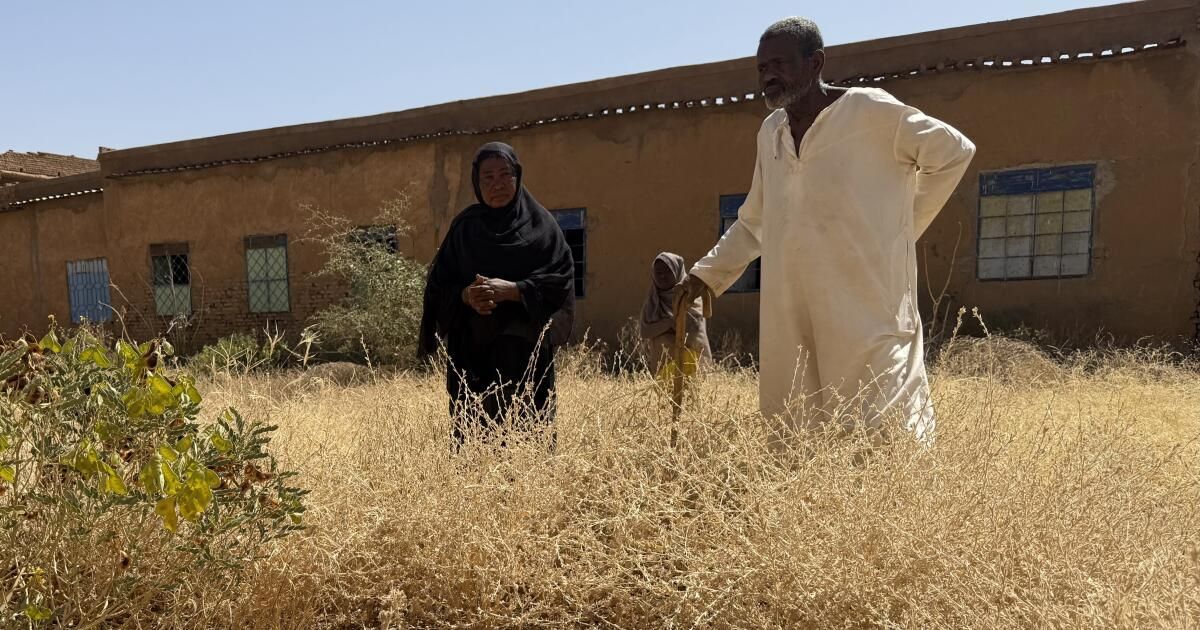
Izzo leaned on his cane, its end digging into the soft earth as he trudged toward the back of the school. A slab driven into the ground marked Hassan's grave, now obscured by chaotic undergrowth. Ikhlass joined him.
“We had no choice,” Ikhlass said. “No one would let us pass. What else could we do?”
As the fighting dragged on, other grieving families asked to bury their dead alongside Hassan. Izzo initially allowed it, but then refused further, fearing the effect being near many graves would have on Ikhlass' children, who lived with her and Izzo at the school.
Residents resorted to burying the bodies outside the school grounds; More than 20 graves run parallel to the school's outer wall, each marked with a broken cement block.
With schools reopening, Izzo hoped the bodies buried there could be moved. But he would also wait for the government to do so.
“I guess I don't care where they put him. His body is here, but his soul is with Allah. And that's what matters,” he said.
He turned toward Hassan's grave, his sun-gray face staring down at the mound of earth as he remained silent.