President Trump on Tuesday signed an executive order seeking to impose new federal controls on mail-in voting in states like California, repeating his long-held but unsubstantiated claim that mail-in voting is a source of widespread fraud in U.S. elections.
California leaders responded immediately with promises to challenge the order in court. They said mail-in ballots are a secure method of voting trusted by millions of Californians, that Trump's order infringes on the state's constitutional right to administer elections as it sees fit and that it amounts to an “unlawful power grab” ahead of midterm elections in which their party is poised to suffer substantial losses.
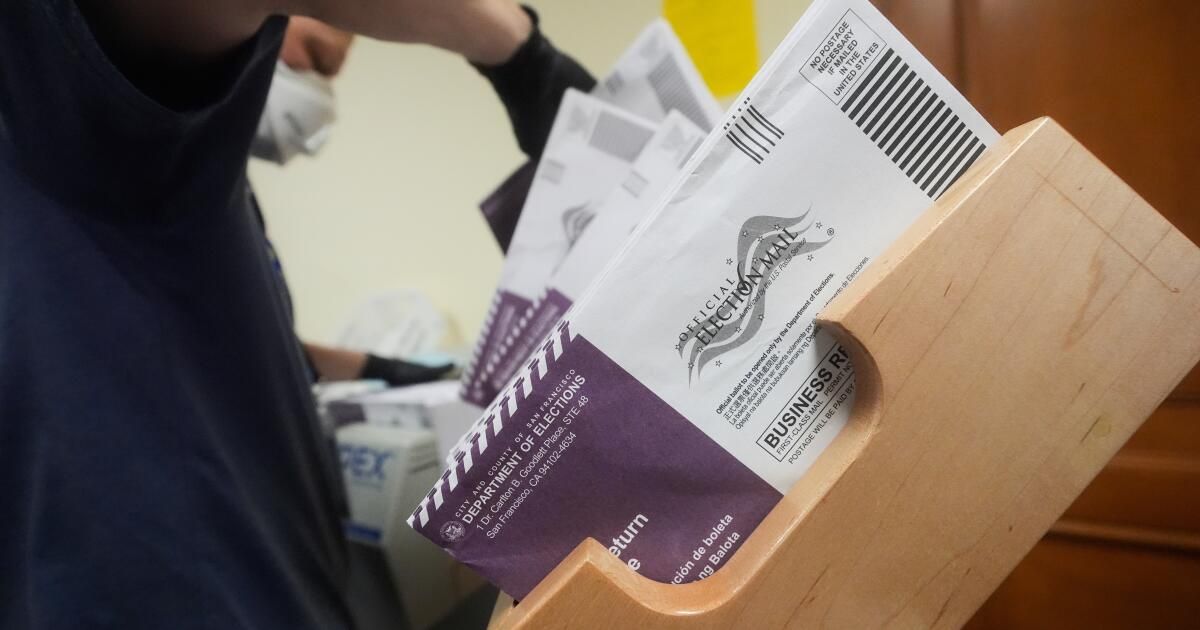
The order directs the United States Postal Service to take control of mail-in voting by designing new envelopes with special barcodes that will allow the federal government to ensure that such ballots are sent only to eligible voters and that only eligible voters return them.
Requires states to submit to the USPS process if they plan to use the federal mail system to send or receive ballots, and to send USPS lists of eligible voters before those ballots pass through the mail system.
It also requires the Department of Homeland Security, U.S. Citizenship and Immigration Services, and the Social Security Administration to “compile and transmit to the chief election official of each state a list of persons confirmed as U.S. citizens who will be over 18 years of age at the time of an upcoming federal election and who maintain a residence in the state in question.”
Those lists will be drawn from federal citizenship and naturalization records, Social Security records and “other relevant federal databases,” and the USPS will be prohibited from transmitting ballots that do not match those lists, the order says.
“Secure voting envelope identifiers provide a reliable and auditable mechanism for enforcing federal law without unduly burdening or infringing on the rights of eligible voters,” the order says. “Unique identifiers on ballot envelopes, such as barcodes, allow confirmation that only citizens receive and cast their votes, reducing the risk of fraud and protecting the integrity of federal elections.”
Trump, who recently voted by mail in Florida, presented the order as a solution to “massive cheating” in the current US election, something he did not back up with evidence.
“Cheating in mail-in voting is legendary. It's horrible what's happening,” Trump said.
“He will ensure that mail-in votes are secure and accurate,” said Commerce Secretary Howard Lutnick, who appeared alongside Trump and whose agency, according to the order, must participate in coordinating the new voting measures.
California officials criticized the president for attacking and undermining election integrity, rather than shoring it up, and said they would prevent the order from taking effect.
“President Trump's Executive Order marks a dangerous and unprecedented escalation in his continued attacks on our elections. The power to regulate elections belongs to the states and Congress; he has no role to play. We blocked his previous Executive Order on elections in court and are prepared to stop him again,” the California prosecutor said. General Rob Bonta.
“The reality is that President Trump and congressional Republicans see evidence that they are likely to lose in the upcoming midterm elections and are pushing to make it harder for people to vote,” Bonta added. “We will not sit idly by.”
Sen. Alex Padilla (D-Calif.), in a statement to the Times, said Trump's actions were “a clear and present threat to our democracy,” that he “will use every tool he can to stop him” and that he expects “immediate legal challenges to protect our free and fair elections.”
“Instead of focusing on reducing the cost of energy, food and health care, Donald Trump is desperately trying to take over and rig our elections and avoid accountability in November. This executive order is a blatant and unconstitutional abuse of power,” said Padilla, the ranking Democrat on the Senate Rules and Administration Committee.
“The President and the Department of Homeland Security have no authority to monitor federal elections or direct the independent Postal Service to undermine the mail-in and absentee voting that nearly 50 million Americans relied on in 2024,” he said. “A decade of lies about electoral fraud does not change the Constitution.”
“In the midst of an unauthorized war abroad and increasing authoritarian repression by ICE here at home, Trump is attempting another illegal power grab,” Padilla said.
“We are challenging him,” Gov. Gavin Newsom posted on X, above a video of Trump announcing the order. “See you in court.”
A large majority of Californians vote by mail. In the state's 2025 special election on Proposition 50, the state's mid-decade redistricting measure, nearly 89% of votes were cast by mail, according to California Secretary of State Shirley Weber's office, or nearly 10.3 million of about 11.6 million votes cast.
Trump has long criticized mail-in voting, without evidence, as a source of fraud and a factor in his loss of the 2020 election to President Biden, which he still maintains was illegitimate.
Election experts, voting rights advocates, local election officials and other California leaders have dismissed those claims as baseless and inaccurate. They have also been preparing for Trump to act to restrict such voting.
Padilla previously warned colleagues that he would force a vote on any attempt by Trump to declare a national emergency to wrest control of this year's midterm elections from the states, forcing them to co-sign on to the takeover or resist it.
Critics of mail-in voting have also been actively working to end or restrict the practice. Last week, the U.S. Supreme Court heard arguments in a case in which the Republican Party challenged a Mississippi law that allows ballots to be accepted and counted if they arrive up to five days after Election Day.
During those arguments, the court's six conservatives appeared poised to rule that federal law requires ballots to be received by Election Day in order to be counted as legal.
Weber, California's top elections official, warned that attacks on mail-in voting risk undermining a system the state has spent years building around universal mail-in voting.
Trump's executive order is the latest front in a campaign he has led for years attacking the integrity of US elections, which has contributed to a sharp decline in voter confidence in US elections.
On Tuesday, Trump said his order was drafted by “great legal minds” and will survive any legal challenges unless “dishonest” judges inappropriately rule against it. “We want to have an honest vote in our country,” he said.
Rick Hasen, an election law expert and director of the Safeguarding Democracy Project at UCLA Law, argued otherwise in a Tuesday post, noting that a previous executive order seeking to impose new federal controls on elections was blocked in the courts, and “this one is likely to fare no better.”
“To put it simply: The order would use the USPS, which is not under the president's direct control, to interfere with a state's legal transmission of votes. If the state does not comply with these rules, federal law would seek to interfere with a state's conduct of its own elections,” Hasen wrote. “The president does not have the authority to do this.”