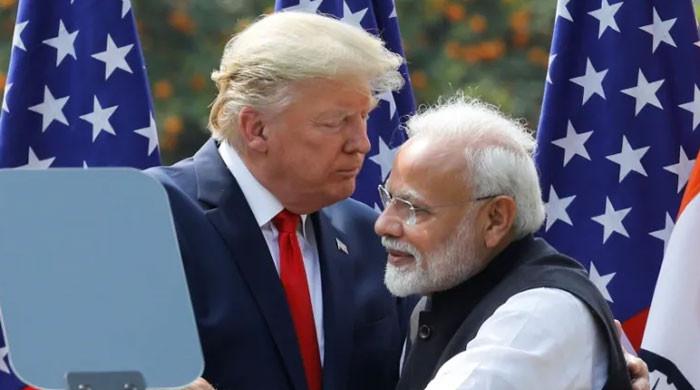
The president of the United States, Donald Trump, has dismissed international law and has stated that only his “own morality” can stop the aggressive policies he is applying around the world after the kidnapping of Nicolás Maduro in Venezuela.
“I don't need international law. I'm not out to harm people,” Trump told the New York Times on Thursday.
Recommended stories
list of 3 itemsend of list
When asked if he needed to respect international law, Trump said yes, but that “it depends what your definition of international law is.”
Trump has shown a willingness to use the brute force of the US military to achieve his foreign policy goals.
On Saturday, the United States launched an early morning attack on Venezuela, with explosions reported in the capital, Caracas, and at Venezuelan military bases.
US troops eventually kidnapped Venezuelan President Maduro in Caracas, in what critics say was a clear violation of the United Nations Charter, which prohibits “the threat or use of force against the territorial integrity or political independence of any state.”
The attack on Venezuela appears to have supercharged the belligerence of the US president, who received the first FIFA Peace Prize last month.
Immediately after the attack, Trump said the United States would “rule” Venezuela and exploit the country's vast oil reserves, although his administration has said it would cooperate with interim President Delcy Rodríguez.
Still, the Trump administration said it would “dictate” policy to the interim government and repeatedly threatened a “second wave” of military action if U.S. demands were disobeyed.
“If he doesn't do the right thing, he will pay a very high price, probably higher than Maduro's,” Trump said of Rodríguez in an interview Sunday with The Atlantic.
Earlier this week, Trump also suggested that the United States could carry out an attack on Colombia's leftist president, Gustavo Petro, and has intensified his campaign to acquire the Danish territory of Greenland.
In June, Trump joined Israel's unprovoked war against Iran and ordered the bombing of the country's three major nuclear sites.
Trump adviser Stephen Miller has criticized the post-World War II international order, saying that from now on the United States would “unapologetically” use its military force to secure its interests in the Western Hemisphere.
“We are a superpower, and under President Trump, we will behave like a superpower,” Miller told CNN on Monday.
But experts warn that failure to comply with international law could have catastrophic consequences for the entire global community, including the United States.
International law is the set of rules and norms that govern ties between states. Includes UN conventions and multilateral treaties.
Margaret Satterthwaite, the UN special rapporteur on the independence of judges and lawyers, told Al Jazeera earlier this week that US statements dismissing international law are “extremely dangerous”.
Satterthwaite said he is concerned that the world may be returning to an “age of imperialism,” and emphasized that degrading international laws may embolden Washington's adversaries to launch their own acts of aggression.
“International law cannot stop states from doing terrible things if they are committed to doing them,” Satterthwaite told Al Jazeera.
“And I think the world is aware of all the atrocities that have occurred in Gaza recently, and despite the efforts of many states and certainly the UN to stop those atrocities, they continued. But I think we are worse off if we don't insist on international law that does exist. We will just be going down a much worse slippery slope.”
Yusra Suedi, assistant professor of international law at the University of Manchester, warned against the belief that “might is right” and the tendency to ignore international law.
“It signals something very dangerous, in the sense that it gives permission to other states to basically follow suit: states like China, which might be looking at Taiwan, or Russia with respect to Ukraine,” Suedi told Al Jazeera.
Ian Hurd, a political science professor at Northwestern University, said the story illustrates the dangers of U.S. policies in Latin America.
The region has seen more than a century of US invasions and US-backed military coups, which have led to instability, repression and human rights abuses.
“Historically there are countless examples of this, from Panama to Haiti to Nicaragua to Chile in the '70s and so on,” Hurd told Al Jazeera.
He added that Trump's policies in Venezuela are “in line” with the way the United States has previously tried to decide how other parts of the Americas are governed.
“You can see that in each of those cases, the United States came to regret its decision to intervene. These never work out well.”