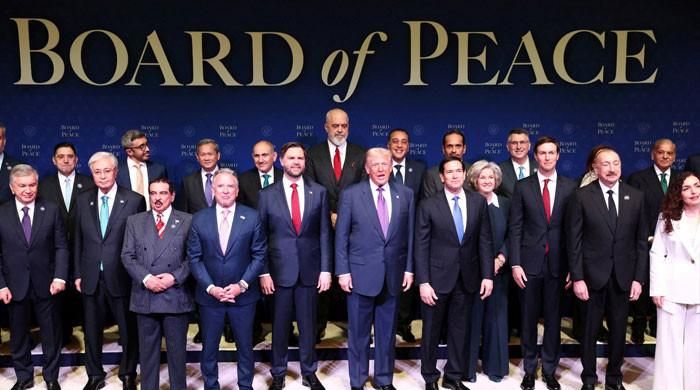
- Trump's Peace Board excludes Palestinian representatives.
- PM Shehbaz and other world leaders attend Trump-led balance of payments meeting.
- Trump greets PM Shehbaz and CDF Asim Munir at inaugural meeting.
US President Donald Trump said at the first meeting of his Peace Board (BoP) on Thursday that $7 billion has been contributed to a Gaza reconstruction fund aimed at rebuilding the enclave.
In a series of announcements at the end of a long, winding speech, Trump said the United States will make a $10 billion contribution to the Peace Board. He said contributing nations had raised $7 billion as a down payment for the reconstruction of Gaza.
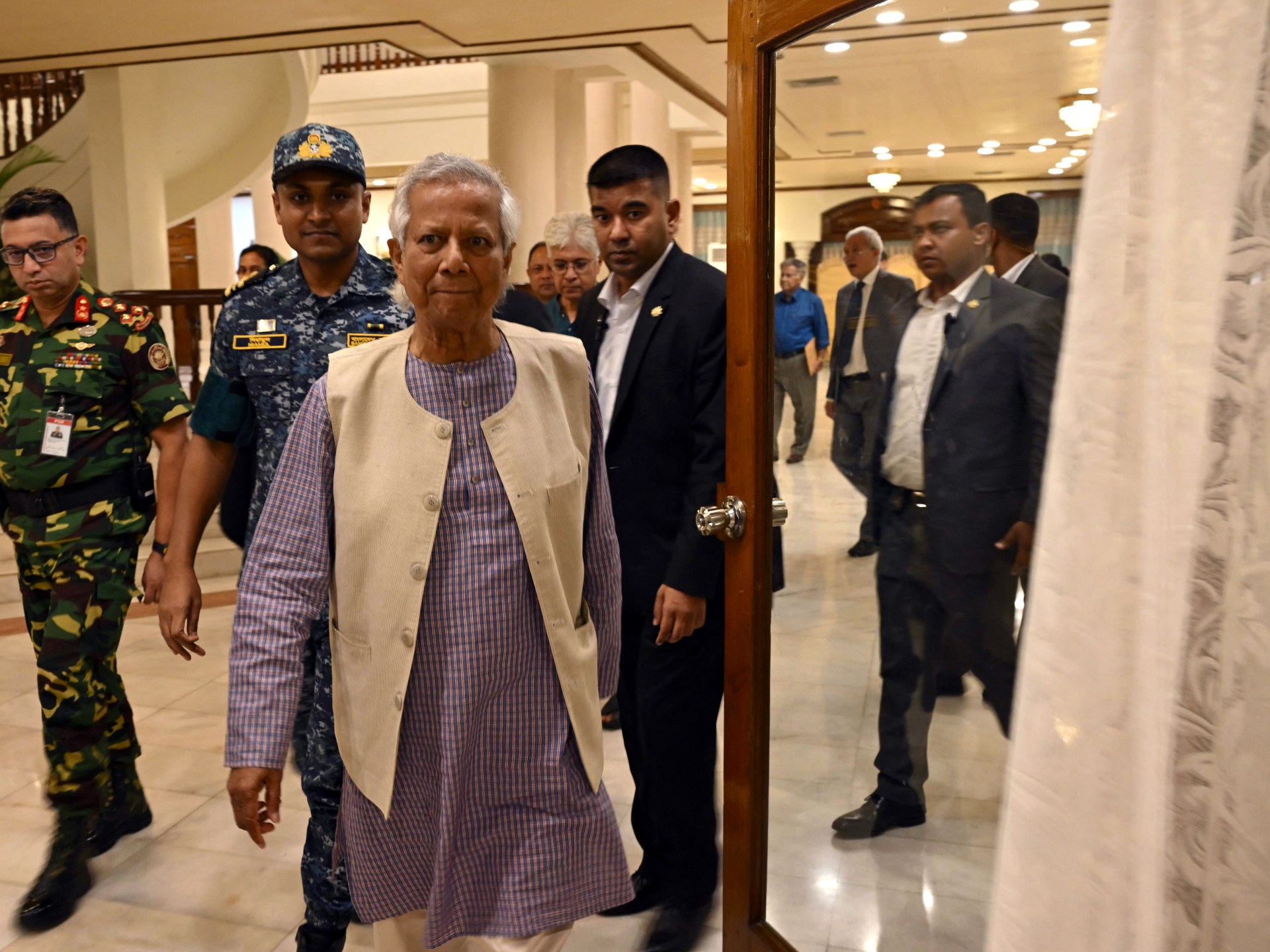
Prime Minister Shehbaz Sharif was among world leaders who attended the inaugural meeting of the Trump-led Peace Board in Washington DC.
Trump first proposed the board last September when he announced his plan to end Israel's war in Gaza. He later made clear that the junta's mandate would expand beyond Gaza to address other conflicts around the world.
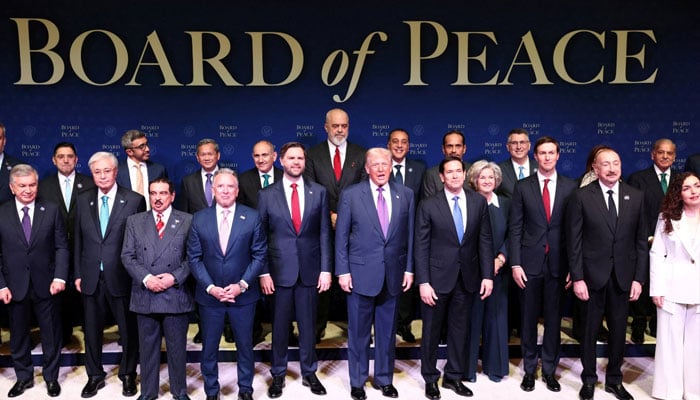
Addressing the meeting, Trump said countries had contributed more than $7 billion to help in Gaza as part of his Peace Board effort.
“I am pleased to announce that Kazakhstan, Azerbaijan, the United Arab Emirates, Morocco, Bahrain, Qatar, Saudi Arabia, Uzbekistan and Kuwait have contributed more than $7 billion to the aid package,” Trump said at the board's inaugural meeting in Washington.
He said it will not be necessary to send soldiers to fight in Gaza.
Trump also said that FIFA will raise $75 million for soccer-related projects in Gaza and that the United Nations will provide $2 billion for humanitarian assistance.
Addressing the inaugural meeting of Trump's Peace Board, Prime Minister Shehbaz described his participation as an honor and reaffirmed Pakistan's commitment to lasting peace in Gaza.
In his speech, the prime minister said the search for sustainable peace in Gaza remains a shared mission, adding that the day marked a “golden chapter in history” for peace efforts in the Middle East.
He expressed hope that the initiative would achieve long-term stability in the war-affected region.
Prime Minister Shehbaz specifically attributed Trump's timely intervention to preventing a full-scale war between Pakistan and India, stating that the ceasefire helped save thousands of precious lives and protected South Asia from large-scale destruction.
The prime minister reiterated that the establishment of an independent and sovereign Palestinian state is essential to achieving lasting peace in the Middle East. He said Pakistan has consistently supported a just and lasting solution based on international principles.
“To achieve lasting peace [in Gaza]ceasefire violations must end,” he said.
Shehbaz also offered prayers for the success of the Peace Board initiative, expressing optimism that it would contribute significantly to peace in Gaza and beyond.
Trump greets Prime Minister Shehbaz and CDF Munir
US President Trump also praised Prime Minister Shehbaz and “tough and serious fighter” Chief of Defense Forces and Chief of Army Staff Field Marshal Asim Munir during the inaugural meeting of the Peace Board in Washington.
Speaking at the initial meeting, Trump said: “I like this man [PM Shehbaz] of Pakistan.”
Referring to last year's May conflict between Pakistan and India, Trump said: “There was some fighting going on when I met him and his great field marshal. [Asim Munir]a great guy.”
The US President recalled the Prime Minister's earlier statements, saying that Prime Minister Shehbaz had credited him with saving 25 million lives by stopping the war between Pakistan and India.
As the war between the two nuclear-armed neighbors raged, Trump reiterated that he played a role in stopping the conflict.
Last year, Pakistan and India engaged in a military standoff, the worst between the old enemies in decades, which was sparked by a terror attack on tourists in the Pahalgam area of IIOJK, which New Delhi alleged was backed by Pakistan.
Islamabad denied involvement in the Pahalgam attack, which killed 26 people, and offered to take part in a neutral investigation into the deadly incident.
During the clashes, Pakistan shot down seven Indian fighter jets, including three Rafales, and dozens of drones. After at least 87 hours, the war between the two nuclear-armed nations ended on May 10 with a US-brokered ceasefire agreement.
On the occasion, the American president praised the professionalism of the CDF Munir, calling him a “good tough fighter.”
The US president said he had heard that Pakistan and India were fighting and the situation was getting worse, adding that many planes were shut down.
Reviewing the count of planes shot down during the war between Pakistan and India, the US president said that “11 very expensive planes” were shot down in the combat.
“Any agreement with Iran must be significant”
The Peace Board includes Israel but not Palestinian representatives, and Trump's suggestion that the Board could eventually address challenges beyond Gaza has raised anxiety that it could undermine the UN's role as a primary platform for global diplomacy and conflict resolution.
“We're going to strengthen the United Nations,” Trump said, trying to calm his critics. “It's really very important.”
The meeting came as Trump threatens war against Iran and has embarked on a massive military buildup in the region should Tehran refuse to abandon its nuclear program.
Trump said he should know in 10 days whether a deal is possible. “We have to reach a meaningful agreement,” he said.
Trump said he hoped the use of force to disarm Hamas would not be necessary. He said Hamas had promised to disarm and that “it looks like they are going to do it, but we will have to find out.”
In Gaza, Hamas spokesman Hazem Qassem said any international force must “monitor the ceasefire and prevent the Israeli occupation from continuing its aggression.” Disarmament could be discussed, he stated, without directly committing to it.
Before the meeting, three sources said Reuters that Pakistan wants firm assurances from Washington before sending troops to Gaza as part of the proposed ISF.
Islamabad is seeking assurances that the deployment will be strictly a peacekeeping mission and will not involve the disarmament of Hamas.
Three government sources said during the visit to Washington that Prime Minister Shehbaz wanted to better understand the objective of the ISF, under what authority they operated and what the chain of command was before deciding on troop deployment.
“We are ready to send troops. Let me make it clear that our troops could only be part of a peace mission in Gaza,” said one of the sources, a close aide of Prime Minister Shehbaz.
“We will not participate in any other role, such as disarming Hamas. It is out of the question,” he said.
Last month, Foreign Ministry spokesperson Tahir Andrabi said Pakistan would continue to participate in international efforts aimed at peace and security in Gaza.
“Pakistan will remain committed to international efforts for peace and security in Gaza, leading to a lasting solution to the question of Palestine in accordance with United Nations resolutions,” he said.
Pakistan has reiterated in international forums its willingness to play a “constructive role” in the US peace plan for Palestine.
Trump unveiled his new board at the World Economic Forum in Davos in late January, and world leaders, including Prime Minister Shehbaz, signed off on signing a lasting deal for Gaza.
Force to oversee reconstruction and recovery
Trump's 20-point plan for Gaza calls for a force of Muslim nations to oversee a transition period for reconstruction and economic recovery in the devastated Palestinian territory, and Washington has been pressuring Islamabad to join.
Analysts say Pakistan would be an asset to the multinational force, with its experienced military that has gone to war with archrival India and faced insurgencies.
“We can initially send a couple of thousand troops at any time, but we need to know what role they will play,” the source added.
Two of the sources said Prime Minister Shehbaz, who met with Trump earlier this year in Davos and late last year at the White House, was likely to have an audience with him on the sidelines of the meeting or the next day at the White House.
Initially designed to consolidate the ceasefire in Gaza, Trump sees the council, launched in late January, taking on a broader role in resolving global conflicts. Some countries have reacted cautiously, fearing it could become a rival to the United Nations.
While Pakistan has supported the establishment of the junta, it has expressed concerns against the mission to demilitarize Hamas.