- Early calls from the United States include urging Iranians to overthrow their government.
- The goals range from weakening Iran's military to ending missile threats.
- Schedule estimates range from less than four weeks to an indefinite duration.
WASHINGTON: President Donald Trump and his top officials have offered shifting goals and reasons for the US-Israel war against Iran, which critics say shows a lack of planning for the conflict and its consequences.
The stated objectives and expected timeline have varied, including overthrowing Iran's government, weakening Iran's military, security and nuclear capabilities and regional influence, as well as supporting Israeli interests.
Here's how Trump described his war goals and timeline:
February 28: Calls for Iranians to overthrow their government
The Iranian people should “take over” the government of their country, Trump said in a video on social media as the United States and Israel launched their attacks. “It will be yours for the taking,” he added. “This will probably be their only chance for generations.”
Trump described the attacks as “major combat operations.”
February 28: Weaken Iran's military and influence
Trump said Washington would deny Iran the ability to have a nuclear weapon, although Tehran has insisted its nuclear program is for peaceful purposes. Iran does not have nuclear weapons, while the United States does. Israel is also widely believed to be the only Middle Eastern country with nuclear weapons.
Trump insisted he would end what he described as Tehran's ballistic missile threat. “We are going to destroy their missiles and wipe out their missile industry,” he said. “We are going to annihilate their navy.”
Trump claimed that Iran's long-range missiles “can now threaten our very good friends and allies in Europe, our troops stationed abroad, and could soon reach the American homeland.”
His comments echoed President George W. Bush's case over the Iraq War, which had false claims. Neither experts nor US intelligence support Trump's claims, and both assess that Iran's ballistic missile program was years away from threatening US territory.
March 2: Changing timeline
Trump said the war was projected to last four to five weeks, but could last longer.
“We are already substantially ahead of our time projections. But whatever the timing is, that's fine. Whatever it takes,” Trump said at the White House. In a social media post, Trump said there was a “virtually unlimited supply” of American munitions and that “wars can be fought 'forever' and very successfully, using only these supplies.”
In a notification to Congress, Trump did not provide a timeline. Trump previously told the Daily Mail that the war could last “four weeks, or less,” then told the New York Times four to five weeks and later said it could take longer.
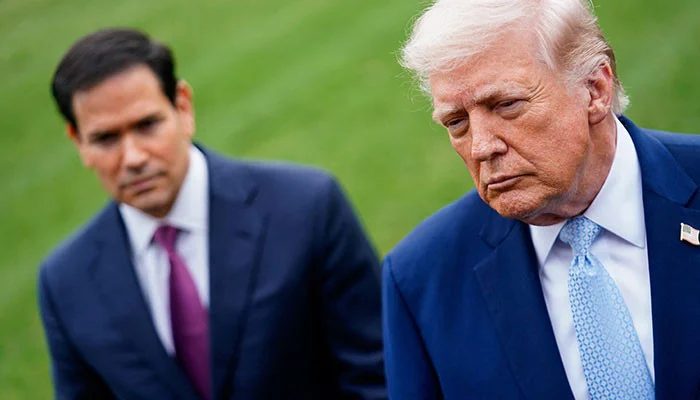
March 2: Rubio says the United States attacked Iran because Israel did it
Secretary of State Marco Rubio told reporters that Israel's determination to attack Iran forced Washington to strike.
“We knew there was going to be an Israeli action, we knew that would precipitate an attack on American forces, and we knew that if we didn't preemptively pursue them before they launched those attacks, we would suffer greater casualties,” Rubio said.
March 3: Trump contradicts Rubio
Trump said he ordered US forces to join Israel's attack on Iran because he believed Iran was about to strike first.
“It could have forced them (Israel) to act,” Trump said. “If we didn't do it, they (Iran) would attack first.”
March 4: Call to 'destroy' security infrastructure
Pentagon chief Pete Hegseth said the goal was to “destroy Iranian offensive missiles, destroy Iranian missile production, destroy their navy and other security infrastructure.”
March 6: call for 'unconditional surrender'
“There will be no deal with Iran except UNCONDITIONAL WAIVER,” Trump wrote on social media.
March 8 to 11: just the beginning, but also “practically complete”
Hegseth told CBS News in an interview broadcast on March 8 that the attacks on Iran were “just the beginning.”
A day later, Trump told the same network: “I think the war is very complete, more or less.”
“We've already won in many ways, but not enough,” Trump told reporters later in the day. When asked if the war was beginning or ending, he said, “Well, I guess you could say both.”
On March 11, Trump said again that he thought the United States had won, but: “We have to finish the job.”
March 13: Call for an internal uprising softens
In a March 13 interview, Trump told Fox News that the war will end “when I feel it in my bones.”
Trump softened his call for the Iranians to overthrow his government. “So I really think that's a big hurdle for people who don't have guns to overcome,” Trump said.
March 19: Hegseth says there is no deadline
Hegseth said Washington was not setting a timetable for the war and that Trump would decide when to stop it.
“We don't want to set a definitive deadline,” the Pentagon chief said. “Ultimately, it will be the president's choice when we say, 'Hey, we've accomplished what we needed.'”
March 20: Trump considers reducing the fire, but does not do so.
Trump posted on Truth Social that “we are getting very close to meeting our goals as we consider reducing our extensive military efforts” in the Iran war. Earlier in the day, Trump told reporters “I don't want to do a ceasefire” when asked about the war.