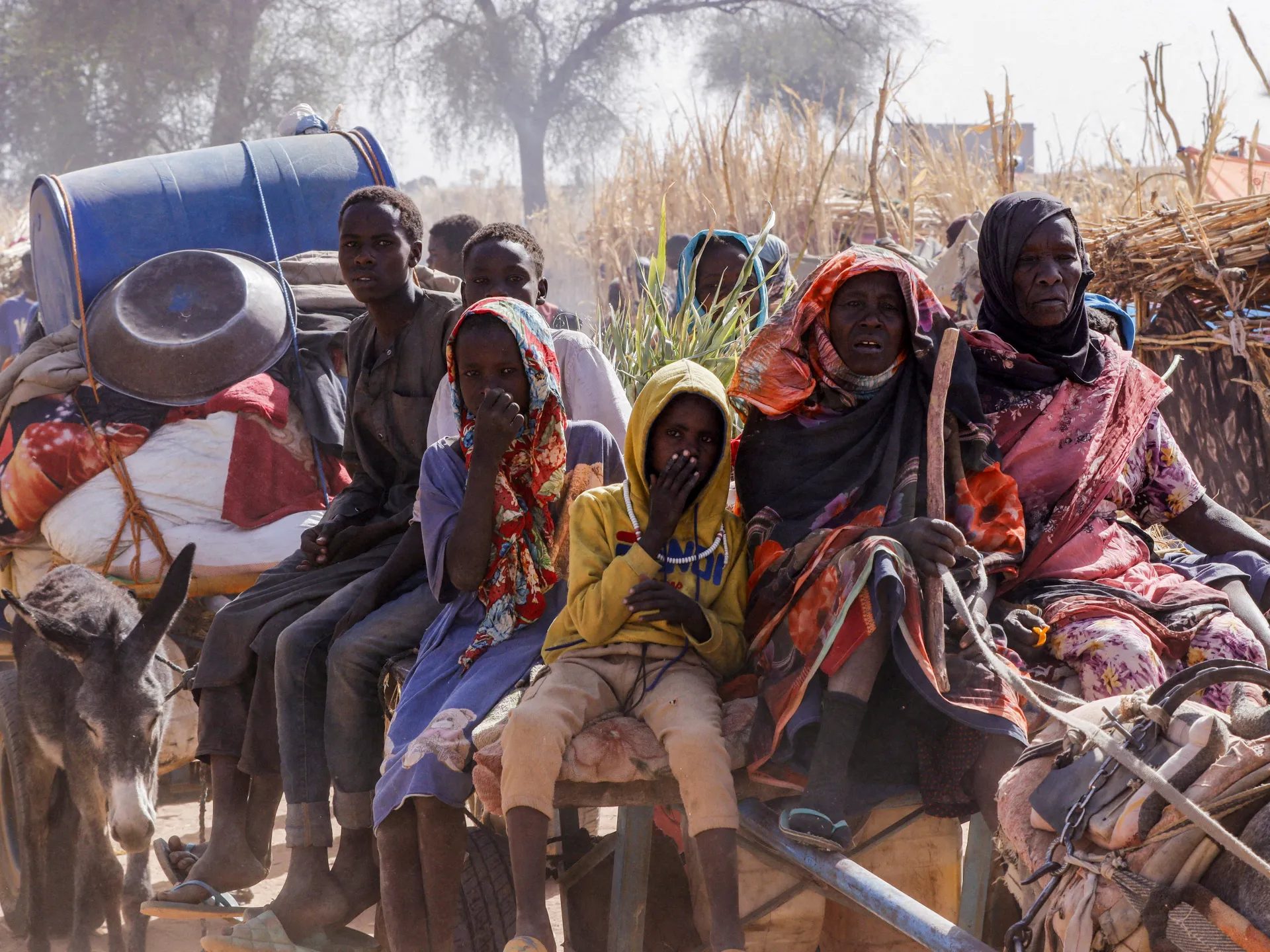
Montaha Omer Mustafa, 18, was one of the many people who managed to leave El Fasher before the takeover of the city by the paramilitary group Rapid Support Forces (RSF), but only after paying the fare and spending days on foot with little water, through villages and bushes.
As fighting approached the last major city controlled by the government-aligned Sudanese Armed Forces (SAF) in North Darfur state, tens of thousands of residents fled westward, abandoning homes, possessions and even family.
Recommended stories
list of 3 itemsend of list
El-Fasher was nearly emptied in a matter of days in October.
“Armed men stopped us and stole everything of value, gold, cash and food,” Mustafa told Al Jazeera from the Tawila refugee camp, about 50 kilometers (30 miles) west of el-Fasher.
Somewhere along the way, between thirst, fear and the rush of thousands of people moving at once, his brother disappeared. They searched and then had to move on.
There was no choice, she said, and she remains unsure of her fate.
Three Sudanese refugees told Al Jazeera about their escape from El-Fasher, making a journey from a city that was under bombardment and siege to the Tawila refugee camp, where the sudden arrival of thousands of people has pushed already scarce resources to the brink.
'Ghost town'
What the fleeing people left behind has become a “ghost town,” according to the medical charity Doctors Without Borders (also known by its French acronym MSF), whose teams visited the city in January.
MSF said it fears that “most of the civilians who were still alive when the RSF took the city have been killed or displaced.”
More than 120,000 people fled the RSF capture of El-Fasher – about 75 percent of whom were already internally displaced persons (IDPs) seeking refuge there – the International Organization for Migration said in January, while the World Food Program says between 70,000 and 100,000 remain trapped in the city.
Nathaniel Raymond, executive director of the Humanitarian Research Laboratory at the Yale School of Public Health, which has been monitoring the war, recounted a rare call last year with someone trapped in el-Fasher, telling Al Jazeera: “They had run out of food and water. And… they saw dead bodies everywhere… they came out during the night.
“We only spoke on the phone once. We haven't spoken to them again.”
RSF accused of more war crimes
The RSF mounted a major offensive to capture el-Fasher late last year, after besieging the city for almost 18 months.
Its long-awaited fall, even as fighters marooned in the city put up determined resistance, precipitated mass atrocities in el-Fasher, including the systematic targeting of non-Arab populations, particularly the Zaghawa and Fur tribes, according to the United Nations and human rights groups.
On January 19, the deputy prosecutor of the International Criminal Court (ICC) told the UN Security Council that the FAR had committed war crimes and crimes against humanity during its capture of el-Fasher.
Nazhat Shameem Khan said the city's fall was followed by a “calculated campaign of deepest suffering,” particularly targeting members of the Zaghawa and Fur ethnic groups. “This crime is repeated in city after city in Darfur,” he said.
Marwan Mohammed, an activist in the Tawila refugee camp, where most refugees have fled., They told Al Jazeera that recent escapees described scenes in the city as “the worst they have seen”, with neighborhood streets strewn with bodies.
Satellite images analyzed by the Yale Humanitarian Research Laboratory showed RSF's systematic efforts to destroy evidence of mass killings as piles of objects consistent with human remains, large enough to be seen from space, formed.
By the end of November, 72 percent of the groups had shrunk and 38 percent were no longer visible.
A Sudan Tribune investigation published in January identified suspected mass graves throughout El-Fasher, along with secret detention centers where the RSF reportedly murders, rapes, tortures, starves and financially extorts civilians.
RSF leader Mohamed Hamdan “Hemedti” Dagalo acknowledged that his fighters had committed abuses in October and said some of the perpetrators had been arrested, a move that was met with skepticism by activists and human rights groups.
Mohamed Badawi, a Sudanese human rights activist with the Uganda-based African Center for Justice and Peace Studies which monitors Darfur, told Al Jazeera that a war economy had emerged to sustain the city, with RSF fighters charging exorbitant prices for the entry of goods. The first aid convoy to enter El Fasher since mid-2024 did not arrive until mid-January.
“The things that arrive include animal feed, salt, really basic products for people,” Badawi said.
“The people inside depend on their friends around the world… who send them money. There are no services within the city. There is no water, no internet, no food. It has become a city in the dark ages,” Badawi added.
Badawi said escaping from El Fasher has now turned into a system of extortion, with RSF fighters frequently kidnapping fleeing people for ransom.
“People pay from $500 on the low end to $1,600,” he told Al Jazeera. “Many people in El Fasher simply cannot afford it.”
'My children and I are suffering'
Many of the displaced people leaving El Fasher make a multi-day journey to the Tawila refugee camp, about 50 kilometers (31 miles) to the west, through multiple checkpoints manned by RSF fighters who often charge fees for passage.
There they join the estimated 1.4 million displaced people in what is now an extensive network of camps in Tawila.
The city, long a refuge for those fleeing violence in North Darfur, offers distance from the front lines but little else for those on its fringes.
“The weather is very cold. We have no mattresses to sleep on or blankets to cover us. We lack food and getting water is extremely difficult,” said Mustafa, the 18-year-old girl who lost her brother while fleeing.
Zahra Mohamed Ali Abakar, 29, who fled El Fasher months earlier in June, said: “We slept on the ground and under the sky.
“There are no tents; people use bags to protect themselves from the sun and the cold.”
The Sudan Doctors Network warned in October that health centers in Tawila are suffering from severe shortages of medicines and medical supplies, lack of adequate food for children and even clean water.
Very little has changed since then, said Mohammed, the Tawila camp activist.
Abdalla Ahmed Fadul Abu-Zaid escaped from El Fasher four and a half months ago, after an RSF bombing shattered his left leg, forcing doctors to amputate it in the city, where medical supplies had virtually run out months earlier, he said.
Since arriving in Tawila with his family of eight, they have only received help twice: small rations of corn that quickly ran out.
His wound still requires regular dressings, but the trip to the hospital is expensive and he has no money.
“My children and I are suffering a lot,” he said.