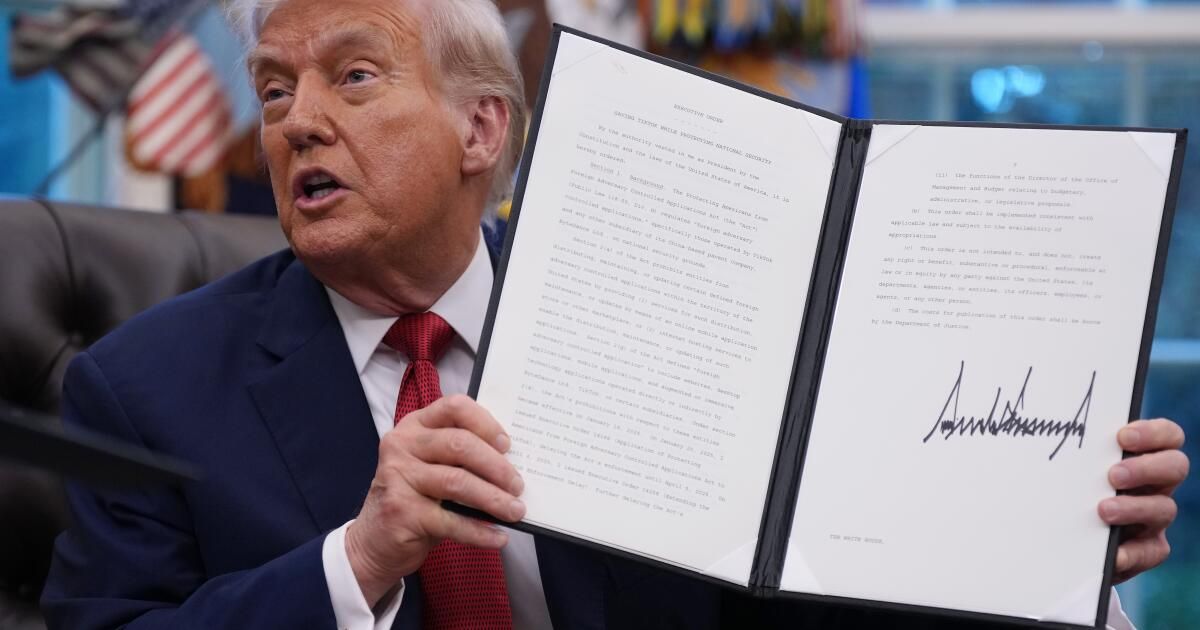
WASHINGTON- President Trump's plan to end birthright citizenship for newborns whose parents are here illegally or temporarily will get a full hearing before the Supreme Court.
The justices agreed Friday to hear arguments on Trump's proposal after judges across the country declared it unconstitutional and blocked it from taking effect.
Trump's lawyers argued that the government had been misinterpreting the 14th Amendment for at least a century.
He proposed a change because “the President recognized that automatic citizenship for the children of illegal aliens operates as a powerful incentive for illegal migration,” the court was told.
“Not only do these children automatically become full citizens, but their citizenship is often quickly asserted to prevent the removal of their illegal alien parents,” Attorney General J. Dean Sauer argued.
The 14th Amendment of 1868 begins with the words: “All persons born or naturalized in the United States and subject to the jurisdiction thereof are citizens of the United States and of the state in which they reside.”
The amendment formally overturned the Dred Scott decision in which the court had said that free blacks were not citizens.
The key phrase “subject to its jurisdiction” has been understood to mean “subject to the laws” of the United States,” and that includes almost everyone present except foreign diplomats.
But Trump's lawyers argued that in 1868 the phrase was understood to refer more narrowly to people who had a political allegiance to the United States, rather than a foreign country.
Based on that understanding, Trump's lawyer argued that the “Citizenship Clause was adopted to grant citizenship to freed slaves and their children, not to the children of illegal aliens, natural-born tourists, and temporary visitors.”
He said that “near-automatic citizenship has spawned an industry of modern 'birth tourism,' whereby foreigners travel to the United States solely for the purpose of giving birth here and obtaining citizenship for their children.”
In rejecting Trump's proposal, lawyers and judges have pointed to the 1898 Supreme Court ruling in favor of Wong Kim Ark. He was born in San Francisco to Chinese parents and his citizenship was later confirmed by the court.
“No president can change the fundamental promise of citizenship contained in the 14th Amendment,” said Cecillia Wang, national legal director of the ACLU. “For more than 150 years, it has been the law and our national tradition that everyone born on American soil is a citizen from birth… We look forward to resolving this matter once and for all at the Supreme Court during this term.”
Trump's lawyers ignored that precedent by arguing that Wong Kim Ark's parents were “permanently domiciled” in California. He said the court's opinion repeatedly referred to that fact, suggesting that birthright citizenship was limited to parents who were legal residents, not those who were here illegally or temporarily.
The court is likely to hear arguments in the Trump v. Barbara case in March and issue a ruling in late June.
If the court were to uphold Trump's proposal, it would act “only on a prospective basis,” Sauer said.
It would deny citizenship to babies whose mother or father is not a citizen or “lawful permanent resident” and would exclude children of mothers who were “visiting on a student, work or tourist visa.”