Victims of Jeffrey Epstein have criticized the US government after it released a partial set of case documents against the late convicted sex offender with heavily redacted pages and blacked out photographs.
Saturday's growing protest came as US media reported that at least 16 files from the stretch, which were posted online, had disappeared from the public website.
Recommended stories
list of 3 itemsend of list
The deleted files included a photograph showing President Donald Trump.
The Department of Justice (DOJ) began releasing the trove on Friday to comply with a law passed overwhelmingly by Congress in November that required the release of all of Epstein's files, despite Trump's months-long effort to keep them sealed.
He said he plans to release more records on an ongoing basis, blaming the delay on what he said was a slow process to withhold survivors' names and other identifying information.
But the tens of thousands of pages made public offered little new information about Epstein's crimes or the court decisions that allowed him to avoid serious federal charges for years. They also omitted some of the most closely watched material, including FBI interviews with victims and internal Justice Department memos on charging decisions.
Meanwhile, a 119-page document titled “Grand Jury-NY,” likely from one of the federal sex trafficking investigations that led to charges against Epstein in 2019, was completely redacted.
One of Epstein's victims, Marina Lacerda, reacted angrily to the large number of redactions and unpublished documents.
“This makes us all angry,” he told media outlet MS NOW on Saturday. “It's another slap in the face. We expected a lot more.”
Lacerda, who said Epstein abused her when she was 14, was a crucial witness in the 2019 investigation that led to the filing of sex trafficking charges against the late financier.
Epstein committed suicide in jail that year shortly after his arrest.
Lacerda told The New York Times in a separate interview that she was disappointed.
“Many of the photos are irrelevant,” he said.
Another survivor, Jess Michaels, told news outlet CNN that she spent hours searching through released files for her victim's statement and records of her call to an FBI tip line, but found none.
“I can't find any of those,” he said. “Is this the best the government can do? Not even an act of Congress will allow us to do justice.”
Marijke Chartouni, who said Epstein abused her when she was 20, decried the lack of openness.
“If everything is redacted, where is the transparency?” he said Friday in an interview with The New York Times.
Some lawmakers also expressed frustration.
Republican Rep. Thomas Massie, who helped lead the legislative push, accused the White House of failing to comply with “both the spirit and the letter of the law Donald Trump signed just 30 days ago” in a social media post Friday.
That law required the government's case file to be released by Friday, limited only by legal and victim privacy concerns.
Meanwhile, the 16 unexplained missing files led to online speculation about what was deleted and why the public was not notified, compounding long-running intrigue about Epstein and the powerful figures around him.
Democrats on the House Oversight Committee pointed to the missing image with a photo of Trump in a post on X and wrote: “What else is being covered up? We need transparency for the American public.”
“If they're eliminating this, imagine how much more they're trying to hide,” said Democrat Chuck Schumer. “This could be one of the biggest cover-ups in American history.”
The Trump administration, however, denied that it had not been forthcoming with the published materials. Deputy Attorney General Todd Blanche said during a television interview with ABC that there was no attempt to “hide anything” to protect Trump.
The Justice Department also issued a statement about X late Saturday. “Photographs and other materials will continue to be reviewed and redacted in accordance with the law with an abundance of caution as we receive additional information,” he said.
Elsewhere, celebrities who appeared in photos available as part of Friday's release include former President Bill Clinton, the late news anchor Walter Cronkite, singers Mick Jagger, Michael Jackson and Diana Ross, British businessman Richard Branson and the former Duchess of York, Sarah Ferguson.
There were also photographs of Epstein with actors Chris Tucker and Kevin Spacey.
Many of the photographs were lacking dates and context, and none of those figures have been charged with any crimes in connection with Epstein.
Andrew Mountbatten-Windsor is also pictured lying on the laps of several women. The former Duke of York, who was stripped of his royal title over his links to Epstein, has denied any wrongdoing.
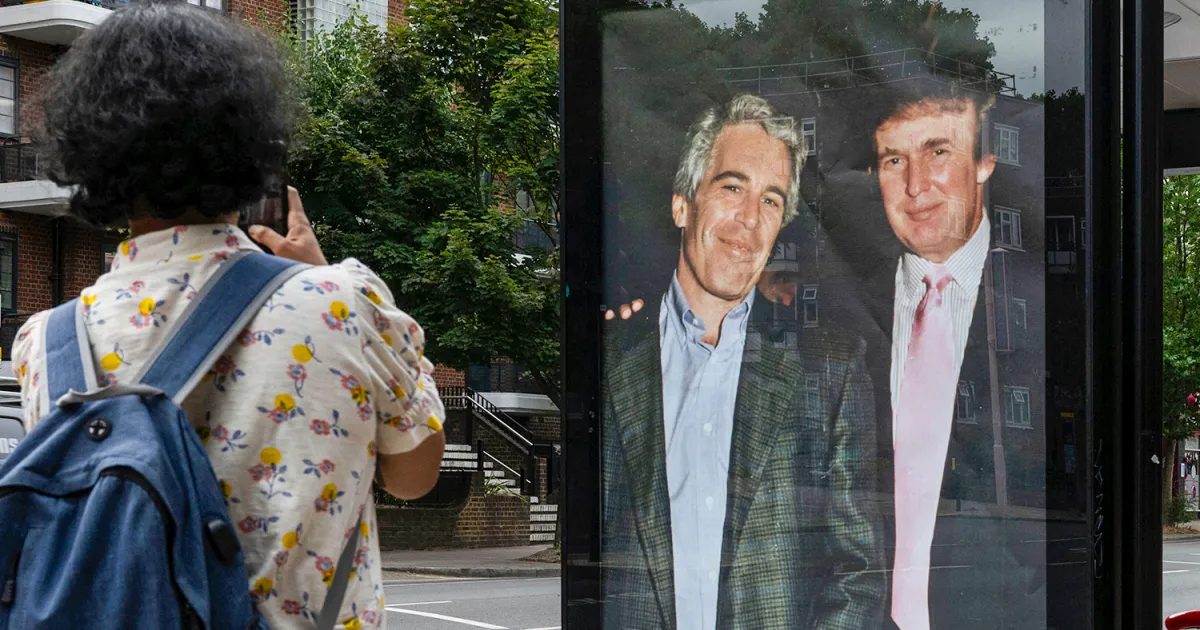
Noticeably missing were references to Trump himself, despite his frequent inclusion in previous releases of Epstein-related documents. Trump and Epstein were friends in the 1990s and early 2000s and had a falling out before Epstein's first conviction in 2008.
Trump has not been charged with any crime and has denied knowledge of Epstein's crimes.
Amid the outcry, the Justice Department attempted to draw attention to Clinton, with two agency spokespeople posting images on social media that they said showed him with Epstein's victims.
Clinton's deputy chief of staff, Angel Ureña, said in a statement that the White House was trying to “protect itself” from scrutiny by focusing on the former president.
“You can post as many grainy 20+ year old photos as you want, but this isn't about Bill Clinton,” he wrote.