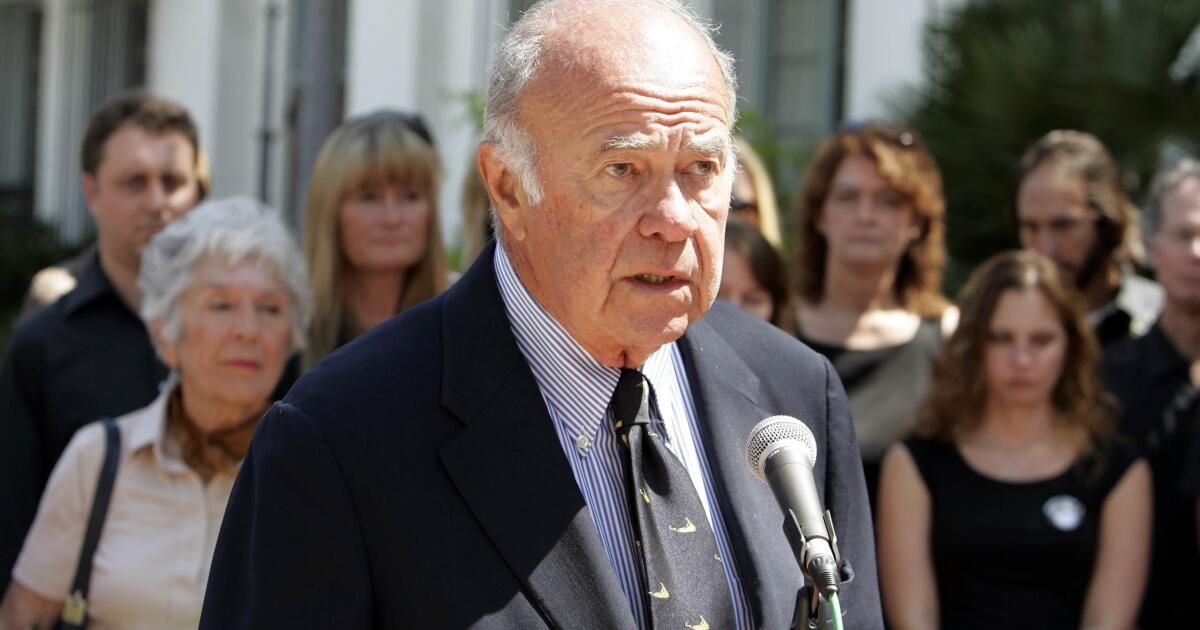
Journalist and author Lou Cannon, considered the nation's leading authority on the life and career of President Reagan, died Friday at a Santa Barbara hospice. He was 92 years old.
His death was caused by complications from a stroke, his son Carl M. Cannon told the Washington Post, where his father worked for years as a White House correspondent.
Cannon's father covered both of Reagan's presidential terms in the 1980s, but his relationship with the enigmatic Republican leader dates back to the 1960s, when Reagan moved from acting into politics.
Cannon interviewed Reagan more than 50 times and wrote five books about him, but he still struggled to understand what made Reagan who he was.
“The more I wrote,” Cannon told the Reno Gazette-Journal in 2001, “the more I felt like I didn't know.”
Cannon was born in New York City and grew up in Reno, Nevada, where he attended the University of Nevada, Reno and later San Francisco State College.
After serving in the U.S. Army, he became a reporter covering Reagan's early years as governor of California for the San Jose Mercury News. In 1972, Cannon began working for the Washington Post as a political reporter.
Cannon recalled his first meeting with Reagan in 1965, while he was assigned to cover a luncheon for journalists and lobbyists, and was surprised by Reagan's command of the room when he spoke.
Reagan was beginning his gubernatorial campaign by proving that he could answer questions and was “not just an actor reading a script.” At the time, the word actor was “synonymous with airhead. Well, Reagan was not an airhead,” Cannon said in a 2008 interview at the Richard Nixon Presidential Library and Museum.
To Cannon's surprise, reporters and lobbyists mobbed Reagan after the event ended for his autograph. Cannon introduced himself.
“I remember those steely eyes of his. I thought he had a great face, but his eyes are hard,” Cannon said. “His eyes are truly extraordinary.”
Later, on the phone, Cannon's editor asked him what he thought of Reagan. He responded, “I don't know anything, but if I were running this, why would anyone want to compete against someone that everyone knows and likes? Why would you want him to be your opponent?”
“I predicted Reagan would be president, but I had no idea he would be governor,” Cannon said. “I was very struck by the fact that he impacted people, not as if he were a politician, but as if he were a celebrity, a force of nature that people wanted to collide with. It was like seeing Kennedy again. They wanted the aura, the sun.”
In 1966, Reagan was elected governor by a margin of nearly a million votes, and Cannon found himself “writing about Ronald Reagan every day.”
Reagan's political opponents in California and Washington consistently underestimated him, assuming the former actor could be easily defeated at the polls, Cannon said. Reagan ran unsuccessfully for president twice, but had the will to keep trying until he won, twice.
“Reagan was tough and determined, and you couldn't talk him out of doing what he wanted to do,” Cannon said. “Nancy couldn't talk him out of what he wanted to do, for God's sake. And certainly no advisor or any other candidate could. Ronald Reagan wanted to be president of the United States.”
Cannon's first book about the president, “Reagan,” was published in 1982. In 1991 he published “President Reagan: The Role of a Lifetime,” which is considered a comprehensive biography of the 40th president.
Cannon also authored a book about the LAPD and the 1992 Rodney King riots in Los Angeles, as well as narrating a number of stories over the years, including the federal bust of a heroin kingpin in 1970s Las Vegas.
Mr. Cannon's first marriage, to Virginia Oprian, who helped him research his early books, ended in divorce. In 1985 he married Mary Shinkwin, according to the Washington Post. In addition to his wife, he is survived by three children.