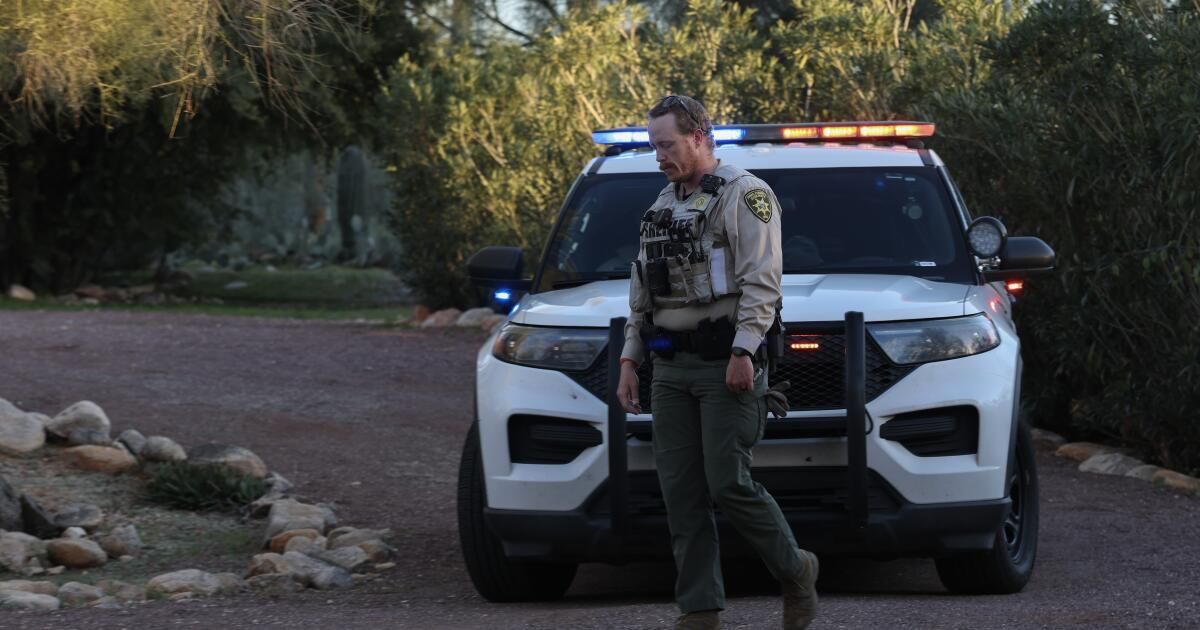
As the search for Nancy Guthrie moves into its third week, there is growing concern that the road to finding the missing 84-year-old woman is quickly cooling.
Investigators have detained two people since Guthrie was abducted from her Tucson-area home in the early hours of Feb. 1. But both were released after being questioned and no suspect has been publicly identified.
Authorities insist the case is still very active and the FBI has received more than 20,000 tips. But the case is branching out in new directions.
look at mexico
Law enforcement sources told The Times that investigators have been in contact with Mexican authorities in the case given Tucson's proximity to the border, but there is no evidence that the kidnappers crossed with Guthrie.
The sources spoke on condition of anonymity to discuss the case candidly.
Guthrie's home, near Tucson, is just an hour's drive from the border. Sources emphasized that Mexico's request for help was to exhaust all options, but there is no clear evidence to suggest Guthrie or the kidnappers are there.
Investigation status
DNA on a glove discovered two miles from Guthrie's home that matched those worn by a masked man seen in Nest camera footage returned no matches in the national DNA database used by law enforcement, CODIS. Biological evidence found in Guthrie's home is still being analyzed, but did not produce a CODIS match, Pima County Sheriff Chris Nanos told Fox News this week.
This week, an anonymous donor donated $100,000 to 88-CRIME for information that would lead investigators to arrest the individual involved in Guthrie's disappearance. This is in addition to the $100,000 reward for information offered by the FBI.
Nanos has tried to allay concerns that investigators are reaching nothing but dead ends, telling NBC News that “as long as we have the ability to follow a lead, it's not cold.”
“We have thousands of leads that we are analyzing,” he said. “We're going to find Nancy and we're going to find out who did this.”
So far, experts say investigators' best bet for solving the case quickly would be if someone recognized the suspect in the Nest video, a masked man seen on Guthrie's porch the morning she was kidnapped.
At 1:47 a.m. on February 1, the individual appears at the door of Guthrie's home. The man is wearing a balaclava, gloves and a backpack. A weapon is holstered at the man's waist, positioned in the front of his body and easily visible.
At one point, the man, whom authorities describe as approximately 5-foot-9 to 5-foot-10 with an average build, notices the camera on the front porch and attempts to cover the lens with his hand. The man scans the yard and patio area, apparently looking for anything obstructing the camera before settling on some vegetation found in the yard.
In the video, the man is carrying a black 25-liter Ozark Trail Hiker Pack backpack that can be purchased at Walmart, according to the FBI. Investigators have been working with Walmart leaders to see if they can identify who purchased the backpack.
Authorities are also searching gun stores and showing the video released by the FBI to see if anyone recognizes him, according to the sheriff's department.
Researchers use genetic genealogy.
DNA found inside Guthrie's home could also prove fruitful in the case, experts say.
Although authorities did not obtain any matches in the federal database, they are also employing genetic genealogy in an effort to identify a suspect in the case.
“If they really have the suspect's DNA, the DNA of Nancy's abductor, it will be identified through genetic genealogy,” said CeCe Moore, a genetic genealogist and co-founder of DNA Justice. “It's just a matter of time.”
Authorities can compare DNA collected at Guthrie's home to publicly accessible databases that contain the genetic profiles of millions of people who have turned them over for family history research and other reasons. From there, investigators can sometimes find distant relatives who can help them piece together a family tree that may point to a suspect.
Technology has helped solve some of the country's most high-profile cases in recent years. Researchers used genetic genealogy to identify Joseph James DeAngelo Jr. as the Golden State Killer who terrorized California in the 1970s and 1980s. It was also used to secure the conviction of Bryan Kohberger, who was sentenced to life in prison for murdering four college students in Idaho in 2022.
The technology has limits, but law enforcement sources told The Times it is probably the best way forward.
Law enforcement does not have easy access to the approximately 50 million genetic profiles contained in the Ancestry.com, 23andMe and MyHeritage databases. The companies have prohibited authorities from accessing such information and said they would disclose it only if compelled by a court order.
The GEDmatch, FamilyTreeDNA and DNA Justice databases are open to law enforcement use, but contain fewer than 2 million genetic profiles, Moore said.
With fewer genetic profiles to work with, there is more legwork involved, but Moore said it will likely be key to identifying a suspect.
“It could happen in minutes, hours, days, weeks, but I don't think it will take much longer because of all the resources available for this case,” he said.
Looking for your pacemaker
Authorities have also deployed “signal tracking” technology in the search for Guthrie.
Parsons Corp confirmed this week that the Pima County Sheriff's Department requested its help earlier this month to deploy BlueFly units to search for Guthrie. BlueFly is a Bluetooth and Wi-Fi sensor that can be used on air and ground vehicles for search and rescue operations in challenging environments, providing authorities with a heat map to identify signals within a specific area, according to the company.
BlueFly can detect medical devices like the Guthrie pacemaker.