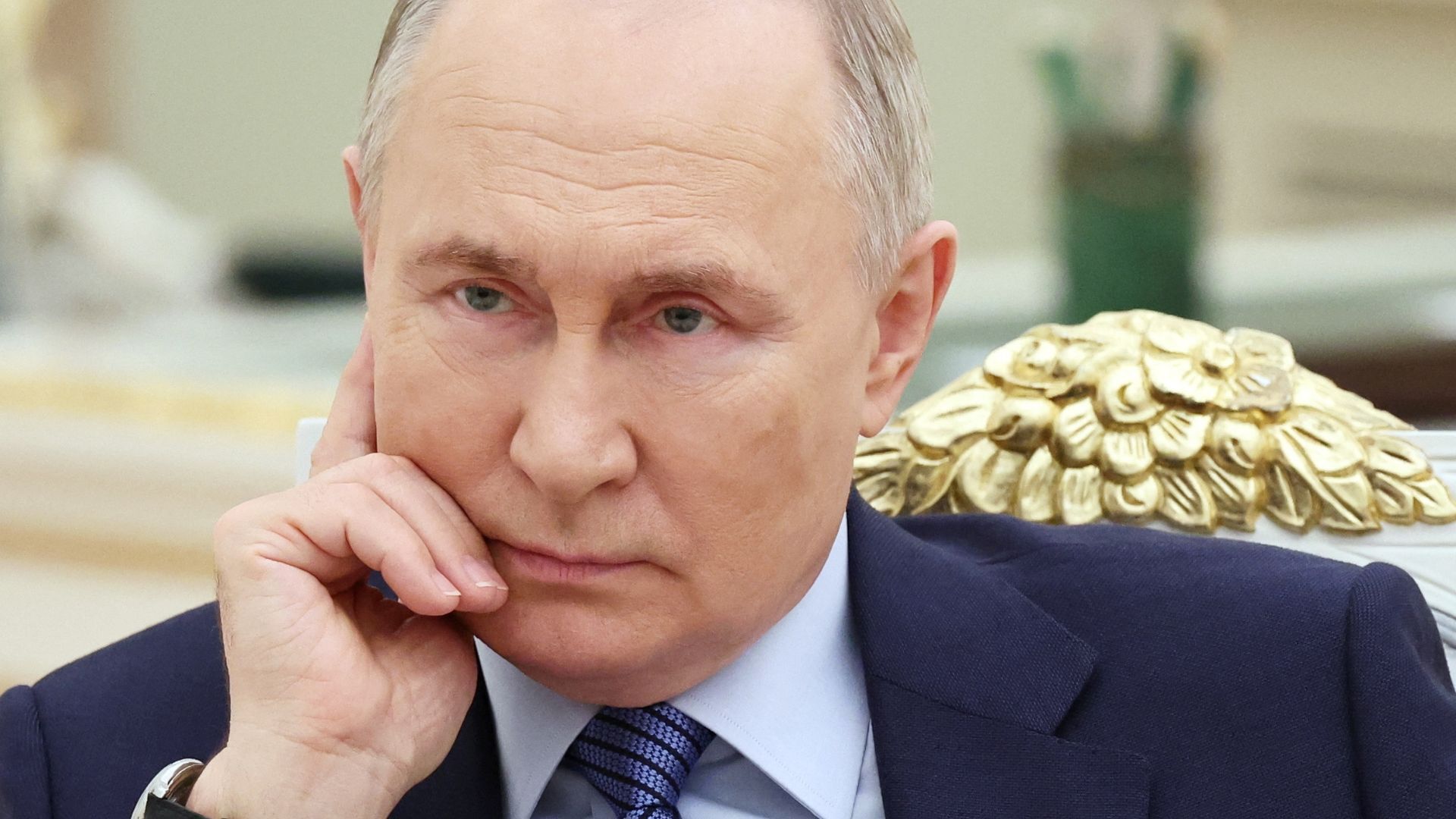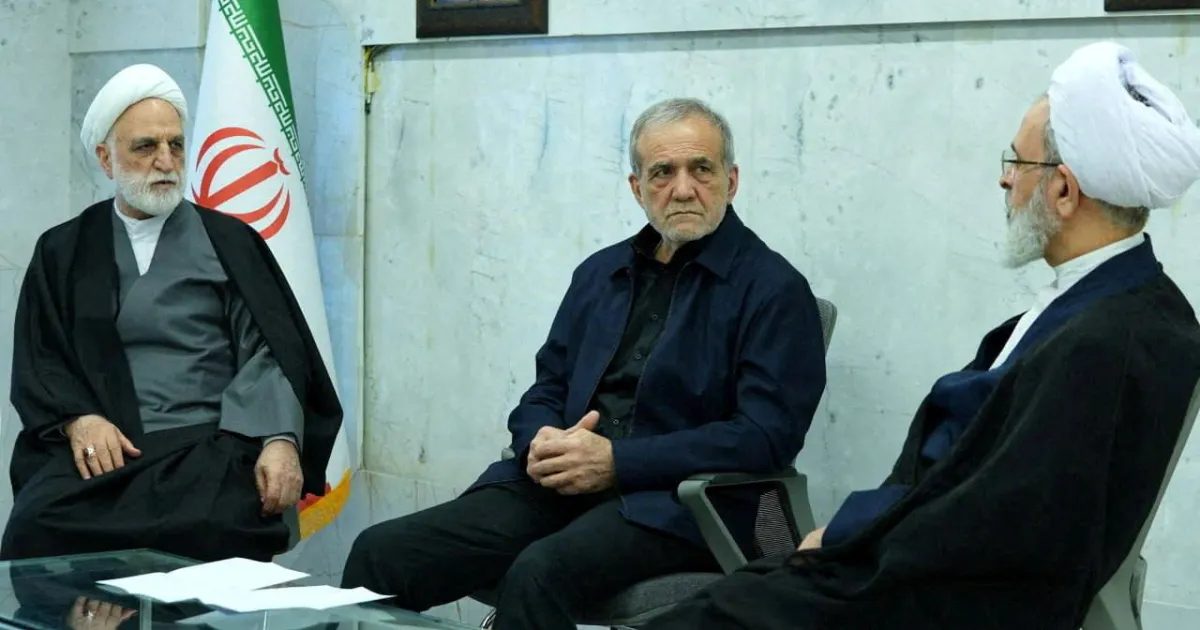
Iranian President Masoud Pezeshkian has set terms for ending the war with the United States and Israel, in what analysts say is a possible sign of a reduction in tensions by Tehran, as the US-Israel war against Iran entered its 13th day on Thursday.
In a Wednesday post on the social site X, Pezeshkian said he had spoken with his counterparts in Russia and Pakistan and had confirmed “Iran's commitment to peace.”
Recommended stories
list of 4 itemsend of list
“The only way to end this war – ignited by the Zionist regime and the United States – is by recognizing Iran's legitimate rights, the payment of reparations and firm international guarantees against future aggression,” Pezeshkian wrote.
This is a rare stance from Tehran, which has maintained a defiant stance and initially rejected any possibility of negotiations or a ceasefire when war broke out almost two weeks ago.
Pezeshkian's statement comes as pressure mounts on the United States to stop what has become a very costly mission. Analysts say Washington's speculation that Iran would quickly submit following the assassination of Supreme Leader Ayatollah Ali Khamenei was wrong.
Tehran is likely to determine the end of this war, not the United States or Israel, because of its ability to broadly inflict economic pain, they say.
Amid a military drubbing by the United States and Israel, Iran has launched heavy retaliatory attacks on American assets and other critical infrastructure in the Gulf countries, disrupting global supplies. It has also adopted what analysts call “asymmetric” tactics – such as disrupting the critical Strait of Hormuz and threatening entities linked to US banking – to inflict as much economic damage as possible on the region and the world at large.
Here's what we know about Pezeshkian's stance and what the pressures are on both sides to end the conflict quickly.
How much has the war cost so far?
Economically, both sides have weaponized energy. Israel first attacked Iran's oil facilities in Tehran on March 8, sparking an outcry from global health experts over the potential risk of air and water contamination.
Meanwhile, Iran has tightened its control over the Strait of Hormuz sea route – the only route to the open sea for oil producers in the Gulf – and its military vowed Wednesday that it has the capacity to fight a long war that could “destroy” the global economy.
Attacks on ships in the strait, where about 20 percent of global oil and gas traffic normally passes through, have effectively closed the route.
Oil prices soared above $100 a barrel late last week, up from $65 before the war, with ordinary buyers feeling the increases at pumps in the United States, Europe and parts of Africa.
On Wednesday, Iran upped the ante, saying it would not allow “one liter of oil” to pass through the strait and warning the world to expect a price of $200 a barrel.
“We don't know how quickly it will happen again,” Freya Beamish, chief economist at GlobalData TS Lombard, told Al Jazeera. “We believe it will return to $80 in due time, but the ball is to some extent in Iran's court,” he said, adding that because Iran needs oil revenues, the price increases are expected to be of limited duration.
The International Energy Agency agreed on Wednesday to release 400 million barrels from the emergency reserves of several member states, but it is not yet clear what impact this will have or how quickly this amount of oil can be released.
Tehran has also been accused of directly attacking oil facilities in neighboring countries this week. Iraq shut down all its oil port operations on Thursday after explosives-laden Iranian “drone” boats appeared to attack two fuel tankers in Iraqi waters, setting them on fire and killing a crew member.
A drone was filmed attacking the Salalah oil port in Oman on Wednesday, although Tehran has denied involvement.
What do Iranian officials say about the end of the war?
There have been mixed messages from Iranian leaders.
Iran's elite military unit and parallel armed force, the Islamic Revolutionary Guard Corps (IRGC), continues to show defiance, issuing threats and launching attacks against Israeli and US military assets and infrastructure in neighboring Gulf countries.
However, analysts say the political leadership appears more inclined toward diplomacy. On Wednesday, President Pezeshkian said that ending the war would require the United States and Israel to recognize Iran's rights, pay reparations to Iran (although it is unclear how much is being sought) and offer strong guarantees that a future war will not be fought.
In a video recording last week, he also apologized to neighboring countries for the attacks and promised that Iran would stop attacking its neighbors as long as they did not allow the United States to launch attacks from its territory.
“I personally apologize to neighboring countries that were affected by Iran's actions,” the president said, adding that Tehran was not seeking confrontations with its neighbors.
However, it is not known how much influence the political leadership has over the IRGC. Hours after the president's apology last week, air defense sirens sounded in Saudi Arabia, Qatar, the United Arab Emirates and Bahrain, as attacks in the Gulf continued.
So what is Iran's real position?
“Iran wants to go all the way to make sure the US and Israel never attack Iran again… so this has to be the final battle,” explained Al Jazeera's Resul Serdar Atas.
Indeed, the IRGC sees this as an existential war, but the timing of Pezeshkian's statement about ending the conflict also shows that Tehran is under pressure economically, politically and militarily, Zeidon Alkinani of Qatar's Georgetown University told Al Jazeera.
“These differences and divisions [between IRGC and political leaders] “It always existed even before this war, but we may notice it more now, given the fact that the IRGC believes it has the right to take the first place in leading this regional war, which is why many of the statements and positions contradict Pezeshkian's official ones,” he said.
The IRGC reports directly to Iran's Supreme National Security Council (SNSC) and not to the country's political leaders. That council is led by Ali Larijani, a senior politician and close aide to the late supreme leader, Ali Khamenei, whom analysts describe as a “hardliner.”
In a post on
The newly elected supreme leader, Mojtaba Khamenei, was once in the IRGC and was proposed by the unit as the next ayatollah after his father was killed on the first day of the war, analysts say. Therefore, he is not expected to follow the reformist diplomatic ideals of President Pezeshkian and other political leaders that his father managed to marry with the IRGC's militarized stance, they say.

What do the United States and Israel say about the end of the war?
There have also been conflicting messages from the Trump administration and Israel about when the war mission against Iran, codenamed Operation Epic Fury, is likely to end.
Trump told US publication Axios on Wednesday that the war against Iran would end “soon” because “there is virtually nothing left to attack.”
“Every time I want this to end, it will end,” he added. Earlier on Monday he had said that “we are well ahead of our schedule” and that the United States had achieved its goals, even as speculation grows about a possible US ground mission.
Separately, Israeli Defense Minister Israel Katz said Wednesday that the war would continue “without a time limit, for as long as necessary, until we achieve all objectives and decisively win the campaign.”
Analysts say Trump's stance that the conflict will be quick reflects growing pressure on his administration ahead of the upcoming midterm elections in November.
Trump's advisers told him privately this week to find a quick end to the war and avoid a political backlash, according to a report by The Wall Street Journal. This came as polls from Quinnipiac University and The Washington Post suggested that a majority of Americans oppose war in Iran.
In his 2024 presidential campaign, Trump promised to lower prices and inflation had stabilized at 2.4 percent before the war, according to government data released Wednesday. Analysts speculate that the conflict will likely cause it to rise again.
The United States spent more than $11.3 billion in the first six days of the war, Pentagon officials told lawmakers in a classified briefing on Tuesday, Reuters reported this week: nearly $2 billion a day.
The Washington-based Center for Strategic and International Studies (CSIS) estimated that the war cost Washington $3.7 billion in its first 100 hours alone, or nearly $900 a day, largely due to its spending on expensive munitions.
“It's quite ironic that [Trump] We chose a war that would make affordability worse, not better,” Rebecca Christie, a member of the Bruegel think tank, told Al Jazeera. Counting the cost.
“Every time the United States loses even one object, air defense or a plane or something like that, it represents an enormous amount of money that could have been used on some of these issues that have an impact on the daily lives of people in the United States.”