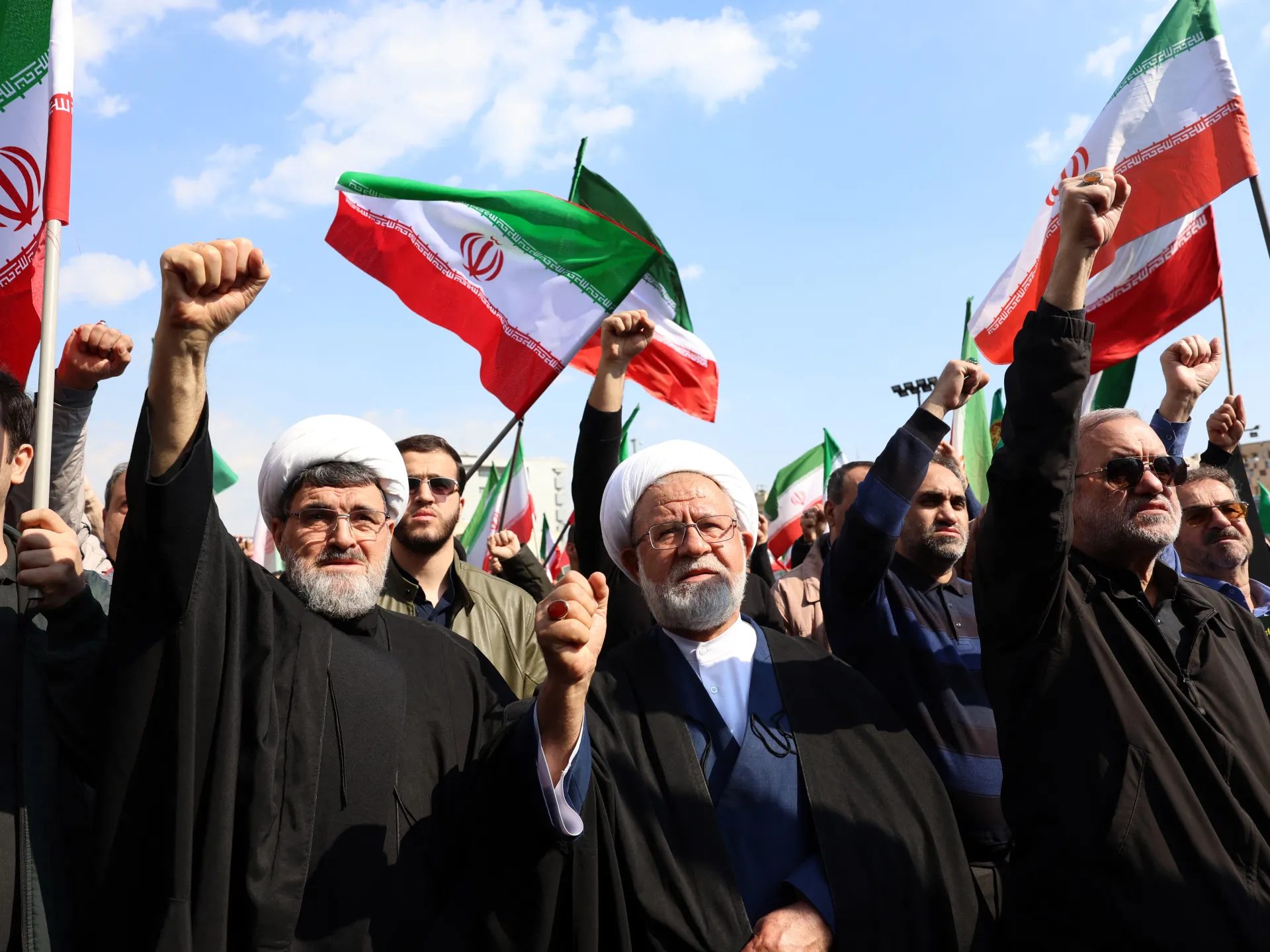
Tehran, Iran – Government supporters have taken to the streets in Iran to mark the anniversary of a referendum nearly half a century ago that solidified the Islamic Republic's hold on power, even as the United States and Israel continued their attacks on the country.
President Masoud Pezeshkian and Foreign Minister Abbas Araghchi were among officials who joined pro-establishment demonstrations on the streets of Tehran on Tuesday night to mark Islamic Republic Day, when the nascent theocratic system in 1979 announced it had won 98.2 percent of the popular vote shortly after an Islamic revolution.
Recommended stories
list of 3 itemsend of list
Shortly afterwards and in the early hours of Wednesday morning, Washington bombed the site of the former US embassy in Tehran, in a move apparently linked to the symbolism of Islamic Republic Day. State media images showed destruction, debris and smoke in the area, which is guarded by the Islamic Revolutionary Guard Corps (IRGC).
On Wednesday afternoon, authorities raised what they said was Iran's tallest and heaviest flag, measuring 150 meters (492 feet) and weighing 300 kilograms (660 pounds), in an area of central Tehran.
Festivities began on Tuesday night and more gatherings are expected on Wednesday night, as political, military and religious leaders say followers must ensure security on the streets, backed by the armed forces, to defend against any local dissent and incitement by opponents of regime change.
Araghchi, Tehran's top diplomat, who told Al Jazeera in an interview on Tuesday that he has been exchanging messages with Washington but has not responded to requests for negotiations, told state television that he joined his supporters to “gain spirit” and encouragement. The president was seen taking selfies with people on the streets while flanked by masked bodyguards.
Hassan Khomeini, son of Ruhollah Khomeini, who led the 1979 revolution and became the first supreme leader before his death in 1989, said that from an Islamic point of view, it was up to them to remain on the streets every night until the war was over, no matter how long it took.
“The enemy could organize a thousand plots to cut off our communications, but our trenches are the mosques, the alleys, the squares and the streets,” he said.
People shown by state media in several cities chanted “Death to America” and “Death to Israel,” in addition to a series of religious slogans.
Authorities issued calls to action for people to participate in group marches while waving flags. Religious singers and eulogists also performed religious songs that drew on the influence of revered figures of Shia Islam.
The IRGC's Basij paramilitary forces, as well as other armed forces, patrolled the streets and set up checkpoints and barricades throughout the city.
But they were not the only forces present.
Hamid al-Hosseini, a senior clerical and paramilitary affiliated with the IRGC and Iraq's Hashd al-Shaabi, also known as the Popular Mobilization Forces (PMF) of Iran-aligned fighters, confirmed that Iraqi citizens were widely located on the streets of the Iranian capital.
While surrounded by those attending state festivities in central Tehran, he told the IRGC-linked Tasnim news agency that Iraqi “mokebs,” or religious food and service stations, are now located around “several squares” to “offer some help to the Iranian people and learn from them about resilience.”
This comes days after Hashd al-Shaabi fighters, dressed in military garb and, in some cases, clerical turbans, proudly marched through the streets of cities in Khuzestan, southwestern Iran, in dozens of pickup trucks as they delivered what they called “humanitarian assistance.” Pezeshkian later thanked them in an online post.
There were reports that they had already been seen in Tehran, but there was no official confirmation from the Iranian authorities. Opponents and human rights organizations have for years accused the Islamic Republic of systematically using fighters from Iraq and other aligned armed forces to suppress local dissent, an accusation authorities have rejected.
'We are waiting for you'
The Iranian state has remained defiant as Washington signals it could soon deploy thousands of troops to the country.
Amid speculation that a ground fight could aim to occupy parts of Iran's southern islands in the Strait of Hormuz, seize oil and gas facilities, or even extract highly enriched uranium from bombed nuclear facilities, Tehran says its defenses are prepared.
Ahmad Reza Pourdastan, head of the Iranian military's research center, said the military has been practicing the scenario of a US invasion since 2001, so any aggression will be met with “heavy casualties.”
The General Staff of the Iranian armed forces and the IRGC's Khatam al-Anbiya Central Headquarters, which manages the war, said the Islamic Republic Day represents “fighting arrogance to achieve the goals of independence, freedom and religious democracy.”
The armed forces “will make the enemies of the glorious nation of our beloved country regret what they have done and be humiliated,” they said.
Police added in a separate statement that the Islamic Republic “is on the verge of securing final victory for the forces of good against evil.”

Tasnim posted a video saying “Come closer” and “We are waiting for you” in Farsi, English, Hebrew and Arabic. The IRGC-linked Fars news agency showed images of pro-state protesters calling for more missile attacks across the region.
The United States and Israel have again attacked Iran's major steel manufacturing companies, in a move that could cost thousands of jobs and deal another blow to civilians living under the economic malaise caused by a combination of local mismanagement and harsh US sanctions. Other attacks this week hit civilian nuclear facilities, a university and military facilities, while affecting several civilian homes.
Surviving the blackout
Iranians remain worried about a very uncertain future as they battle an unprecedented near-total internet shutdown that has left them in the dark for more than a month, aside from news carried by state media.
“I just can't afford to buy VPN [virtual private networks] more,” said one Tehran resident, who said they had so far spent nearly $300 on VPN access, more than two months' wages for minimum wage workers, while being squeezed by an inflation rate of more than 70 percent.
“I've bought a lot of powers since the start of the war, and most connections were cut within hours or days. I'm tired of overspending the money I need for meat and eggs on something that should be available as a basic human right,” he said.
He told Al Jazeera that two of the anonymous online providers he had paid money to for VPN access turned out to be scammers, and that the prolonged digital blackout created a profitable black market.
Some of the providers have been detained and their servers taken offline by Iranian authorities, who have also said they are actively pursuing anyone using smuggled Starlink satellite internet in connection with national security charges. State television said Wednesday that Starlink's infrastructure in the region is among Tehran's “legitimate” ones.
National security and espionage charges are also being imposed against anyone found to have committed acts of dissent, including recording videos of missile impact sites. This could involve confiscation of assets and execution, the judiciary warned.
The Fars news agency on Wednesday published images of “confessions” from more arrested Iranians, including a sobbing young woman with her face blurred, who said she had applauded US President Donald Trump and Israeli Prime Minister Benjamin Netanyahu for attacking Iran in a clip posted online, as she believed the war would help topple the Islamic Republic.
Amid the state-imposed information blackout, some Iranians have devised their own early warning systems, including phone calls and text messages from people in the northern and western provinces.
“They hear the planes flying overhead first, so they warn us and, in many cases, we take cover and hear those planes complete their bombing raids on Tehran in a matter of minutes,” said another resident of the capital.