Tabby Refael's messages to Iran remain unanswered.
For weeks, he has called, sent text messages and voice notes to loved ones in Tehran, where massive crowds have demanded the overthrow of the country's authoritarian government.
Are you OK? Refael, a West Los Angeles-based writer and Iranian refugee, has texted again and again. Do you have enough food? Do you have enough water? Are you safe?
No response.
When protests, initially driven by economic problems, began in late December, Refael consistently got responses. But that stopped last week, when Iranian authorities imposed a near-total internet blackout, while calls to landlines also went unconnected. Videos circulating online show rows and rows of body bags. And human rights groups say the government is carrying out a deadly crackdown on protesters in Tehran and other cities, with more than 2,000 dead.
A woman shops at Shater Abbass Bakery and Market in Westwood in June 2025 after the US attacks on Iranian nuclear facilities.
(Jason Armond / Los Angeles Times)
Like many members of Southern California's large Iranian diaspora, Refael, 43, has been glued to her phone, constantly updating the news coming in from Iran, where, she fears, “a widespread massacre is taking place in literal darkness.”
“Before the regime completely cut off the Internet and, in many places, electricity, there was an electrifying sense of hope,” said Refael, a prominent voice in Los Angeles' Persian Jewish community. But now, as the death toll rises, “that hope has been devastatingly tempered by a sense of visceral fear.”
Refael's family fled Iran when she was 7 years old due to religious persecution. Born a few years after the 1979 Islamic Revolution, she grew up in a time when the hijab was mandatory and people had to adhere, she said, to the “anti-American and anti-Semitic policies of the state.”
Refael has never been able to return. Like other Iranian-Americans, he said he feels “a sense of guilt” about being physically far from the crisis in his homeland, watching with an abundance of Internet and electricity, living among Americans who pay little attention to what is happening on the streets of Iran.
The demonstrations, which began on December 28, were sparked by a catastrophic fall in the Iranian currency, the rial. They have since spread to the country's 31 provinces, with protesters questioning the rule of Supreme Leader Ayatollah Ali Khamenei, 86.

People walk past the damaged Fiscal Affairs building on January 10, 2026 in Tehran. Some parts of the capital have suffered serious damage during the ongoing protests.
(Getty Images)
In a post on his social media website Tuesday morning, President Trump wrote that he had canceled planned meetings with Iranian officials, who he had previously said were willing to negotiate with Washington.
“Iranian patriots, KEEP PROTESTING – TAKE DOWN YOUR INSTITUTIONS!!!” he wrote. “Save the names of the murderers and abusers. You will pay a heavy price. I have canceled all meetings with Iranian officials until the senseless killing of protesters STOP. HELP IS ON THE WAY.”
Trump has repeatedly vowed to attack Iran's leadership if it kills protesters. On Monday he announced that countries doing business with Iran will face 25% tariffs from the United States, “effective immediately.”

This frame grab from a video taken between January 9 and 11, 2026 and circulating on social media purportedly shows images of a morgue with dozens of corpses and mourners on the outskirts of Iran's capital, Kahrizak.
(Associated Press)
In the United States, few, if any, places have followed the crisis as closely as Southern California, home to the largest population of Iranians outside of Iran. An estimated 141,000 Iranian-Americans live in Los Angeles County, according to the Iranian Diaspora Panel, housed at the UCLA Center for Near Eastern Studies.
In Westwood, the community's epicenter, where the eponymous boulevard is lined with storefronts covered in Persian writing, it's hard to miss widespread opposition to Iran's hardline theocracy.
This week, a clothing store's window displayed caps reading “MIGA / Make Iran Great Again” alongside a lion and a sun, emblems of the country's flag before the Islamic Revolution of 1979. At a nearby ice cream shop, a hand-painted sign behind the cash register read: “Stop oppressing our people in the name of Islam.” In the window of a bookstore across the street, a sign demanded “Regime Change in Iran.”
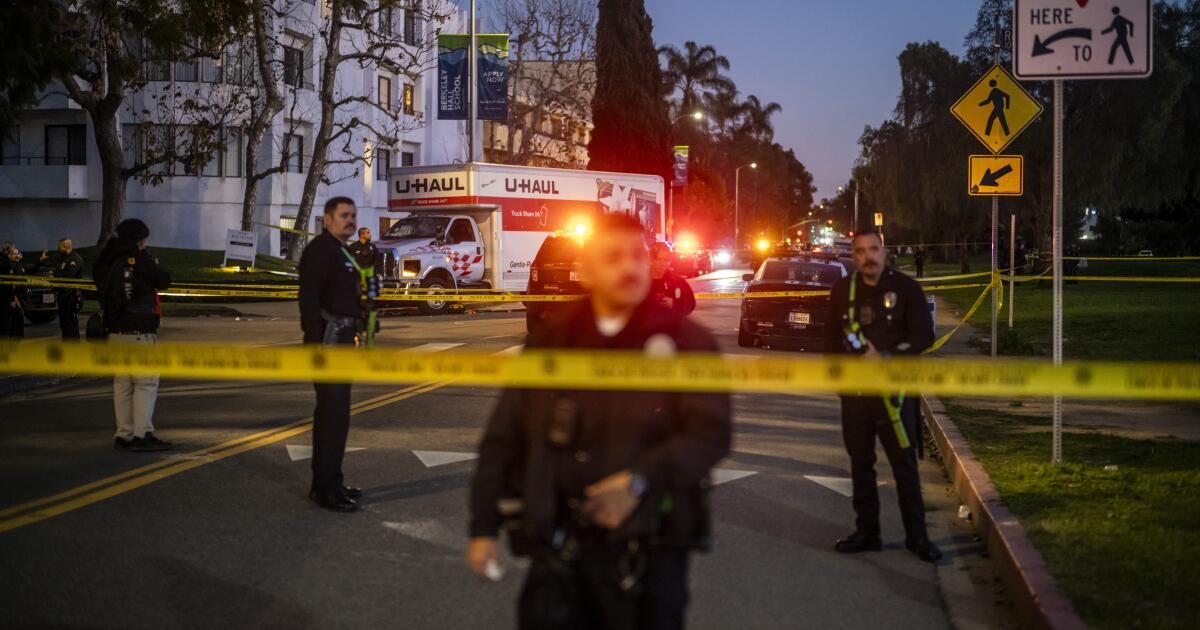
On Sunday, thousands of people were marching through Westwood in solidarity with anti-government protesters in Iran when, to their horror, a man drove into the crowd in a U-Haul truck carrying a sign that read: “No Shah. No Regime. America: Don't Repeat 1953. No Mullah.” The signage appeared to reference a 1953 U.S.-backed coup that overthrew Iran's prime minister, consolidated the power of Shah Mohammad Reza Pahlavi and lit the fuse of the 1979 Islamic Revolution.

-
Share via
Police announced Monday that the driver, Calor Madanescht, 48, was arrested on suspicion of reckless driving. He was released Monday afternoon, according to Los Angeles County sheriff's inmate records.
Video shared with The Times by attendees showed protesters trying to remove him from the vehicle and continuing to hit and assault him while police detained him.
In a statement published in X on Sunday, First Assistant U.S. Atty. Bill Essayli said the FBI was “working with the Los Angeles police to determine the driver's motive” and that “this is an active investigation.”
During a Los Angeles Police Commission meeting Tuesday, LAPD Chief Jim McDonnell said he does not expect federal charges and that there is no apparent “terror nexus.”
In Westwood this week, the atmosphere was tense after the U-Haul incident that police say caused no serious injuries. Few store owners wanted to talk as reporters went from store to store. Although many Iranian immigrants hope that the theocratic regime in Iran will be overthrown, they fear for loved ones left behind and said they preferred not to be in the public eye.
Among those who wanted to speak was Roozbeh Farahanipour, executive director of the West Los Angeles Chamber of Commerce and owner of three Westwood Boulevard restaurants.

Roozbeh Farahanipour and her young son wave the flag of Iran before the 1979 Islamic Revolution in front of their Delphi Greek restaurant in Westwood, in this June 2025 photo.
(Jason Armond / Los Angeles Times)
At her Mary & Robb's Westwood Café, where the walls are adorned with decorative plates depicting American film icons such as John Wayne and Marilyn Monroe, she conducted interviews all morning about Sunday's protest in Westwood, where she stood in the crowd, just yards from the path of the U-Haul.
Farahanipour said Iranian-Americans have conflicting opinions about what should happen next in Iran, including whether Reza Pahlavi, the exiled crown prince and son of the late shah, Mohammad Reza Pahlavi, should have a leadership role.
“At the moment, I think everyone needs to focus on overthrowing this regime. That's why I participated. Many other people from different backgrounds participated,” he said, adding that he is “not a monarchist” but that “the opposition is united against the regime.”
Farahanipour was seven years old when the Islamic Revolution took place. He remembers traveling with his mother to school and listening to a reading on the radio about “people who were executed by the regime.” One day, the name of his mother's cousin was read on the airwaves.
Although his family was not Catholic, Farahanipour, 54, attended a Catholic school. He has fond memories of soccer games between the children and the priests, who played in their long religious vestments. After the revolution, he said, the government attacked the school and executed the principal.
Before seeking asylum in the United States, Farahanipour was jailed and beaten in Iran for his role as a leader of the 1999 student protests against the government. He has been repeatedly threatened, including with death, by the government over the years, he said.
In 2022, her Persian Gulf Café in Westwood was vandalized and its glass front door shattered, after she shared images on Instagram of a monument in the café honoring Iranian women in the anti-government protests that year. He said he didn't flinch.
Now a U.S. citizen, “officially retired from my Iranian opposition role,” he said he dreams of returning to Iran for a trial against Khamenei and helping “call for the maximum sentence for him.”
Sam Yebri, a 44-year-old Iranian Jewish refugee whose family fled the country when he was 1, said he has spent the past two weeks constantly receiving updates on social media about what is happening in Iran and contacting elected officials, begging them to speak on behalf of the protesters.
Yebri, an attorney and former Los Angeles City Council candidate, grew up in Westwood. He is a longtime Democrat and said it has been “very infuriating to see so many friends and activists who don't shy away from discussing other issues just completely silent and absent in this fight.” He said he sees it as “the most important moment in world history since the fall of the Berlin Wall.”
“The regime must go,” he said, adding that he hopes Trump “does everything prudent to allow the Iranian people to overthrow the brutal mullahs who have their boots on their necks.”
Yebri said he has not returned to Iran since his family fled when he was a baby. She hopes to do so one day, visiting the beautiful places her parents describe: where they honeymooned on the beaches of southern Iran and skied in its snowy mountains.
Alex Mohajer, vice president of the Iranian-American Democrats of California, 40, was born in Orange County, where he was raised by a single mother who emigrated from Iran. He visited his family there when he was 14 and “felt great pride” in seeing that “Western representations of the country are very far from reality, that it is a very warm and loving country where the people are very hospitable and it is very clear that they have lived under an oppressive regime.”
Mohajer, who was unsuccessful in his bid for the California State Senate in 2024, wants a future in which he can freely travel back and forth to visit loved ones in Iran. But more immediately, he just wants to know that they're okay. His text messages also go unanswered.
Times staff writer Libor Jany contributed to this report.