BORJ QALAOUIYA, Lebanon — After dinner, Ali Jishi, a nurse who works at the health center in this southern Lebanese city, thought it was calm enough to deliver supplies to the civil defense team further down the road.
He was returning on Friday when he saw the Israeli missile pass through all four floors of the building, killing his father and 11 of his colleagues.
“Ten minutes earlier, or 10 seconds later, it would have been there. It would have caught me too,” Jishi said.
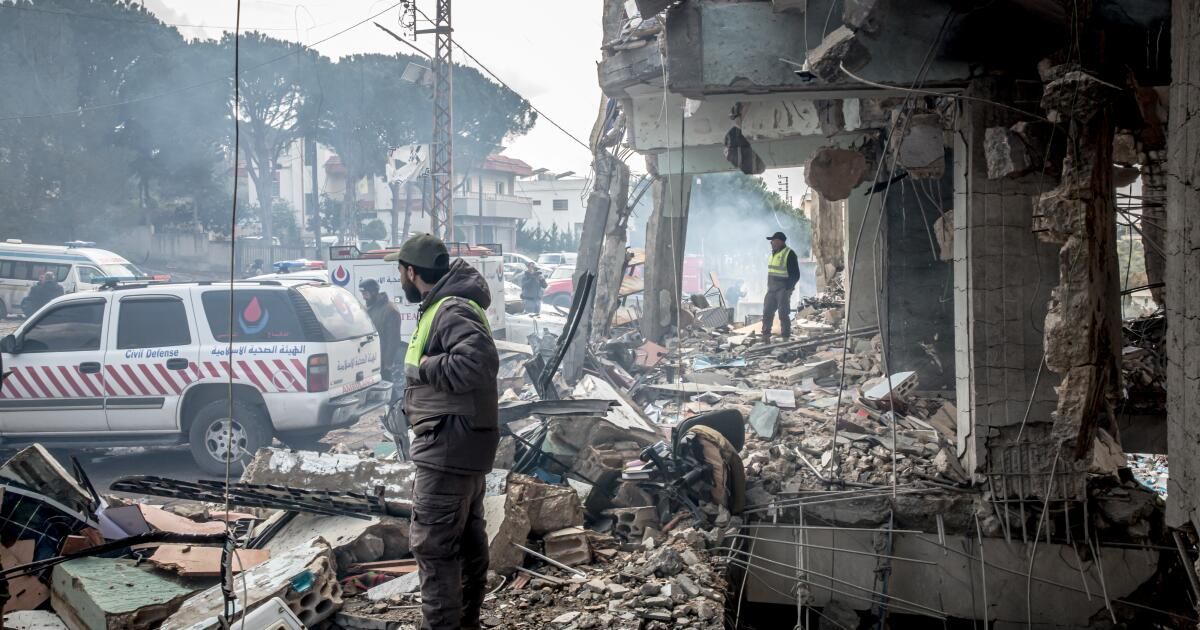
Jishi, 35, trudged through the building's destroyed shell two days after the attack, walking between chunks of masonry hanging from tangled metal rods, to gaze into the still-smoking maw where the missile struck.
The explosion had turned everything into a gray mulch, from which the occasional object could be discerned: a pamphlet on reproductive health, somewhat pristine-looking strips of pills, the crumpled remains of a desktop computer.
-
Share via
The Israeli military says the incident in Borj Qalaouiyah is under review. But a day after the attack, the military's Arabic-language spokesman accused Hezbollah of using ambulances for military purposes.
The latest conflict between Israel and the Iran-backed Shiite group was triggered by the US-Israeli attack on Iran on February 28. Two days later, Hezbollah retaliated by launching rockets and drones into Israel.
Israel responded in kind and on Monday, Israeli Defense Minister Israel Katz said the military had “begun a ground operation” to eliminate threats and protect residents of northern Israel.

Israeli army tanks maneuver along the border with Lebanon on Sunday.
(Odd Andersen/AFP/Getty Images)
Lebanese health facilities have increasingly come under attack.
Since March 2, the World Health Organization said Saturday, 27 attacks on health care facilities in Lebanon have left 30 dead and 35 injured. Lebanon's Health Ministry reported additional attacks on Monday, raising the death toll to 38 and 69 wounded, along with dozens of ambulances and vehicles destroyed and 13 health centers bombed.
In the center of Borj Qalaouiya, doctors, paramedics and nurses were killed along with Jishi's father, a doctor from the civil defense service.
Speaking with the unnatural calm of someone still surprised to be alive, Jishi recounted how he ran to help the victims after the attack.
But the astonishing power of the detonation meant it was more of a recovery mission than a rescue. Only one person survived, seriously injured and remains hospitalized. All the rest, dead.

Abdullah Nour Al-Din, who heads the Islamic Health Commission's regional civil defense unit, looks over the rubble of the health center attacked by Israeli forces in Borj Qalaouiyah, Lebanon.
(Nabih Bulos / Los Angeles Times)
“We found the first martyr next to the orange car. Four were where that guy was. The doctor (God have mercy on him, the mattress is still there) was sleeping. My father was in the hallway,” he said, his voice breaking for a moment.
He himself had pulled Hassan Jishi's body out of the rubble.
“My heart was breaking,” Jishi said. “It was horrible, of course. But I had to do it.”
The attacks on health facilities marked “a tragic development in the growing Middle East crisis,” said WHO Director-General Tedros Adhanom Ghebryesus, adding in a post on X that another Israeli attack on a nearby village two hours earlier on Friday had killed two health workers.
“The escalation of the conflict in Lebanon and across the Middle East increases the likelihood of tragedies of this kind,” he wrote.
Israel says its operation in Lebanon is aimed at destroying Hezbollah, and its scope has already exceeded previous conflagrations between the nation and the Shiite group.
So far, Israeli bombings have uprooted nearly a million people (one-sixth of the country's population) and left nearly 900 dead, including 107 children. More than 2,100 other people are injured, according to the Lebanese Ministry of Health.

People walk past tents erected along Beirut's waterfront to house people displaced by Israeli airstrikes elsewhere in Lebanon.
(Hassan Ammar / Associated Press)
Katz said that “the hundreds of thousands of Shiite residents of southern Lebanon who have been and are being evacuated from their homes will not return to their homes” in southern Lebanon “until the safety of northern residents is guaranteed.”
But the Lebanese see in the contours of Israel's campaign the evacuate, eliminate and erase doctrine that it employed against Hamas in Gaza.
The strategy involves emptying areas with general evacuation orders, eliminating resistance there, and then wiping out civilian and medical infrastructure to ensure no one returns.
Some fear that is what is planned for Borj Qalaouiya, a village about seven kilometers from Lebanon's southeastern border.
“Why hit the [health] center? What is the purpose of this? said Abdullah Nour Al-Din, who heads the regional civil defense unit at the Islamic Health Commission, an emergency medical and rescue services provider affiliated with Hezbollah. “They want to terrorize the medical teams so that we stop providing services to the people who remain here.”
He added that the center, which included a pharmacy, an X-ray room, a laboratory, an emergency room and clinics for medical and dental specialists, serves 20 villages in the area.
There was no one at the scene who would have justified the attack, he insisted, inviting journalists to look inside the vehicles or through the rubble to see for themselves.

An Israeli self-propelled howitzer artillery gun fires rounds toward southern Lebanon on Sunday.
(Odd Andersen/AFP/Getty Images)
On Friday, the staff had finished their iftar meal, ending their daily Ramadan fast, and were turning in for the night. The head of the center was recording a voice note for Nour Al-Din on WhatsApp just before the attack; It never arrived.
“We did not receive any warning,” said Nour Al-Din. “If we had, we would have left. We know that Israel does not commit to international conventions regarding the protection of medical workers.”
A Hezbollah official, Hajj Salman Harb, said Israeli bombing had so far destroyed 750 housing units and partially damaged another 17,000.
“The massacres committed by this enemy against civilians are to compensate for their failures in the war,” he stated.
The attacks on health services were part of the Israeli playbook against Hamas in Gaza, said Jonathan Whittall, a former senior U.N. official in the Occupied Palestinian Territories who now heads the KEYS initiative, a Beirut-based political affairs organization.
In that war, Israel was accused of deliberate and systematic destruction of the enclave's health infrastructure, with 22 hospitals out of service and more than 1,700 medical workers killed, according to Palestinian health authorities in Gaza.
Although the scale in Lebanon has not yet reached anything seen in Gaza, Whittall said, “the groundwork is being laid.”
Israel's next step, he said, “is to dismantle the means of survival. That includes putting pressure on health facilities and critical civilian infrastructure in general.”
In Gaza, Israel said Hamas used medical facilities as cover, a charge the group denied. Now, the Lebanese are making similar denials.
“Go look at our vehicles, there is nothing there. And from the day the center was built until now, not a single bullet entered. This was a purely medical facility,” Jishi said, adding that there was even a public library and a cultural center on the top floor. He pointed to the charred books that the explosion had catapulted onto the street.
“The Israelis don't need an excuse to attack us,” he said. “And when they want to justify it, they find a million reasons.”
Jishi looked out from where a wall once stood, taking in the green of the hills surrounding Borj Qalaouiyah before his thoughts were interrupted by the deepening smoke.
At the moment, he said, he was not planning a proper funeral, nor could he join his family, who now live near Beirut, to mourn his father. His wife, children, mother and sisters fled the town when the war began.
Israel's insistence on attacking anything or anyone even remotely linked to Hezbollah means that the property owners housing the displaced consider it an unacceptable risk.
“I wanted to be with them, but they don't even allow me to visit them. That was the condition,” he said.
In any case, there was little chance of crying. The smoldering ashes at the bottom of the building had erupted into some incipient fires, and he moved to put them out.
“This is no time for sadness,” Jishi said.
“After the war I will be sad.”